In This Article
Somewhere between painting the nursery and packing the hospital bag, every expectant parent hits the same wall: the pushchair aisle. It’s a wall of wheels, hoods and acronyms, and nobody warns you that “suitable from birth” doesn’t always mean what you think it means. Choosing the right pushchair for newborn use is one of the first genuinely consequential decisions you’ll make as a parent, because unlike a babygro you’ve outgrown by six weeks, this is the thing you’ll be leaning on — literally — for the next three or four years.

Here’s the shortcut most guides skip: a pushchair for newborn babies has to lie completely flat, not just recline a long way. A newborn’s neck can’t yet hold their head up, so a seat that stops at 150 degrees rather than a true 180 can let their chin tip forward and compromise their airway — hardly the “cosy nap on the go” the marketing photos suggest. This guide walks through seven real, currently available pushchairs sold in the UK, what their specs actually mean day to day, and how to avoid the mistakes that see so many parents rebuying within the first year.
We’ve built this article around genuine product research and aggregated review sentiment rather than invented testimonials, because a newborn purchase deserves facts, not fluff, and it’s worth cross-checking any shortlist against Which?’s independent pushchair testing before you commit to a model. Whether you’re weighing up a budget buggy under £300 or a full travel system with ISOFIX, you’ll find honest, specific guidance below — including where each option falls short.
Quick Comparison Table
| Pushchair | Best For | Weight | Lie-Flat From Birth | Price Range |
|---|---|---|---|---|
| Silver Cross Pop 2 | Budget umbrella-fold buggy | 7.2kg | Yes (seat unit) | Under £250 |
| hauck Runner 3 | Budget all-terrain rides | 10.75kg | Yes (one-hand recline) | £250–£270 |
| Joolz Aer2 | Ultra-lightweight travel | 6.5kg | Reclined seat; true flat needs optional cot | £380–£480 |
| Cybex Balios S Lux | City suspension & style | 11.7kg | Near-flat; full flat needs Cot S Lux | £430–£500 |
| Ickle Bubba Stomp Luxe | All-in-one ISOFIX travel system | 13kg+ (system) | Yes (carrycot to 9kg) | £550–£650 |
| Mamas & Papas Ocarro 2 | Premium all-rounder | 12.5kg | Yes (seat); overnight-approved carrycot optional | £350–£800 |
| BabyStyle Oyster 4 | 19-configuration travel system | 12.3kg | Yes (seat); or pair with Oyster Carrycot | £550–£650+ |
The spread here tells its own story: you can get a genuinely flat-lying newborn seat for under £250, but the moment you want ISOFIX car-seat integration, overnight-sleep-approved carrycots, or four-wheel suspension smoothing out cracked pavements, you’re realistically looking at £500 upward. Neither end is “wrong” — it depends on whether you’ll be driving daily with a newborn in tow or mostly walking from the front door. Budget buggies like the Silver Cross Pop 2 earn their keep through simplicity, while systems like the Ickle Bubba Stomp Luxe earn theirs by removing decision fatigue entirely — car seat, carrycot and chassis, sorted in one box.
💬 Just one click — help other parents find the right pushchair too! 😊
Top 7 Pushchairs for Newborn: Expert Analysis
The seven pushchairs below span budget, mid-range and premium, and every one of them is a real, currently sold model rather than a composite or invented product. We’ve grouped honest spec interpretation, aggregated review sentiment, and buyer-type guidance for each, so you can match the right pushchair to your actual life rather than an aspirational one.
1. Silver Cross Pop 2 — best budget lie-flat buggy
The standout here is the price-to-lie-flat ratio: few buggies under £250 actually recline to a genuine horizontal position, and the Silver Cross Pop 2 does. At 7.2kg with an umbrella-style one-hand fold and a built-in carry handle, this is a buggy designed to be picked up, folded and slung over a shoulder without a second thought — useful when you’re also holding a baby, a changing bag and, inevitably, a coffee that’s gone cold. The seat itself is generously sized with adjustable calf support, a one-hand recline mechanism, and an anti-crease, water-resistant, UPF50+ fabric that shrugs off the on-again-off-again British weather.
Where the Silver Cross Pop 2 loses points against pricier rivals is car-seat compatibility: it doesn’t accept an infant car seat or a coordinated carrycot, so if you drive regularly with a newborn, this becomes a second buggy rather than a whole travel system. Reviewers consistently note that while Silver Cross markets the seat as lie-flat, some parents of very young newborns feel the recline, though genuinely flat, could use a touch more head support without an additional insert. It’s best suited to walking-heavy households — a short drive to the shops is fine, but this isn’t the pushchair for daily motorway trips to grandparents.
Pros:
- ✅ Genuinely flat recline at a budget price point
- ✅ Lightweight umbrella fold with built-in carry handle
- ✅ Three-year manufacturer warranty as standard
Cons:
- ❌ No car seat or carrycot compatibility at all
- ❌ Minimal head support for very young newborns without an insert
At under £250, the Silver Cross Pop 2 represents strong value for families who mostly walk rather than drive, though anyone needing a proper travel system should look further down this list.
2. hauck Runner 3 — best all-terrain buggy on a budget
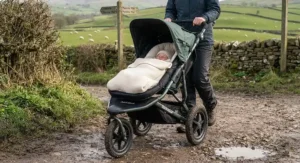
The three extra-large, spring-loaded pneumatic air wheels are the headline feature, and what that means in practice is a noticeably smoother ride over the kind of broken pavement, gravel driveways and grass verges that make foam-wheeled buggies judder. Paired with dual-adjustable rear suspension and a lockable front swivel wheel, the hauck Runner 3 handles like a jogging stroller without the jogging-stroller price tag. The backrest is genuinely long at 52 x 35cm, and the one-handed recline drops all the way to a full lie-flat position — ideal for a newborn who’s dozed off mid-walk and needs somewhere proper to rest their head.
At 10.75kg, this is noticeably heavier than the lightweight options on this list, which matters most when you’re lifting it in and out of a car boot rather than while pushing it. Aggregated reviewer sentiment points to a common praise theme around the handbrake and puncture-proof handling on hills, alongside occasional complaints about a squeaky frame developing after several months of regular use. Based on the spec comparison with rivals at this price, the Runner 3’s biggest selling point is genuinely rugged wheels rather than portability, so it suits families in semi-rural areas or anyone who walks daily regardless of weather more than city dwellers hopping on and off buses.
Pros:
- ✅ XL pneumatic air wheels smooth out rough terrain
- ✅ Full lie-flat recline for newborn naps on the move
- ✅ Handbrake gives real control on slopes and hills
Cons:
- ❌ Heavier than most rivals at 10.75kg
- ❌ No carrycot or car seat adaptor option included
For under £270, the hauck Runner 3 is hard to beat if your daily walk includes anything rougher than smooth pavement, though city parents managing stairs and buses may find the weight a genuine downside.
3. Joolz Aer2 — best ultra-lightweight travel companion
At just 6.5kg, the Joolz Aer2 is what most “lightweight” buggies claim to be and rarely are. The standout feature is the one-hand, one-second self-standing fold — genuinely useful when you’re also managing a baby carrier, a nappy bag and possibly a toddler’s hand. What most buyers overlook about this model is the newborn suitability nuance: the seat reclines fully and is usable from birth with the included baby net for extra support, but a true lie-flat bassinet position requires the separately sold foldable cot accessory. That’s an important distinction — reclined-flat and true-flat aren’t identical, and Joolz is clearer about this than some competitors.
The compact fold (just 20.9 x 17.3 x 9.2 inches) is IATA carry-on compliant, meaning this is genuinely one of the few pushchairs you could take through airport security without checking it in. It’s compatible via adaptors with a specific shortlist of infant car seats, including the Cybex Aton range and Nuna Pipa models, so check compatibility with your specific car seat before assuming it’ll click straight in. Reviewers, including a hands-on assessment published by Forbes, consistently highlight how the narrow folded footprint makes it easy to squeeze into a loaded car boot, and praise the lie-flat recline for both newborn naps and older toddlers resting mid-walk. The trade-off for that portability is a smaller under-seat basket than full-size rivals and a firmer ride on rough ground, since the wheels are built for weight-saving rather than shock absorption.
Pros:
- ✅ Genuinely one of the lightest strollers at 6.5kg
- ✅ Cabin-approved fold for frequent travellers
- ✅ 10-year transferable warranty included
Cons:
- ❌ True lie-flat bassinet mode needs a separate cot accessory
- ❌ Smaller storage basket than full-size alternatives
Typically listed in the £380–£480 range with the cot accessory adding roughly £100 on top, the Joolz Aer2 suits parents who travel often or live somewhere storage space is tight, more than those wanting one buggy that does absolutely everything out of the box.
4. Cybex Balios S Lux — best for smooth city handling
The four-wheel suspension is what sets the Cybex Balios S Lux apart from cheaper full-size buggies, and in practice that means London’s notoriously uneven pavements, tram tracks and kerb cuts transmit noticeably less jolt through to the seat. It’s a reversible seat unit too, so you can have your newborn facing you for reassurance in the early months, then flip it to world-facing once they’re curious about their surroundings. The one-pull harness system is a small but genuinely time-saving detail — precision-fitting a 5-point harness one-handed while holding a squirming baby is not a trivial task, and Cybex has clearly designed around that exact moment.
For newborn use specifically, the Balios S Lux needs either the optional Cot S Lux carrycot or a compatible Cybex infant car seat clicked onto the frame via adaptors — the seat unit alone is described by Cybex as “near-flat” rather than a true lie-flat, and reviewer sentiment is mixed on whether that’s flat enough for very young newborns without additional support. Based on the spec comparison, this is best understood as a stroller that becomes newborn-ready once you add a car seat or carrycot, rather than one that’s newborn-ready in its base configuration. Aggregated feedback repeatedly praises the suspension quality on cobblestones and cracked pavements as noticeably better than foam-wheeled competitors at a similar price, though several reviewers note it’s not designed for genuine off-road use like muddy trails.
Pros:
- ✅ Four-wheel suspension handles urban terrain smoothly
- ✅ Reversible seat for parent- or world-facing use
- ✅ One-pull harness adjustment is genuinely quick
Cons:
- ❌ True newborn use needs an additional carrycot or car seat
- ❌ Only compatible with Cybex-brand infant car seats via included adaptors
Priced around £430–£500 for the pushchair alone, the Cybex Balios S Lux rewards city-dwelling families who’ll use it daily on pavements, but budget-conscious buyers should factor in the extra cost of a compatible carrycot before comparing headline prices.
5. Ickle Bubba Stomp Luxe — best all-in-one ISOFIX travel system
If decision fatigue is the problem, the Ickle Bubba Stomp Luxe is the answer: this is a 12-piece bundle that includes the pushchair chassis, a seat unit, a carrycot suitable from birth up to 9kg, an i-Size car seat, and an ISOFIX base, all matched to the same fabric and colourway. What that means in practice is you’re not hunting down separate adaptors or discovering three weeks after the birth that your car seat doesn’t actually fit your pushchair frame — a surprisingly common and stressful new-parent problem this bundle sidesteps entirely. The car seat and ISOFIX base meet the ECE-R129 i-Size safety standard, which brings improved side-impact protection and keeps children rear-facing for longer than older R44 seats.
The puncture-proof rear wheels with a quick-release feature for cleaning are a practical touch that reviewers mention repeatedly, alongside self-locking swivel front wheels that add manoeuvrability without sacrificing stability on rougher ground. Here’s what to weigh: the carrycot is intended for supervised daytime naps rather than overnight sleep, which matters if you were hoping to use it as a bedside bassinet too — some rival carrycots are explicitly overnight-sleep-approved and this one isn’t. Aggregated sentiment is strongly positive on value, since bundling everything together at £550–£650 typically undercuts buying an equivalent chassis, carrycot and car seat separately from three different brands.
Pros:
- ✅ Complete ISOFIX travel system in a single purchase
- ✅ i-Size car seat meets the newer ECE-R129 safety standard
- ✅ Puncture-proof wheels with quick-release for easy cleaning
Cons:
- ❌ Carrycot is daytime-nap only, not overnight-sleep approved
- ❌ Heavier and bulkier than standalone lightweight buggies
For new parents who drive regularly and want zero compatibility guesswork, the Ickle Bubba Stomp Luxe at roughly £550–£650 is genuinely one of the better-value all-in-one bundles on the UK market right now.
6. Mamas & Papas Ocarro 2 — best premium all-rounder
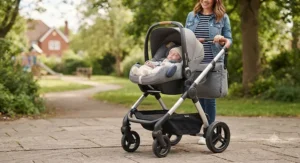
The full-size carrycot is the star of the newer Ocarro 2, and unlike the Ickle Bubba bundle above, it’s specifically approved for overnight sleep, complete with a cushioned mattress and breathable lining designed to meet the same comfort standard whether it’s clipped to the chassis outdoors or sat on its coordinating stand indoors. The lie-flat pushchair seat, meanwhile, includes a removable newborn liner and a soft head-hugger insert, addressing the exact “not enough head support” complaint that dogs some rival lie-flat seats. Four-point suspension and puncture-proof all-terrain tyres mean the ride quality holds up on coastal paths, woodland trails and cracked urban pavements alike, not just smooth city streets.
What most buyers overlook about this model is just how wide the car-seat compatibility net is: adaptors support Cybex Aton and Cloud ranges, Maxi-Cosi Cabriofix, Nuna models and several others, so if you already own a car seat from a previous pregnancy, there’s a fair chance it’ll click straight onto the Ocarro 2 frame. The trade-off is weight and price — reviewers note it as heavier to lift in and out of a car boot than the lightweight options on this list, and the carrycot is typically sold separately from the pushchair itself, which can push a genuinely “birth-ready” bundle price closer to £700–£800 once you’ve added everything.
Pros:
- ✅ Overnight-sleep-approved carrycot, not just daytime naps
- ✅ Wide car seat compatibility across major brands
- ✅ Four-point suspension smooths coastal paths and cracked pavements
Cons:
- ❌ Carrycot typically sold separately, adding to the total cost
- ❌ Noticeably heavier to lift than lightweight alternatives
Starting around £350–£450 for the pushchair alone and rising toward £800 for a full carrycot-and-car-seat bundle, the Mamas & Papas Ocarro 2 suits families who want one premium buggy to genuinely last from birth through to nursery runs years later.
7. BabyStyle Oyster 4 — best for configuration flexibility
Nineteen approved configurations is an unusually high number, and what that means practically is the BabyStyle Oyster 4 can flex from a parent-facing newborn seat, to a world-facing toddler seat, to a full travel system with the Oyster Carrycot or the brand’s own Capsule Infant Car Seat, without ever needing a different chassis. The one-handed auto-fold works with the seat still attached in either facing direction — a genuinely useful detail when you’re managing a car boot one-handed because the other arm is full of baby. Which?, the UK’s independent consumer testing body, has lab-tested the Oyster 4 and rated it across handling, folding ease and comfort criteria as part of its ongoing pushchair reviews, giving buyers an independent reference point beyond manufacturer claims.
At 12.3kg it sits mid-pack for weight, neither the lightest nor the heaviest option here, and the lie-flat seat unit is genuinely usable from birth without requiring the separate carrycot — though pairing it with the Oyster Carrycot gives a more traditional pram-style newborn experience if that’s your preference. Reviewers consistently praise the fabric quality and colourway choices as feeling more premium than the roughly £599 price tag for the stroller alone suggests, while a recurring criticism concerns the size of the folded footprint, which is bulkier than the Joolz Aer2 or Silver Cross Pop 2 when it comes to boot space.
Pros:
- ✅ Nineteen configurations cover almost every use case
- ✅ Independently lab-tested by Which? for handling and comfort
- ✅ One-handed auto-fold works with the seat attached
Cons:
- ❌ Bulkier folded footprint than lightweight rivals
- ❌ Carrycot for the full pram-style newborn experience costs extra
At around £550–£650 for the stroller and closer to £700+ once bundled with the carrycot or car seat, the BabyStyle Oyster 4 earns its premium price through genuine flexibility rather than flashy extras — a strong pick for parents who aren’t sure yet exactly how they’ll use their pushchair day to day.
Practical Newborn Pushchair Setup & First-Month Guide
Getting a new pushchair out of the box is rarely as simple as the folded diagram on the packaging suggests, and the first 30 days are when most avoidable mistakes happen. Start by fully assembling the chassis indoors on a flat surface before you ever try to fold it — most one-hand folds only work smoothly once you’ve done the initial full unfold-refold cycle two or three times to bed the mechanism in. Check the recline position before your first outing: with a newborn, the seat back should sit at a genuine 180-degree flat angle, not the 150-degree “nearly there” recline that some cheaper reclining seats stop at.
A common first-month mistake is over-tightening the 5-point harness out of anxiety, which can restrict a newborn’s breathing comfort during longer naps — aim for two fingers’ width of slack across the chest strap. Equally common is under-inflating pneumatic tyres on models like the hauck Runner 3; check tyre pressure monthly, since underinflated air wheels noticeably increase how hard the pushchair is to push on flat ground. For any travel system with a car seat, such as the Ickle Bubba Stomp Luxe or BabyStyle Oyster 4, practice clicking the car seat on and off the frame at home before you need to do it one-handed in a car park in the rain — the mechanism usually needs a firm, decisive push rather than a tentative one.
Maintenance-wise, wipe down fabric weekly with a mild detergent (never a washing machine, per most manufacturer care labels), and check wheel bearings for grit every few weeks if you’re walking on gravel or beach paths regularly with something like the Mamas & Papas Ocarro 2. A five-minute monthly check — brakes, tyres, harness clips, fold mechanism — catches the small issues before they become squeaky, sticky, or genuinely unsafe.
Real-World Scenarios: Which Pushchair Actually Suits You?
If you’re a first-time parent living in a third-floor flat with no lift, weight and fold size matter more than almost anything else on the spec sheet. The Joolz Aer2 at 6.5kg with its one-second self-standing fold is built precisely for this scenario — you can lean it against a wall in a hallway rather than needing a dedicated cupboard, and lifting it up several flights with one arm while carrying a baby carrier in the other is genuinely realistic in a way it isn’t with an 11–13kg full-size system.
If you’re commuting into central London daily on buses and the Tube, the calculation shifts toward manoeuvrability and a compact fold that clears ticket barriers — both the Silver Cross Pop 2 and Joolz Aer2 are strong fits, while heavier all-terrain options become a genuine daily burden rather than an occasional inconvenience.
If you live somewhere semi-rural with unpaved lanes, gravel driveways, or a regular need to cross fields to reach a dog walk, terrain-handling becomes the priority over portability. The hauck Runner 3‘s pneumatic wheels or the Mamas & Papas Ocarro 2‘s four-point suspension will noticeably outperform a lightweight city buggy, which tends to judder and struggle on anything beyond smooth pavement.
And if you’re a driving-heavy family — regular visits to grandparents an hour away, frequent supermarket runs, or simply don’t fancy the logistics of clicking a separate car seat into a taxi — an all-in-one ISOFIX system like the Ickle Bubba Stomp Luxe removes an entire category of stress. You install the base once, and from that point on, transferring a sleeping newborn from car to pushchair without waking them becomes a genuine one-click operation rather than a full unbuckle-and-rebuckle production.
Problem → Solution: Common Newborn Pushchair Headaches
Problem: The seat “reclines” but doesn’t actually lie flat. This is the single most common source of buyer’s remorse in this category. Solution: before buying, check the manufacturer specification for the words “lie-flat” or “180 degrees” specifically, not just “reclining.” Models like the Silver Cross Pop 2 and hauck Runner 3 state genuine full lie-flat recline; others, including the base Cybex Balios S Lux seat, are described as “near-flat” and need a carrycot to achieve a true newborn-safe horizontal position.
Problem: The pushchair won’t fit through your front door or into your car boot. Solution: measure both before you buy, not after — check the folded dimensions against your boot’s actual load space (not just its advertised litre capacity, which rarely accounts for irregular shapes), and check your narrowest internal doorway against the pushchair’s folded width.
Problem: Your existing car seat doesn’t click onto the new pushchair frame. Solution: always check the specific adaptor compatibility list before assuming a “universal fit” claim applies to your exact car seat model — the Joolz Aer2 and Cybex Balios S Lux in particular only work with specific brand shortlists via included adaptors, while all-in-one bundles like the Ickle Bubba Stomp Luxe sidestep this problem entirely by including a matched car seat from the start.
Problem: The pushchair feels unstable or tips when the shopping basket is loaded. Solution: always load the underseat basket rather than hanging bags from the handlebars, which shifts the centre of gravity forward and increases tipping risk — a habit worth breaking early, however tempting it is after a big supermarket shop.
Problem: Fold mechanisms seize up or feel stiff within the first few weeks. Solution: this is often grit or fabric caught in the folding hinge rather than a fault — a quick wipe-down and a few practice folds usually resolves it, though persistent stiffness on a new pushchair is worth raising with the retailer under your statutory consumer rights.

How to Choose a Pushchair for a Newborn
Choosing the right newborn pushchair comes down to seven practical criteria, roughly in order of importance for very young babies:
- Genuine lie-flat recline. Confirm the specification explicitly states a full 180-degree recline or a compatible carrycot, since this is a safety requirement for newborns, not a comfort preference.
- Weight and fold mechanism. Consider how many stairs, doorways, or public transport barriers you’ll navigate daily, since a 13kg system feels very different on the fifth flight of stairs than it does in a showroom.
- Car seat compatibility. If you drive regularly, check the specific adaptor list against any car seat you already own before assuming compatibility.
- Terrain suitability. Match wheel type to your actual daily walking surface — pneumatic air wheels for gravel and grass, smaller foam wheels for smooth pavements and public transport.
- Storage basket size and access. A basket that’s easy to load from the front, not just the back, saves genuine daily hassle once you’re carrying nappies, wipes and shopping.
- Warranty length and brand support. Longer transferable warranties, like the 10-year offering from Joolz, add resale value if you plan to pass the pushchair on or sell it once your child outgrows it.
- Total system cost, not headline price. Factor in any separately sold carrycot, car seat adaptors or accessories before comparing the sticker price across brands.
Pram vs Pushchair: What’s Actually the Difference?
The terms get used interchangeably in everyday conversation, but there’s a meaningful distinction worth understanding before you shop. A pram, in the traditional sense, is a carriage-style design where the baby always lies flat facing the parent, typically with a separate bassinet or carrycot body sitting on a chassis — think classic Silver Cross coach-built prams. A pushchair, by contrast, is a seat-based design that can usually be adjusted between reclined and upright positions and often faces either the parent or the world, growing with the child from newborn through toddlerhood on the same frame.
| Feature | Traditional Pram | Modern Pushchair |
|---|---|---|
| Newborn positioning | Always lie-flat, facing parent | Lie-flat available, but check specification |
| Growth with child | Typically needs replacing around 6 months | Usually usable birth to 4 years |
| Weight | Often heavier, sturdier build | Ranges from 6.5kg to 13kg+ |
| Best For | Parents wanting a traditional bassinet feel from day one | Parents wanting one purchase that lasts years |
| Typical cost | Can be similar to a premium travel system | £200–£800 depending on spec |
Most parents buying today are, functionally, choosing a pushchair rather than a traditional pram, simply because a single travel system that adapts from a newborn carrycot through to a toddler seat represents better long-term value than buying and then replacing a dedicated pram after a few months. That said, if the specific pram aesthetic and always-flat newborn positioning matters to you — some parents genuinely prefer the classic coach-built pram experience for the first six months — options like the Mamas & Papas Ocarro 2 with its dedicated overnight-approved carrycot bridge that gap reasonably well while still converting into a full pushchair later.
Best Lightweight Pushchair for Newborn: What to Look For
“Lightweight” gets thrown around loosely in pushchair marketing, so it’s worth being specific: genuinely lightweight in this category means under 8kg, which narrows the field considerably. The Joolz Aer2 at 6.5kg and the Silver Cross Pop 2 at 7.2kg are the two standout options on this list that meet that bar while still offering a full lie-flat recline suitable for newborns. Reviewers consistently note that weight matters far more in daily life than most first-time buyers initially expect — a two-kilogram difference sounds trivial on paper, but it’s genuinely noticeable when you’re lifting a pushchair into a car boot one-handed with a newborn balanced on your hip.
The trade-off with ultra-lightweight designs is usually storage capacity and ride smoothness: lighter frames typically mean smaller baskets and firmer, less cushioned rides over rough ground, since the suspension and wheel size that smooth out bumps also add weight. If you’re choosing based primarily on portability — flats without lifts, frequent public transport, regular air travel — a lightweight model is worth the trade-off. If your daily walk includes anything beyond smooth pavement, weigh that decision against the terrain guidance covered earlier in this guide.
Best All-in-One Travel System: Is It Worth It?
An all-in-one travel system bundles a chassis, seat unit, carrycot and car seat (often with an ISOFIX base) into a single coordinated purchase, and the honest answer to whether it’s worth it depends almost entirely on how often you’ll actually use the car seat element. For families who drive daily — school runs for older siblings, commuting to childcare, regular visits to family — a bundle like the Ickle Bubba Stomp Luxe genuinely saves money versus buying a chassis, carrycot and separate car seat individually, and it removes the compatibility guesswork entirely since everything is designed to click together from the factory.
For families who mostly walk and rarely drive, an all-in-one system is often more bulk and cost than necessary — you’re paying for a car seat and ISOFIX base that might sit unused for months. Based on the spec comparison across this guide, the break-even point is roughly this: if you expect to use the car seat component more than once or twice a week, a bundled system like the Ickle Bubba Stomp Luxe or a full BabyStyle Oyster 4 package typically works out better value than buying components separately. If not, a standalone lie-flat pushchair such as the Silver Cross Pop 2, paired later with a car seat only if and when you actually need one, avoids paying for capability you won’t use.
Top Newborn Pushchairs Under £300
Budget shouldn’t mean compromising on the one non-negotiable safety feature for newborns: a genuine flat recline. Two models on this list clear that bar comfortably under £300.
| Pushchair | Price Range | Lie-Flat | Best For |
|---|---|---|---|
| Silver Cross Pop 2 | Under £250 | Yes | Lightest, most portable budget option |
| hauck Runner 3 | £250–£270 | Yes | Rougher terrain and all-weather walks |
Looking at the comparison above, the Silver Cross Pop 2 wins on portability and simplicity, while the hauck Runner 3 justifies its slightly higher price with genuinely better handling on gravel, grass and uneven pavements thanks to its pneumatic air wheels. Neither includes car seat compatibility, which is the trade-off you’re accepting at this price point — if driving with a newborn regularly is part of your routine, budgeting toward the mid-range bundles covered earlier in this guide will likely save money and hassle over buying a separate car seat solution later.
✨ Don’t Miss These Exclusive Deals!
🔍 Take your newborn essentials shopping to the next level with these carefully selected pushchairs. Click on any highlighted model to check current pricing and availability. These picks will help you create comfortable, genuinely safe outings your whole family will love!
Lie-Flat Newborn Seat: Why “Reclines” Isn’t the Same as “Flat”
This distinction deserves its own section because it’s the single most consequential spec on this entire list, and it’s also the easiest one for marketing copy to blur. A genuinely lie-flat seat positions a newborn’s body in a straight, horizontal line, supporting their spine in its natural, gently curved but not folded position. A seat that merely “reclines,” even generously, often still leaves the baby’s chin tipped toward their chest at an angle — precisely the position that parenting safety guidance warns can compromise a newborn’s airway during unsupervised sleep, since young babies don’t yet have the neck strength to correct their own head position.
The practical test, beyond marketing copy, is to check whether the manufacturer explicitly states “180 degrees” or “full lie-flat” in the specification, versus vaguer language like “multi-position recline” or “near-flat.” Among the models covered here, the Silver Cross Pop 2, hauck Runner 3, BabyStyle Oyster 4 and the seat units on the Mamas & Papas Ocarro 2 and Ickle Bubba Stomp Luxe carrycot all explicitly claim genuine flat positioning suitable from birth. The Cybex Balios S Lux base seat and the standard Joolz Aer2 seat (without its optional cot accessory) are more accurately described as near-flat, requiring an additional carrycot for a true horizontal newborn position. For further guidance on safe sleep positioning for babies, the NHS’s advice on reducing the risk of Sudden Infant Death Syndrome is worth reading alongside any pushchair specification sheet.
0+ Car Seat Compatibility Explained
A “Group 0+” car seat, under the older British Standard, or an “i-Size” seat under the newer ECE-R129 regulation, is designed for babies from birth up to roughly 13kg or around 15 months, and is the category most parents pair with a newborn travel system. The key thing to understand is that not every pushchair accepts every car seat brand — compatibility depends on matching adaptors, which either come included, need buying separately, or in the case of true all-in-one systems like the Ickle Bubba Stomp Luxe, are already built into a matched bundle from day one.
If you already own a car seat from a previous pregnancy or a hand-me-down, check the specific compatibility list before buying a pushchair chassis on its own — the Joolz Aer2, for instance, only pairs with a defined shortlist including certain Cybex, Nuna and Clek models, while the Mamas & Papas Ocarro 2 casts a noticeably wider net across major UK brands. Under UK law, all car seats sold and used must meet either the i-Size (ECE R129) or the older ECE R44 standard, and official gov.uk guidance on child car seat rules sets out exactly which seats are legal for which ages and weights — worth checking directly before you buy either the seat or the pushchair that needs to accept it.
Common Mistakes When Buying a Pushchair for a Newborn
The most frequent mistake is buying based on looks or brand reputation alone without checking the actual lie-flat specification — a stylish pushchair that only reclines to 150 degrees isn’t newborn-safe no matter how good it looks in photos. A close second is skipping the measurement step: not checking folded dimensions against your specific car boot or front door before purchase, which leads to daily frustration that a five-minute tape-measure check would have avoided entirely.
Buying the heaviest, most feature-loaded system “to be safe” is another common overcorrection — many first-time parents assume more expensive automatically means more suitable, when in reality a lightweight buggy suits many households better if driving with a newborn isn’t a daily occurrence. Conversely, some parents underspend on car-seat compatibility and end up buying a second, separate pushchair within months once they realise how often they actually need to transfer a sleeping baby from car to pram without waking them.
Finally, overlooking warranty terms and return policies is a mistake that only becomes apparent months later, when a fold mechanism sticks or fabric wears prematurely — checking the manufacturer’s warranty length (Joolz’s 10-year transferable warranty stands out here) before purchase is a five-minute task that can save real money down the line.
Long-Term Cost & Maintenance
Thinking in terms of total cost of ownership rather than headline price changes the value calculation considerably. A £250 buggy like the Silver Cross Pop 2 with no car seat compatibility might need a separate car seat purchased anyway (typically £150–£300 for a decent i-Size seat), bringing the real first-year cost closer to £400–£550 once you factor that in — not far off the all-in-one bundles that included everything from the start.
Replacement parts also factor into long-term cost: pneumatic tyres on models like the hauck Runner 3 occasionally need replacing or repairing if punctured, typically £15–£30 per wheel, while foam-wheeled options like the Silver Cross Pop 2 avoid that cost entirely but trade away terrain performance. Fabric seat liners and rain covers wear out with regular use regardless of pushchair quality, and budgeting roughly £30–£60 every year or two for replacements is realistic across most brands.
Warranty length genuinely affects resale value too — a pushchair with Joolz’s 10-year transferable warranty retains meaningfully more resale value on the secondhand market than one with a standard two-year warranty, since a buyer can register the remaining warranty period in their own name. For a purchase this significant, factoring resale value into your initial decision is a reasonable piece of long-term financial planning many parents skip entirely.
Safety, Regulations & Compliance Guide
All pushchairs sold in the UK must meet British Standard BS EN 1888, which covers structural safety, stability, braking systems and harness requirements — every model featured in this guide meets that baseline standard. Beyond the pushchair itself, if you’re pairing it with a car seat, UK law requires the seat to meet either the i-Size (ECE R129) or R44 standard, with i-Size seats generally offering improved side-impact protection and longer rear-facing use, as covered in the 0+ compatibility section above.
For newborns specifically, safe sleep guidance extends beyond just the pushchair recline angle: never leave a baby to sleep unsupervised in a pushchair for extended daytime naps in the same way you would a cot, and always use the pushchair’s 5-point harness even when reclined flat, since it’s designed to keep a baby securely positioned rather than restrict comfortable sleep. The Lullaby Trust, a UK charity focused on reducing the risk of sudden infant death, publishes detailed, evidence-based guidance on safe sleep positioning that’s worth reading in full alongside any pushchair purchase, since the principles apply whether your baby is sleeping in a cot, a carrycot, or a reclined pushchair seat.
Always register your pushchair with the manufacturer after purchase, since this is how you’ll be notified promptly in the rare event of a product recall — a five-minute step that’s easy to skip amid the chaos of a newborn’s arrival but genuinely matters for safety follow-up.
FAQ
❓ What's the difference between a pram and a pushchair for a newborn?
❓ Can a newborn use a pushchair straight away, or do they need a carrycot?
❓ How much should I spend on a pushchair for a newborn?
❓ Is a 0+ car seat the same as an i-Size car seat?
❓ How do I know if a pushchair seat is genuinely lie-flat?
Conclusion
Choosing a pushchair for newborn use ultimately comes down to matching real specifications to your actual daily routine, not the aspirational lifestyle in a brand’s marketing photos. If you’re mostly walking and want maximum portability, the Silver Cross Pop 2 or Joolz Aer2 cover that brief without unnecessary bulk. If daily driving is part of your life, an all-in-one system like the Ickle Bubba Stomp Luxe removes compatibility headaches entirely, while the Mamas & Papas Ocarro 2 and BabyStyle Oyster 4 sit at the premium end for families wanting one buggy that genuinely lasts from birth through to nursery pickups years down the line.
Whatever you choose, the one specification that isn’t negotiable is a genuine flat recline or a compatible carrycot — everything else on this list is a matter of lifestyle fit rather than safety. Take the time to check folded dimensions against your own front door and car boot, confirm car seat compatibility if you drive regularly, and factor total system cost rather than just the headline price into your final decision. Get those fundamentals right, and the rest of this purchase becomes a matter of colour preference and personal taste.
Recommended for You
- Beach Stroller Sand Wheels: 7 Best UK Picks for 2026
- Pushchair For Countryside Walks: 7 Rugged Picks For 2026
- 3 Wheel Pushchair 2026: 7 Best Picks Tested; Compared
Disclaimer: This article contains affiliate links. As an Amazon Associate, I earn from qualifying purchases. If you purchase products through these links, we may earn a small commission at no additional cost to you.
✨ Found this helpful? Share it with your friends! 💬🤗
