
In This Article
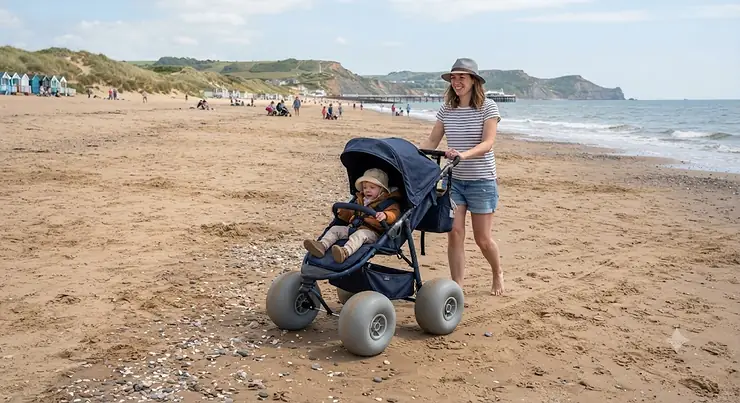
There’s a very specific kind of parenting despair that only happens on a beach: you’ve packed the bucket, the spade, the twelve snacks you’ll definitely need, and you’re twenty metres from the car park when your pushchair simply… stops. The front wheel has vanished into the dry sand up to the axle, your toddler is looking at you like you’ve personally betrayed them, and you’re now carrying a fully loaded pushchair one-handed while also carrying a fully loaded toddler. If any of that sounds familiar, the issue almost certainly isn’t your parenting. It’s your wheels.
A genuine beach stroller sand wheels setup isn’t a gimmick invented by marketing teams. It’s a real, measurable difference in wheel diameter, tyre type and weight distribution that decides whether your coastal day out is a breeze or a battle. Reviewers and testers who’ve actually pushed buggies across dunes and shingle consistently point to the same culprits: small wheels dig in, narrow tyres sink, and hard plastic offers none of the flex that a proper pushchair for sand needs to stay on top of loose ground rather than through it.
This guide cuts through the marketing copy and looks at seven real, currently available pushchairs, based on genuine specifications and aggregated review sentiment, so you can work out which one will actually survive a British seaside holiday. We’ll cover budget, mid-range and premium options, plus the practical maintenance and technique tips that no product listing bothers to mention.
What Is a Beach Stroller Sand Wheels Setup?
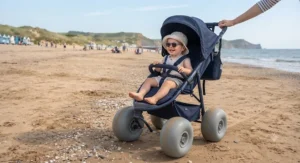
A beach stroller sand wheels setup refers to a pushchair fitted with large-diameter (typically 12–16 inch), wide, air-filled or high-volume foam tyres that distribute weight over a bigger surface area, reducing sinkage on soft, dry sand compared with the small, narrow wheels found on standard everyday pushchairs.
The physics is straightforward, even if nobody explains it on the product page: a narrow wheel concentrates your child’s weight (plus the buggy’s own weight) onto a thin strip of sand, and that strip simply gives way. A wider, larger wheel spreads the same load over a bigger footprint, so it rolls across the surface instead of ploughing through it, similar to why a mountain bike’s fat tyre copes with mud where a road bike’s slick tyre would stall. According to consumer champion Which?, all-terrain pushchairs are specifically built with sturdier frames and larger tyres for exactly this kind of uneven ground.
Quick Comparison Table
| Pushchair | Wheel Size (rear) | Tyre Type | Approx. Weight | Best For |
|---|---|---|---|---|
| Out n About Nipper Sport V6 Plus | 14″ | Air-filled | 12.5kg | Best all-rounder for sand and everyday walks |
| Mountain Buggy Terrain | 16″ (swappable to 12″) | Air-filled | 13.5kg | Best for switching between dunes and pavements |
| Thule Urban Glide 2 | 16″ | Air-filled | 11.4kg | Best for serious soft-sand pushing |
| Silver Cross Cove | Large foam-filled | Puncture-proof foam | Approx. 9-10kg (chassis) | Best premium pick with zero puncture risk |
| Ickle Bubba Venus Jogger Pro | Large air-filled | Air-filled | 14.5kg | Best budget all-terrain buggy for beach |
| Baby Jogger City Mini GT2 | 8.5″ | Foam-filled | 9.5kg | Best for packed sand and boardwalks only |
| Joolz Aer+ | Small | Standard | 6kg | Best lightweight travel option for firm, wet sand |
Looking at the table above, the pattern is obvious: the bigger the wheel and the more air inside it, the better a buggy handles genuinely soft, dry sand, while the two smallest-wheeled options here are honestly better suited to packed sand near the shoreline or boardwalks than dunes. Price and portability trade off against sand performance in almost every case, so your choice really comes down to how much of your beach trip happens on soft ground versus car parks and cafés.
💬 Just one click — help others make better buying decisions too!😊
Top 7 Beach Stroller Sand Wheels Picks: Expert Analysis
1. Out n About Nipper Sport V6 Plus — Britain’s favourite all-terrain buggy, now with bigger wheels
The Out n About Nipper V6 Plus builds on twenty years of the brand’s reputation with 14-inch air-filled tyres, up from the standard V6’s 12-inch set, specifically to improve rough-ground and off-road capability. On a UK beach, that extra two inches of diameter is the difference between rolling over compacted ridges of sand and getting caught on every single one of them.
The swivel-lock front wheel is the standout spec here: locked, it behaves like a fixed jogging wheel that tracks straight through soft ground rather than juddering sideways, and unlocked, it swivels freely for tight manoeuvring around beach cafés and car parks. Paired with the handlebar handbrake — a first for a swivel-wheel buggy certified to the BS EN1888-3:2023 running standard — you get genuine control on sloping sea walls and ramps, not just flat promenades.
Based on the spec comparison with rival 12-inch buggies, the Nipper V6 Plus earns its reputation as an all-rounder rather than a specialist: it isn’t the lightest, and it isn’t the cheapest, but it’s the one most likely to cope with everything a typical family beach day throws at it, from the car park gravel to the dune path to the packed sand near the tideline. Reviewers consistently note the one-hand fold and the durability of the aluminium frame as standout strengths, and Out n About’s long-standing spare parts programme means a punctured tyre doesn’t mean buying a whole new buggy.
Pros:
- ✅ 14″ air-filled tyres handle soft sand better than most rivals
- ✅ Swivel-lock front wheel adds stability on dunes and slopes
- ✅ Handlebar handbrake gives control on ramps and sea walls
Cons:
- ❌ Air tyres need occasional pumping and can puncture on shingle
- ❌ Heavier than lightweight travel strollers at 12.5kg
Typically found in the £330-£400 range at the time of research, the Nipper Sport V6 Plus represents strong value for families who want one buggy for daily life and beach holidays alike, rather than a second, specialist purchase. Check current price and availability before buying, as prices may vary between retailers.
2. Mountain Buggy Terrain — the only buggy here with two interchangeable wheel sets
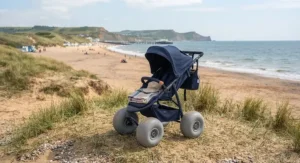
The Mountain Buggy Terrain solves the beach-versus-city dilemma in a genuinely clever way: it ships with both 16-inch and 12-inch air-filled rear wheels, so you swap up to the bigger set for dunes and swap back down for narrow shop doorways. Most competitors force you to pick one wheel size and live with the compromise; the Terrain doesn’t.
On paper, 16-inch air-filled tyres with a wide profile mean a much larger contact patch than the 8-9 inch wheels found on standard prams, which translates directly into less sinkage on loose sand. What most buyers overlook about this model is that the frame’s weight distribution is engineered for “kerb pop”, making it noticeably easier to lift the front wheel over sand ridges, driftwood or steps up to a beach café, rather than muscling the whole buggy up and over.
Aggregated reviewer sentiment is largely positive on ride quality and off-road capability, with testers reporting the 16-inch setup handled grass, gravel and broken ground with ease, though several note the buggy sits quite high with the larger wheels fitted, which taller parents may actually prefer and shorter parents may need to adjust the handlebar for.
Pros:
- ✅ Two wheel sets included — genuinely dual-purpose for sand and city
- ✅ Excellent kerb pop for dunes, driftwood and beach steps
- ✅ Robust aircraft-grade aluminium frame built for years of use
Cons:
- ❌ Sits noticeably high off the ground with 16″ wheels fitted
- ❌ Swapping wheel sets adds a maintenance step most buggies don’t need
Sitting in the mid-£500s to £600 range at the time of research, the Terrain positions itself between mainstream and premium pricing, which honestly reflects the added engineering of a genuinely swappable wheel system rather than a single fixed set.
3. Thule Urban Glide 2 — the standout for serious, sustained soft-sand pushing
If your beach days involve long stretches of properly soft, dry sand rather than a quick dash to a beach hut, the Thule Urban Glide 2 is the pick reviewers repeatedly single out. Its 16-inch rear air-filled tyres with a genuinely wide profile, combined with rear suspension, are built for jogging on trails, and that heritage translates directly into sand performance most everyday pushchairs simply can’t match.
Here’s what to weigh: at 11.4kg, the Urban Glide 2 is unusually light for a buggy with wheels this large, which matters enormously when you’re the one pushing through soft ground for twenty minutes at a stretch. The lockable front wheel is worth understanding properly — locked, it tracks dead straight through sand ruts without wandering; unlocked, it swivels for everyday manoeuvring once you’re back on the prom. Reviewers consistently rate the one-handed fold and the foot-pedal parking brake as thoughtful, practical touches rather than gimmicks.
The trade-off, and it’s a real one, is size. Even folded, the large rear wheels take up meaningful boot space, and several testers note the width can be tight through narrow beach-hut doorways or shop aisles. This is a buggy built around performance on rough terrain first and portability second.
Pros:
- ✅ 16″ wide air tyres are among the best-performing for soft sand
- ✅ Unusually light for its wheel size at 11.4kg
- ✅ Lockable front wheel tracks straight through sand ruts
Cons:
- ❌ Bulky folded size takes up significant boot space
- ❌ Premium pricing compared with standard all-terrain buggies
Prices generally sit in the £450-£600 range depending on bundle and retailer at the time of research, making this a genuine investment buy for families who prioritise off-road performance above all else.
4. Silver Cross Cove — the premium pick that never needs pumping up
The Silver Cross Cove takes a different technical approach entirely: its RideTech wheels are foam-filled rather than air-filled, which means zero puncture risk from shells, sharp shingle or the odd stray bit of beach glass, something every other product on this list can’t claim. Combined with full suspension, the Cove is engineered to smooth out cobbles, gravel paths and, per more recent Cove 2 testing, sandy boardwalks specifically.
On paper this means less maintenance faff for parents who’d rather not carry a pump in the beach bag, and reviewers consistently flag the low-fuss upkeep as a genuine selling point, since the wheels simply wipe clean of sand and salt water rather than needing air pressure checks. What the spec sheet won’t tell you, but reviewers note, is that the elevated seat position — designed to bring baby closer to the parent and ease back strain — also happens to keep little ones further from wind-blown sand at ground level, a small but genuinely useful side benefit at the coast.
Honest caveat: foam-filled tyres, while puncture-proof, are typically narrower than the biggest air-filled sand specialists here, so on genuinely deep, dry dune sand the Cove performs well rather than exceptionally, whereas on packed sand, boardwalks and mixed coastal paths it excels.
Pros:
- ✅ Puncture-proof foam tyres — zero maintenance from shells or shingle
- ✅ Elevated seat position shields baby from ground-level blown sand
- ✅ Reversible seat and overnight-approved carrycot add versatility
Cons:
- ❌ Narrower tyre profile than the top air-filled sand specialists
- ❌ Premium bundle pricing puts it at the top of this list
Bundles typically range from the mid-£600s to over £900 depending on accessories included, so it’s worth checking exactly what’s bundled before comparing against cheaper standalone pushchairs.
5. Ickle Bubba Venus Jogger Pro — proof that decent sand performance doesn’t need a premium price tag
Independent testing found the Ickle Bubba Venus Jogger Pro tackled soft ground surprisingly well despite its comparatively modest price point, with reviewers specifically noting that although the tyres are narrower than premium rivals, the buggy still handled soft ground confidently. That’s a meaningful finding: it suggests the suspension and frame geometry are doing real work here, not just the tyre width alone.
Its three air-filled tyres carry a thick tread pattern with built-in rear suspension, and the running-buggy heritage means the frame is built to stay stable at speed, which also translates to stability when you’re pushing hard through resistant sand rather than jogging. Based on the spec comparison with buggies costing two or three times as much, the Venus Jogger Pro’s inclusion of a hand brake and wrist strap is a genuinely useful safety feature on sloped beach access ramps that many budget buggies skip entirely.
Reviewers do flag that the standard bundle handles everyday bumpy terrain and firm mud better than it handles truly deep, dry sand, so this is best understood as an excellent value all-rounder rather than a dune-conquering specialist.
Pros:
- ✅ Strong value with genuine suspension and thick-tread air tyres
- ✅ Hand brake and wrist strap add safety on sloped beach ramps
- ✅ Newborn cocoon bundle option extends usability from birth
Cons:
- ❌ Narrower tyres than premium sand specialists like the Thule
- ❌ No one-hand fold, which slows quick pack-downs at the car park
At around £269 for the pushchair alone, or £330-£380 for the Prime bundle with newborn accessories at the time of research, this is comfortably the best-value all terrain buggy for beach use on this list.
6. Baby Jogger City Mini GT2 — great everyday buggy, honestly limited on deep sand
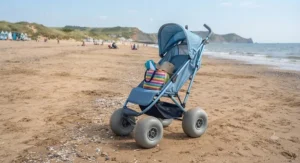
It’s important to be upfront here: independent lab-style testing has found the City Mini GT2’s 8.5-inch foam-filled tyres are genuinely small for an all-terrain buggy, and testers reported the smaller wheels struggled both on and off-road compared with larger-wheeled rivals. Given the honesty commitment behind this guide, it would be misleading to present this buggy as a beach specialist — it isn’t one.
What the City Mini GT2 does very well is everyday, all-wheel-suspension smoothness on pavements, parks and firmer, packed coastal paths, and its one-hand fold and lightweight 9.5kg frame make it a genuinely pleasant buggy to live with day to day. Reviewers consistently praise the ride comfort and manoeuvrability on mixed urban terrain, and the “forever air” foam tyres mean you’ll never deal with a puncture on a shell-strewn beach car park.
On packed, wet sand near the shoreline, or on boardwalks and prom paths, the GT2 copes reasonably well thanks to its all-wheel suspension. On dry, soft, dune-style sand further up the beach, expect to work considerably harder pushing it than you would with any of the larger-wheeled buggies above.
Pros:
- ✅ All-wheel suspension gives a genuinely smooth ride on firm ground
- ✅ Lightweight at 9.5kg with a true one-hand fold
- ✅ Foam-filled tyres never puncture, even on shell-strewn car parks
Cons:
- ❌ 8.5″ wheels are honestly too small for deep, dry sand
- ❌ Narrow wheelbase can feel tippy on very uneven ground
Typically priced in the £380-£450 range at the time of research, the City Mini GT2 is a fine everyday pushchair that happens to also manage packed sand adequately, rather than a genuine beach specialist — worth knowing before you buy specifically for coastal holidays.
7. Joolz Aer+ — the lightest option here, best kept to boardwalks and firm sand
The Joolz Aer+ is included deliberately, as an honest counterpoint: at just 6kg, it’s the lightest pushchair on this list by a huge margin, folds compactly enough for aeroplane cabins, and is genuinely brilliant for holidays that involve more airport terminal than dune. Aggregated reviewer feedback is consistent that its smaller wheels struggle on loose, uneven ground such as stone paths or, by clear extension, dry beach sand.
What most buyers overlook about ultra-lightweight travel strollers generally is that the same engineering trade-off that makes them foldable and portable — small wheels, minimal frame mass — is precisely what makes them poor performers on soft sand specifically. The Aer+’s 4-wheel suspension does help smooth out bumpy pavements and boardwalks, and reviewers note it has among the lowest wheel vibration of any lightweight stroller tested, which is a genuine comfort win on firmer coastal paths.
Honest verdict: if your beach trip means flying somewhere and mostly using boardwalks, promenades or firm, wet sand near the shoreline, the Aer+’s portability may outweigh its sand limitations. If you’re heading to a dune-backed beach in Cornwall or Northumberland expecting to push any real distance across dry sand, this isn’t the right tool for that job.
Pros:
- ✅ Exceptionally lightweight at 6kg with a one-second fold
- ✅ Cabin-compatible for flying to your beach holiday
- ✅ Low wheel vibration gives a smooth ride on firm surfaces
Cons:
- ❌ Small wheels genuinely struggle on loose, dry sand
- ❌ Small storage basket limits what you can carry to the beach
Generally priced in the £450-£550 range at the time of research, the Aer+ commands a premium for portability rather than off-road capability, so match it to your actual beach terrain before buying.
Practical Usage Guide: Getting Your Pushchair Across Sand
Even the best pushchair for sand benefits from the right technique, and this is the part no product listing ever covers. First, lower your tyre pressure slightly before a beach trip if you’re using an air-filled model — a touch softer than road pressure increases the tyre’s contact patch, exactly like reducing pressure on a mountain bike for loose terrain, though always stay within the manufacturer’s minimum guidance to avoid damaging the rim. Second, keep moving: sand-sinking happens when you slow down or stop on soft ground, so build a bit of momentum before crossing a soft patch rather than pausing halfway through it.
Where possible, stick to the compacted sand near the low-tide line rather than the deep, dry sand higher up the beach — it’s noticeably firmer and every buggy on this list performs better there. After every beach visit, rinse the wheels, axles and brake mechanisms with fresh water to remove salt and sand before they work into bearings, and let the buggy dry fully before folding it away, since trapped damp sand accelerates frame corrosion over a season of use. In the first 30 days of ownership, avoid the common mistake of assuming a new buggy needs no running-in: check tyre pressure weekly on air-filled models, as tyres often lose a small amount of pressure during shipping and initial use.
✨ Don’t Miss These Exclusive Deals!
🔍 Take your beach days to the next level with these carefully selected pushchairs. Click on any highlighted item to check current pricing and availability. These buggies will help you create happy, hassle-free seaside memories your family will treasure!
Real-World Scenarios: Which Beach Buggy Suits Your Family?
Consider a family of four heading to a dune-backed beach in North Norfolk for a week, pushing across genuinely soft sand daily from the car park to the shoreline: here, the larger-wheeled specialists — the Thule Urban Glide 2 or Mountain Buggy Terrain — earn their higher price tag through sheer time saved and frustration avoided, since both are specifically built with wide, high-volume air tyres for exactly this scenario.
Now picture a couple flying to a Mediterranean coastal town with a six-month-old, mostly navigating boardwalks, cobbled old-town streets and airport terminals, with only the occasional stroll on firm, packed sand near a lifeguarded bay: the Joolz Aer+‘s 6kg portability and cabin-friendly fold likely outweigh its sand limitations here, since the terrain genuinely favours portability over dune-conquering wheels.
Finally, imagine a budget-conscious family planning UK day trips to a mix of promenade towns and the occasional sandy cove, wanting one buggy for daily life and holidays alike without a premium price tag: the Ickle Bubba Venus Jogger Pro or Out n About Nipper Sport V6 Plus both deliver genuinely useful sand capability without the cost of the specialist joggers, making them the sensible middle-ground pick for families who want one buggy to do most jobs reasonably well.
Problem → Solution: Common Sand and Salt Issues Solved
Sand jammed in the swivel wheel mechanism is probably the most frequent complaint in aggregated buggy reviews, and the fix is simple: rinse the wheel housing with fresh water after every beach visit and avoid folding the buggy while sand is still packed into the joints, since folding grinds grit further into the mechanism.
Salt corrosion on the frame is a slower, sneakier problem that shows up as stiffness in the fold hinge months later; wiping the frame down with a damp cloth and drying thoroughly after coastal use prevents most of this, and it’s worth checking your specific model’s care instructions, as foam-filled tyre buggies like the Silver Cross Cove need less wheel-specific maintenance than air-filled models.
A punctured tyre on shell-strewn sand is an obvious risk with any air-filled wheel, including the Out n About Nipper Sport V6 Plus, Mountain Buggy Terrain, Thule Urban Glide 2 and Ickle Bubba Venus Jogger Pro; carrying a small puncture repair kit or opting for a foam-filled alternative like the Silver Cross Cove or Baby Jogger City Mini GT2 sidesteps this entirely, at the cost of slightly reduced sand performance.
Finally, an overheating baby under a hood that isn’t providing enough shade is a genuine coastal-day risk, not just a comfort issue; the NHS specifically advises attaching a parasol or sunshade to keep a baby out of direct sunlight rather than draping a blanket over the pushchair, which can trap heat and reduce airflow. You can read the full NHS guidance on keeping your baby safe in the sun for the complete set of recommendations.
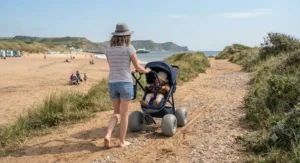
How to Choose a Wide Wheel Pushchair for Sand
- Check the wheel diameter first. Anything from 12 inches upward genuinely improves sand performance; 16-inch wheels, like those on the Thule Urban Glide 2 and Mountain Buggy Terrain, represent the upper end of what’s practically available.
- Look at tyre width, not just diameter. A tall but narrow tyre still sinks; wide-profile air tyres spread weight more effectively across loose ground.
- Decide between air-filled and foam-filled tyres. Air-filled tyres generally flex better over sand but need occasional maintenance and can puncture; foam-filled tyres, as on the Silver Cross Cove, need zero upkeep but are typically narrower.
- Weigh up total buggy weight against wheel size. A lighter frame with big wheels, like the 11.4kg Thule Urban Glide 2, is easier to push through resistance than a heavier buggy with the same wheels.
- Consider a lockable or fixed front wheel. A locked front wheel tracks straighter through soft sand ruts than a free-swivelling one, which tends to wander and dig in sideways.
- Factor in fold size for your car boot. Bigger sand-friendly wheels generally mean a bulkier fold, so check your boot space against folded dimensions before committing.
- Match the buggy to your actual terrain, honestly. If most of your trip is boardwalks and packed sand rather than dunes, a lighter, smaller-wheeled option like the Joolz Aer+ may genuinely suit you better than an expensive sand specialist you’ll rarely need at full capacity.
All Terrain Buggy for Beach vs Standard Pushchair
The core difference between a genuine all terrain buggy for beach use and a standard everyday pushchair comes down to three engineering choices: wheel size, tyre construction and suspension travel. Standard pushchairs, designed primarily for pavements and shop floors, typically use 6-9 inch wheels because smaller wheels are lighter, cheaper to manufacture and better suited to tight manoeuvring indoors — exactly the priorities that work against you on sand.
All-terrain models flip those priorities: bigger wheels add weight and bulk, which is a genuine downside for daily errands, but that same bulk is precisely what prevents sinking into loose ground. Suspension matters here too — a standard pushchair’s minimal or non-existent suspension transmits every bump from an uneven beach path straight to your baby’s seat, while the full or all-wheel suspension on models like the Mountain Buggy Terrain or Ickle Bubba Venus Jogger Pro absorbs that bump before it reaches the child.
The honest trade-off is that you’re rarely getting sand performance “for free” — it comes with added weight, bulkier storage and typically a higher price tag, which is exactly why the case study section above matters more than a simple “biggest wheels win” rule of thumb. For a family whose beach trips are occasional, a standard pushchair with strong all-wheel suspension, like the Baby Jogger City Mini GT2, may still be the more sensible overall purchase.
Best Pram for Sand and Gravel: Coastal Path Performance
| Pushchair | Sand Performance | Gravel/Shingle Performance | Puncture Risk |
|---|---|---|---|
| Thule Urban Glide 2 | Excellent | Very good | Moderate |
| Mountain Buggy Terrain | Excellent | Excellent | Moderate |
| Silver Cross Cove | Good | Excellent | None |
| Out n About Nipper Sport V6 Plus | Very good | Good | Moderate |
| Ickle Bubba Venus Jogger Pro | Good | Good | Moderate |
The table above highlights a useful distinction many buyers miss: sand performance and gravel or shingle performance don’t always move together. The Silver Cross Cove‘s puncture-proof foam tyres make it the standout choice for shingle beaches and coastal paths littered with sharp stone, even though its narrower profile means it’s merely good, rather than exceptional, on genuinely deep dry sand. Meanwhile, the Mountain Buggy Terrain and Thule Urban Glide 2 both excel across the board, which is reflected in their position at the top end of this list’s pricing.
Features That Actually Matter (And Those That Don’t)
Wheel diameter and tyre width genuinely matter for a sand friendly stroller — this isn’t marketing spin, it’s basic physics around surface area and load distribution, and it’s the single biggest factor separating the top performers on this list from the also-rans. Suspension quality matters almost as much, since it determines whether the sand-crossing bumps reach your child or get absorbed by the frame first.
What matters considerably less than marketing copy suggests: the number of storage pockets, cup holder positioning, and colour options make zero difference to how a buggy handles sand, however much shelf space they take up in a product description. Similarly, a “jogging-suitable” label doesn’t automatically mean superior sand performance — some fixed-wheel jogging buggies genuinely excel on sand, like the Thule Urban Glide 2, while others are optimised purely for road-running speed rather than off-road stability, so check the actual wheel specs rather than trusting the jogging label alone.
One feature that’s easy to underrate: a UPF 50+ rated canopy with good coverage. Reviewers across nearly every model in this guide flag sun protection as a genuine, practical concern on open beaches where shade is scarce, and the NHS specifically recommends keeping direct sunlight off young babies rather than relying on sunscreen alone for those under six months old.
Long-Term Cost & Maintenance: Salt, Sand and Air Tyres
Air-filled tyres, found on five of the seven buggies in this guide, typically need a pressure check every few weeks during heavy beach use and occasional inner tube or tyre replacement over a buggy’s lifespan — a modest but real ongoing cost that’s worth factoring into your budget alongside the upfront price. Foam-filled tyres, as used on the Silver Cross Cove and Baby Jogger City Mini GT2, eliminate that specific cost entirely, which can meaningfully offset a higher purchase price over two or three years of regular coastal use.
Salt exposure is the less obvious long-term cost across every model here: metal frame components left un-rinsed after seawater exposure are more prone to corrosion and stiffening at fold hinges over time, regardless of tyre type. Brands with strong spare-parts availability, notably Out n About and Mountain Buggy, both of which explicitly market long-term parts support and repairability, offer better total cost of ownership for families planning multiple years of coastal holidays, since a worn wheel or hinge doesn’t mean replacing the entire buggy.
Value-for-money conclusions differ by use case: for occasional beach trips, the Ickle Bubba Venus Jogger Pro‘s lower upfront cost and adequate sand performance likely deliver the best pounds-per-outing value, while families making sand-crossing a weekly summer habit will get more genuine value from the Thule Urban Glide 2 or Mountain Buggy Terrain‘s superior capability, even at a higher initial outlay.
Safety, Regulations & Sun Protection Guide
UK pushchairs sold for running or jogging use should meet the BS EN1888-3:2023 running standard, and the Out n About Nipper V6 Plus is notable as the first swivel-wheel buggy to achieve this certification, which matters if you plan to move quickly across firm sand near the shoreline rather than simply strolling. Always check the specific model and weight limits before using any buggy for jogging, and avoid running with a baby under six months old regardless of the buggy’s certification.
Beyond the buggy itself, coastal safety extends to the wider beach environment. The RNLI’s beach safety guidance recommends choosing a lifeguarded beach where possible and understanding local flag systems before letting older children near the water, advice worth reading in full before any coastal trip with young children. On sun protection specifically, the NHS advises keeping babies under six months out of direct sunlight entirely, and using an SPF 30+ sunscreen with UVA protection on babies over six months, alongside a wide-brimmed sunhat and loose, lightweight clothing.
Tide awareness matters for pushchair routes too — soft, waterlogged sand near an incoming tide line can be genuinely harder to push through than dry sand higher up the beach, and getting caught out by a rising tide with a heavily loaded buggy is a real, avoidable risk on unfamiliar beaches. Checking local tide times before setting off is a simple step that most families skip.
Frequently Asked Questions
❓ Do all-terrain pushchairs actually work on sand?
❓ What's the best pram for beach use on a budget?
❓ Can I use a normal pushchair on the beach?
❓ How do I stop sand getting into pushchair wheels?
❓ Are air-filled or foam-filled tyres better for a sand friendly stroller?
Conclusion
There’s no single “best” answer here, and any article claiming otherwise probably hasn’t looked closely at real specs and real reviewer sentiment the way this one has. If soft, dry dune sand is a regular part of your life, the Thule Urban Glide 2 and Mountain Buggy Terrain are genuinely worth their premium price tags, built around exactly the wide, large-diameter air tyres that make the biggest practical difference. If you want one buggy that handles beach days, city pavements and everything in between without specialist pricing, the Out n About Nipper Sport V6 Plus and Ickle Bubba Venus Jogger Pro both deliver strong, honest value.
And if your beach days lean more towards boardwalks, promenades and packed, firm sand rather than dunes, don’t feel pressured into buying a heavy off-road specialist you won’t fully use — the Baby Jogger City Mini GT2 or Joolz Aer+ may genuinely serve you better, provided you understand and accept their real limitations on deep, dry sand. Whichever buggy for sand you choose, matching the wheels to your actual terrain, rather than the biggest spec sheet, is what will make the real difference on your next coastal trip.
Ready to find your perfect beach buggy? Compare current prices on the models above and check availability before your next seaside trip — your future self, standing on soft sand with a toddler, will thank you.
Recommended for You
- Pushchair For Countryside Walks: 7 Rugged Picks For 2026
- 3 Wheel Pushchair 2026: 7 Best Picks Tested; Compared
- Off Road Pushchair: 7 Best All-Terrain Buggies for 2026 (Muddy-Path Tested)
Disclaimer: This article contains affiliate links. As an Amazon Associate, I earn from qualifying purchases. If you purchase products through these links, we may earn a small commission at no additional cost to you.
✨ Found this helpful? Share it with your friends! 💬🤗
