In This Article
Somewhere between the second blue line and the first scan showing two heartbeats, most parents of twins have the same quiet realisation: nothing in the baby aisle was designed with you in mind. A pram for newborn twins isn’t a nice-to-have accessory, it’s the single piece of kit that decides whether your first year is spent gliding round the park with a coffee in hand or wrestling a chassis through a doorway it was never going to fit through. What is a pram for newborn twins? It’s a wheeled child conveyance, tested to the UK’s BS EN 1888 safety standard, built with two flat-lying or reclining seats (side-by-side or tandem) that can each safely carry a baby from birth, unlike single-to-double converters that often only manage one newborn at a time.

This guide is built the honest way. Rather than reheating Amazon listings, we’ve researched real 2026 UK models, compared their specs against what genuine reviewers and independent testers report, and worked out where each one earns its keep — and where it falls short. You’ll get width measurements against actual UK doorways, price bands instead of prices that’ll be out of date by next Tuesday, and a proper look at tandem vs side-by-side, twin pram width, and double buggy storage, because those are the details that make or break daily life with two babies. Whether you’re planning to buy newborn pushchair online tonight or you’re still deciding between styles, here’s what the spec sheets won’t tell you.
Quick Comparison Table
| Pram | Style | Width | Price Range | Best For |
|---|---|---|---|---|
| Joie Aire Twin | Side-by-side | 76-78cm | under £220 | Tightest budgets |
| Ickle Bubba Venus Prime Double | Side-by-side | 76.5cm | £350-£450 range | Value with newborn kit included |
| Out n About Nipper Double V5 | Side-by-side, all-terrain | 72cm | £650-£700 range | Country walks and rough pavements |
| Baby Jogger City Mini GT2 Double | Side-by-side | 76-78cm | £700-£800 range | Daily errands on cracked pavements |
| Hauck Duett 2 | Tandem | Around 66cm | £350-£450 range | Newborn plus an older toddler |
| iCandy Peach 7 Twin | Stacked tandem | Narrow, doorway-friendly | £1,600-£1,800 range | Long-term luxury investment |
| Bugaboo Donkey 5 Twin | Side-by-side, premium | 74cm | £1,800-£2,200+ range | Families wanting one buggy for years |
Looking at the spread above, the gap between the cheapest and most expensive option isn’t just about badge snobbery — it reflects genuinely different engineering, from the tyre type to how many years the seat unit is rated to last. Budget side-by-sides like the Joie Aire Twin get two babies out of the house safely, but you’re trading away suspension quality and long-term durability that heavier-use families will eventually feel. If your terrain is smooth pavements and lifts rather than cobbles and kerbs, that trade-off barely matters; if you’re navigating a Victorian high street daily, it starts to matter a great deal.
💬 Found a pram that fits your doorway and your budget? Bookmark this page and share it with another twin parent who’s still scrolling at 2am.
Top 7 Prams for Newborn Twins: Expert Analysis
1. Joie Aire Twin — lightest true side-by-side for tight budgets
At just 11.8kg, the Joie Aire Twin is one of the lightest side-by-side options built specifically with twins in mind, and that lightness is the whole point of the design. Both seats recline fully flat independently of one another, which is the detail that actually matters for newborns — a seat that “reclines a long way” isn’t the same as one that lies genuinely flat, and only the latter is appropriate for two babies who can’t yet hold their own head up. There’s no carrycot or car seat compatibility, so this isn’t a travel system; you’re buying a pushchair, full stop.
Based on the spec comparison with pricier rivals, what most buyers overlook about this model is that the missing travel-system function is precisely why it’s so light and manoeuvrable — you’re not carrying the weight of adaptors and dual-purpose engineering you’ll never use if you’re happy transferring sleeping babies by hand. It suits parents in flats or terraced houses with narrow hallways, and anyone who wants a second, lighter buggy to sit alongside a heavier all-terrain model for quick trips. Reviewers consistently note the one-hand fold and narrow footprint as standout strengths, while a recurring theme in aggregated feedback is that the front wheels can feel a little loose and prone to spinning on cambered pavements.
Pros:
- ✅ One of the lightest genuine side-by-side twin buggies available
- ✅ Both seats lie fully flat, independently, from birth
- ✅ Narrow enough to clear most standard UK doorways
Cons:
- ❌ No carrycot or car seat adaptors, so it’s pushchair-only
- ❌ Front wheels reported as prone to spinning on uneven ground
At under £220, the Joie Aire Twin represents the strongest value-for-money entry point in this list, and it’s a genuinely sound buy for parents whose daily routine is pavements, parks and public transport rather than muddy trails.

2. Ickle Bubba Venus Prime Double — best value bundle with newborn kit included
The Ickle Bubba Venus Prime Double ships as a full bundle rather than a bare chassis, including a newborn cocoon insert, two footmuffs and a raincover, which changes the maths considerably against buggies that charge extra for every accessory. At 13.4kg it’s heavier than the Aire Twin but still comfortably liftable, and its 76.5cm width sits right at the edge of what most UK internal doorways will allow.
What the spec sheet won’t tell you, but user reports suggest, is that the independent recline on each seat is more valuable in practice than it sounds on paper: one twin can nap flat while the other sits more upright to watch the world, which matters enormously once babies start developing different sleep patterns around eight to twelve weeks. Front and rear suspension is a genuine step up from budget rivals with no suspension at all, smoothing out the judder of cracked sitting-room floors and pavement edges. Aggregated reviewer sentiment is broadly positive on manoeuvrability and value, with a recurring caveat that the folded bulk is more than some buyers expect from a “compact” description, and the folding motion itself needs both hands and a bit of practice in the first week.
Pros:
- ✅ Newborn cocoon and accessories bundled into one purchase
- ✅ Independent seat recline, useful once sleep patterns diverge
- ✅ Front and rear suspension smooths kerbs and uneven paths
Cons:
- ❌ Bulkier folded than the marketing suggests
- ❌ Two-handed fold takes practice to master quickly
Sitting in the £350-£450 range, the Ickle Bubba Venus Prime Double is arguably the strongest all-round value pick here for parents who want newborn-ready kit without assembling a shopping list of separate accessories.
3. Out n About Nipper Double V5 — best all-terrain option for active families
Built by a British brand with two decades on UK streets, the Out n About Nipper Double V5 is the pick for parents who live somewhere without pavements worth the name. Its 12-inch pneumatic tyres and independent rear suspension handle gravel, mud and broken kerbs in a way that budget foam-wheeled buggies simply can’t, and at 72cm wide it’s the narrowest all-terrain double on this list, narrower even than several premium rivals.
Here’s what to weigh: the pneumatic tyres that make the ride so smooth also mean you’ll occasionally need a pump, unlike the puncture-proof options elsewhere in this guide — a genuine trade-off between comfort and convenience rather than a flaw. Twin carrycots are sold separately with a dedicated dual adaptor, so newborn twins need that extra purchase factored into the initial budget rather than assumed as included. Reviewers who’ve used it daily for two-plus years describe minimal wear on the frame, and the brand’s award history (Gold for Best Multiple, Twin or Tandem Pushchair at the Mother & Baby Awards in both 2024 and 2025) lines up with what independent testers report about its steering and one-handed manoeuvrability.
Pros:
- ✅ Pneumatic tyres and suspension excel on rough, rural ground
- ✅ Narrowest all-terrain double buggy in this comparison at 72cm
- ✅ Strong independent reputation for long-term durability
Cons:
- ❌ Twin carrycots and adaptors are sold as separate extras
- ❌ Pneumatic tyres need occasional pumping up
In the £650-£700 range, the Out n About Nipper Double V5 justifies its premium over basic side-by-sides for anyone whose daily walk involves anything rougher than smooth tarmac.
4. Baby Jogger City Mini GT2 Double — best for daily errands on cracked pavements
The Baby Jogger City Mini GT2 Double uses “forever-air” foam-filled tyres that never go flat, combined with all-wheel suspension, aimed squarely at parents doing the daily school run and shopping circuit rather than genuine off-roading. Independent seats recline to a near-flat position with vented tops, and the signature one-step, in-seat fold is one of the faster folding mechanisms among side-by-side doubles.
In the interest of complete honesty, this is where the pram for newborn twins conversation needs a straight caveat: several accessory retailers confirm the chassis only accepts one bassinet attachment, not two, which makes it a stronger match for a newborn-and-toddler household than for two newborns lying flat simultaneously. Families using it for genuine twins from day one typically run one baby in an infant car seat via adaptor while the other uses the pushchair seat reclined flat, which works but isn’t the elegant from-birth solution some listings imply. Reviewers rate the ride quality and manoeuvrability highly, while a consistent complaint across independent reviews is the weight gain versus the previous generation, now pushing towards 16.6kg.
Pros:
- ✅ Forever-air tyres never puncture or need pumping
- ✅ Fast one-step, in-seat folding mechanism
- ✅ Near-30-inch width keeps it doorway-conscious for a double
Cons:
- ❌ Only one bassinet attachment fits the chassis, not two
- ❌ Heavier than the previous generation at nearly 16.6kg
Priced in the £700-£800 range, the Baby Jogger City Mini GT2 Double earns its place through everyday ride quality, but twin parents specifically should budget for a car seat adaptor rather than assuming dual-bassinet use from birth.
5. Hauck Duett 2 — genuinely best for newborn to toddler, not simultaneous twins
Here’s an important honesty check the brief demands: several UK retailers explicitly state that the Hauck Duett 2 is not suitable for newborn twins, because only the main seat reclines flat from birth while the second seat is rated from six months. That makes it a poor fit for two babies who both need to lie flat on day one — but it’s precisely why it earns a spot here as the standout answer to a closely related question, the best pushchair for newborn to toddler.
For a family with a new baby and an older sibling still small enough for a pushchair, the tandem layout genuinely shines: the carrycot-to-seat conversion means one child gets proper newborn support while the other, older child rides in a proper seat rather than being squeezed into an ill-fitting toddler mode. Reviewers note that the aluminium frame keeps the 16kg weight manageable for a tandem, and the seven-position adjustable handle (94cm to 111cm) suits parents of very different heights sharing pushing duties. What most buyers overlook is that this flexibility — running it as a single buggy, a carrycot-plus-seat combo, or full tandem — makes it a longer-serving purchase than its price suggests, provided you buy it for the right family shape in the first place.
Pros:
- ✅ Genuinely excellent for a newborn and an older sibling
- ✅ Converts between single, carrycot-plus-seat and full tandem modes
- ✅ Seven-position handle suits parents of different heights
Cons:
- ❌ Not suitable for two newborn twins simultaneously
- ❌ At 16kg it’s heavier to lift than most side-by-sides here
Sitting in the £350-£450 range, the Hauck Duett 2 is the clearest example in this guide of why “double buggy” and “twin pram” aren’t always interchangeable terms — read the small print before you buy.
6. iCandy Peach 7 Twin — premium single-to-double investment piece
Now in its seventh generation, the iCandy Peach 7 Twin converts a single luxury pushchair into a genuine twin setup using the brand’s own adaptors, with carrycots approved for permanent overnight sleeping — a detail that matters because it means the carrycot can double as a first Moses basket rather than sitting unused after the newborn stage. Seats measure 36cm wide, 20mm longer than the previous generation, and support up to 25kg each, giving it a genuinely long runway from birth to around age six.
Based on the spec comparison, the price tag — starting from roughly £1,600 for the twin bundle — buys engineering depth that’s hard to replicate cheaply: a five-year guarantee, 22 seating configurations, and a chassis narrow enough to clear most doors despite carrying two children. A twin mum who tested it for Mumsnet described the carrycots as looking slightly squeezed once both are attached side by side in tandem formation, with underseat storage noticeably reduced as a result — a fair trade some parents make willingly for the styling and build quality on offer, and one that shows exactly how the “storage vanishes in tandem mode” pattern discussed later in this guide plays out in real life. Reviewers consistently praise the smoothness of the ride on mixed terrain and the practicality of extras like the integrated cup holder and parasol.
Pros:
- ✅ Five-year guarantee and 25kg-per-seat capacity to age six
- ✅ Carrycots approved for permanent overnight sleeping
- ✅ Narrow enough to clear most standard doorways despite carrying twins
Cons:
- ❌ Underseat storage basket shrinks noticeably in twin mode
- ❌ Among the heaviest upfront prices in this comparison
At £1,600-£1,800, the iCandy Peach 7 Twin suits families who see a pram as a multi-year investment rather than a stage-one purchase, and who’ll get genuine mileage from the extended weight limits.
7. Bugaboo Donkey 5 Twin — luxury side-by-side built for two from day one
Unlike its Duo sibling — which suits a toddler and a newborn but only ships with one carrycot — the Bugaboo Donkey 5 Twin specifically includes two bassinets as standard, making it one of the few premium platforms genuinely engineered around twins rather than adapted after the fact. In twin configuration it measures 74cm wide, narrower than several mid-range doubles despite the premium badge, and the seat and carrycot sit three centimetres higher than the previous generation, bringing both babies closer to eye level with the parent pushing.
What the spec sheet won’t tell you, but independent testers note, is that the size that makes it feel so substantial on the pavement becomes the main sticking point at the car boot: several reviewers describe needing to dismantle the frame for smaller cars, which undercuts the “one buggy for years” promise if your vehicle is on the compact side. The three-click switch between single, duo and twin modes genuinely works as described, and the storage bin remains large and accessible even with both seats or carrycots fitted — a rarer feature than it should be at this end of the market. Aggregated reviewer sentiment is polarised: those with big boots and pram-friendly homes rate it highly for ride quality and steering, while independent lab testers have flagged the bulky, lockless fold as a genuine practical drawback.
Pros:
- ✅ Two bassinets included as standard, built for twins from day one
- ✅ Storage bin stays large and accessible even in twin mode
- ✅ Three-click switch between single, duo and twin configurations
Cons:
- ❌ Bulky fold that some testers say needs the frame dismantled for smaller boots
- ❌ Among the heaviest and most expensive options here
Typically found in the £1,800-£2,200+ range, the Bugaboo Donkey 5 Twin is the pick for families with generous car boots and wide front doors who want a genuine day-one twin specialist rather than a converted single-to-double.
Practical Usage Guide: Your First 30 Days
Getting a pram for newborn twins out of the box and onto the pavement isn’t always as intuitive as the assembly leaflet suggests, and the first month is where most avoidable mistakes happen. Build the chassis fully before your due date, not after — twin parents rarely get a spare afternoon once both babies arrive, and testing the fold, brake and seat attachment while you’re not sleep-deprived saves real frustration later. Practise the one-handed fold (where the model has one) at least five times before you need it for real, ideally while holding a bag of shopping to simulate the actual conditions you’ll be folding it under.
Check tyre pressure on any pneumatic-wheeled model like the Out n About Nipper Double V5 before first use and monthly thereafter, since underinflated tyres both ride harshly and wear unevenly. For models with independent recline, such as the Ickle Bubba Venus Prime Double or Joie Aire Twin, get into the habit of checking both harnesses separately every single outing — it’s easy to tighten one side after a nappy change and forget the other. A common mistake in the first 30 days is leaving heavy shopping bags hung off the handlebar rather than the underseat basket, which shifts the centre of gravity backwards and increases tip-back risk on kerbs, something Twins Trust specifically flags as a stability hazard for parents of multiples to watch for. Finally, measure your front door, garden gate and boot space with a tape measure before delivery day, not after — it’s the single most common return reason across every retailer’s customer service data.
Real-World Scenarios: Which Twin Pram Suits Your Situation
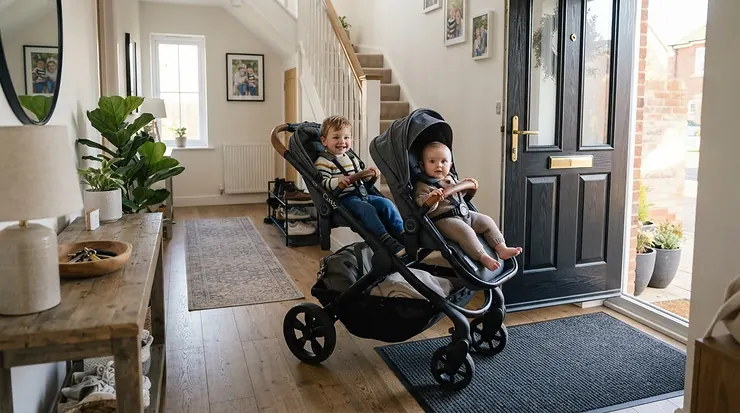
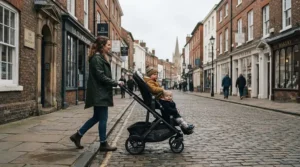
Picture a family in a Victorian terrace in Manchester, narrow hallway, no downstairs loo, and a car boot barely big enough for the weekly shop. For them, the 72cm width of the Out n About Nipper Double V5 or the compact folded footprint of the iCandy Peach 7 Twin matters more than raw price, because a buggy that can’t get through the front door isn’t a bargain at any cost. Contrast that with a family in a new-build with a wide integral garage and an SUV: the Bugaboo Donkey 5 Twin‘s boot-dismantling quirk barely registers as a problem, and the higher seat position becomes the more relevant selling point for daily comfort.
Then there’s the family juggling a toddler and newborn twins together — a genuinely different challenge from twins alone, since you need a buggy that can absorb an occasional third passenger via a buggy board without tipping. Here, models with a strong underseat basket and low centre of gravity, like the Ickle Bubba Venus Prime Double, tend to cope better than tandems with limited ground clearance. And for the family who lives three flights up with no lift, weight becomes the decisive factor above almost everything else: the Joie Aire Twin‘s sub-12kg frame is liftable in a way that the 16kg-plus tandems on this list simply aren’t, even if it means sacrificing suspension and long-term seat capacity.
✨ Whichever scenario matches yours, check the current price and availability on the model that fits your doorway before you commit — availability shifts fast on popular twin models.
How to Choose a Pram for Newborn Twins
Choosing correctly the first time matters more with twins than with a single pushchair, since replacing a double buggy mid-year is a far bigger expense and hassle than swapping a single pushchair.
- Measure your narrowest doorway first. Most UK doorways measure around 76cm, so anything wider needs checking against your specific home before you fall in love with a model online.
- Decide tandem or side-by-side early, since it shapes everything else — width, weight, and how your twins interact with each other during walks.
- Confirm both seats genuinely recline flat, not just “almost flat,” since newborns need a fully flat surface for safe, comfortable sleep.
- Check whether carrycots or car seat adaptors are included or sold separately, as this can add £100-£200 to your real first-year cost.
- Weigh the folded weight against your daily reality — stairs, car boot height and whether you’ll be lifting it solo regularly.
- Look at the maximum weight limit per seat, since a higher limit like the 25kg on the iCandy Peach 7 Twin extends the buggy’s useful life by a year or more.
- Read the underseat storage basket capacity, because tandem and stacked models frequently lose basket space that side-by-sides retain.
Tandem vs Side-by-Side: Which Wins for Newborn Twins
The tandem vs side-by-side question doesn’t have a universally correct answer, but it does have a clearly correct answer for your specific home and habits. Side-by-side models, such as the Joie Aire Twin and Bugaboo Donkey 5 Twin, give both babies equal eye contact with each other and with you, which many parents find matters enormously in the early months when twins are learning to recognise one another’s presence. The trade-off is width: even the narrowest side-by-sides in this guide sit around 72-78cm, close to or beyond many UK internal doorways.
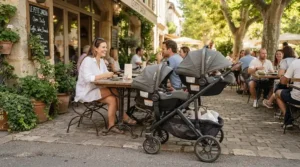
Tandem and stacked models, like the Hauck Duett 2 and iCandy Peach 7 Twin, solve the width problem by placing one child behind or slightly staggered from the other, keeping the frame closer to single-buggy width. What most buyers overlook about tandems is the flip side of that neat doorway trick: one child, typically the rear or lower seat, gets a more restricted view, and the frame runs noticeably longer, which can make three-point turns in small shops genuinely awkward. For families in cottages, terraces or flats with narrow hallways, a tandem or stacked model is usually the more liveable daily choice; for families with wider homes and a priority on twin bonding and equal seating, side-by-side wins on comfort and fairness between the two seats.
Twin Pram Width: Doorways, Car Boots and Public Transport
Twin pram width is the single measurement that causes the most buyer’s remorse, because it’s the one dimension that can’t be worked around after delivery day. UK internal doors typically measure around 76cm, though older properties and internal doors can run narrower, so the difference between the Out n About Nipper Double V5 at 72cm and the Baby Jogger City Mini GT2 Double at roughly 76-78cm can be the difference between gliding through and getting stuck at the threshold daily.
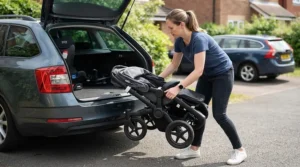
Car boots add a second layer of complexity that width alone doesn’t capture — folded length and height matter just as much, and several reviewers of the Bugaboo Donkey 5 Twin specifically mention needing to remove wheels or dismantle the frame for smaller boots, something worth testing in a showroom before buying rather than discovering on the school run. Public transport adds a third constraint: buses and lifts often have narrower functional space than their stated dimensions suggest once other passengers and pushchairs are already aboard, so Which?’s independent testing consistently flags storage and manoeuvrability as genuine differentiators between double pushchair models rather than marketing fluff. If you’re a regular bus or Tube user, prioritise a narrower tandem over a wider side-by-side even if it means a slightly longer wheelbase to manage.
Buy Newborn Pushchair Online: What to Check Before You Click Buy
Buying a pram for newborn twins online rather than in a showroom saves time but removes your ability to physically test the fold, feel the weight, or check the seat recline in person, so a few extra checks matter more than usual. Always confirm the return policy explicitly covers “doesn’t fit through my door” as a valid reason, since general returns policies sometimes exclude assembled or used pushchairs. Check whether the listing price includes carrycots or car seat adaptors, or whether — as with several models in this guide — they’re sold as costly extras that inflate your real spend well beyond the headline price.
Verify the retailer is a genuine UK-registered seller rather than a marketplace reseller shipping from overseas, since warranty claims and spare parts become considerably harder if something goes wrong with an international purchase. Cross-check the exact model generation, since manufacturers frequently keep a similar name across several product generations (the difference between a “Duett” and “Duett 2,” for instance, is significant in real-world suitability). Finally, read a spread of independent reviews rather than only the retailer’s own product page, since sellers rarely surface the genuine limitations — like a chassis only accepting one bassinet — that matter enormously for twin parents specifically.
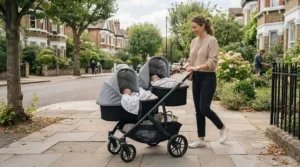
Common Mistakes When Buying a Pram for Newborn Twins
The single most common mistake is assuming “double buggy” automatically means “suitable for newborn twins,” when, as the Hauck Duett 2 example in this guide demonstrates plainly, several genuinely excellent double pushchairs are built for a newborn-and-toddler pairing rather than two babies who both need to lie flat simultaneously. A second frequent error is buying based on folded dimensions alone without checking the built-up width, since a buggy that folds impressively small can still be too wide to push through your actual front door when open.
Underestimating weight is another recurring pitfall — a chassis that feels manageable in a shop, empty, can feel entirely different once loaded with two babies, changing bags and shopping, particularly for parents managing stairs without a lift. Many buyers also skip checking maximum weight limits per seat, then find themselves needing a replacement buggy a full year earlier than expected once twins outgrow a lower 15kg ceiling. Finally, a genuinely common and costly mistake is failing to budget for carrycots or car seat adaptors sold separately — as flagged with the Out n About Nipper Double V5 — which can add £150-£250 to the real cost of “from birth” use that the headline price doesn’t include.
Double Buggy Storage: What Actually Fits Underneath
Double buggy storage is one of the most under-discussed features until you’re standing in a supermarket car park realising the shopping won’t fit. Side-by-side models generally retain the most generous underseat baskets, since there’s no second seat stacked in front eating into the space; several reviewers of side-by-side models describe genuinely practical basket access even with both seats occupied. Tandem and stacked models tell a different story: as noted with the iCandy Peach 7 Twin, adding a second carrycot in twin mode visibly compresses the storage space beneath, and with models like the Hauck Duett 2, the second seat’s footwell often overlaps directly with what would otherwise be basket space.
Practically, this means families who do a proper weekly shop with the pram in tow should weight their decision towards side-by-side models or invest in a dedicated buggy-mounted shopping bag as a workaround for tandems. It’s also worth checking basket accessibility, not just capacity — some baskets with a rear crossbar or support strut, mentioned by testers of the Baby Jogger City Mini GT2 Double, restrict how easily larger items like nappy boxes can actually be loaded, even when the stated litre capacity looks generous on paper.
Long-Term Cost & Maintenance
The upfront price range for a pram for newborn twins tells only part of the financial story, since ongoing costs and eventual resale value shift the real total cost of ownership considerably. Budget side-by-sides like the Joie Aire Twin carry the lowest purchase price but also the shortest realistic lifespan before wheels, fabric or suspension components show wear, particularly under daily heavy use; premium options like the iCandy Peach 7 Twin and Bugaboo Donkey 5 Twin cost several times more upfront but typically hold stronger resale value on the second-hand market, partly offsetting the initial outlay if you sell once your twins outgrow the buggy.
Maintenance costs also diverge sharply by tyre type: pneumatic tyres, as fitted to the Out n About Nipper Double V5, occasionally need pumping and can, in rare cases, puncture, while foam-filled “forever-air” tyres, as used on the Baby Jogger City Mini GT2 Double, avoid that maintenance entirely at the cost of a slightly firmer ride on rough ground. Fabric replacement is another hidden cost worth checking before purchase — brands offering separately purchasable replacement seat covers, like Hauck and iCandy, extend the practical lifespan of the chassis well beyond what the original fabric would allow if it wore out or stained irreparably.
Safety, Regulations and Compliance for Twin Prams
Every pram or pushchair legally sold in the UK, new or second-hand, must meet the BS EN 1888 safety standard, which covers everything from the safety harness and locking mechanisms to entrapment hazards and structural stability testing. Local authority trading standards guidance confirms this requirement applies equally to new and second-hand prams and pushchairs alike, so a compliance label on the frame or seat pad is worth checking regardless of whether you’re buying new or considering a pre-loved twin buggy to save money.
Beyond the legal minimum, twin-specific safety habits matter: always use the parking brake fully when stationary, since a two-child load creates more momentum on a slope than a single buggy carries, and check both harnesses independently at every nappy change rather than assuming one adjustment covers both seats. For models with independently reclining seats, confirm the recline locks securely in the flat position before leaving a newborn unattended even briefly, since a seat that slips from flat to a slight incline mid-nap isn’t something you’ll necessarily notice immediately with two babies to manage at once.
Frequently Asked Questions
❓ Can one pram really work for newborn twins from day one?
❓ Is a side-by-side or tandem pram better for twins?
❓ How much does a pram for newborn twins cost in the UK?
❓ Do twin prams need two separate carrycots?
❓ Will a twin pram fit through a standard UK doorway?
Conclusion
There’s no single best pram for newborn twins, only the best one for your doorway, your car boot, your budget and the terrain you’ll actually walk every day. What genuinely separates a good choice from a regretted one isn’t brand prestige, it’s whether both seats truly lie flat from birth, whether the width clears your home’s narrowest point, and whether you’ve budgeted honestly for carrycots or adaptors that aren’t always included in the headline price. The Joie Aire Twin and Ickle Bubba Venus Prime Double prove that genuine newborn-ready twin buggies exist well under £500, while the iCandy Peach 7 Twin and Bugaboo Donkey 5 Twin show what several extra years of durability and capacity buy at the premium end.
Take the width of your front door, the size of your car boot and your realistic weekly terrain, match them against the seven models above, and you’ll land on a pram that earns its keep for years rather than months. Whichever you choose, prioritise the models here that are honestly built for two newborns simultaneously — the Hauck Duett 2‘s explicit “not for newborn twins” label in this guide is exactly the kind of detail worth reading twice before you commit.
✨ Don’t Miss These Exclusive Deals!
🔍 Take your search for the right double pram to the next level with the carefully researched picks above. Click through on any highlighted model to check current pricing and availability before stock runs low. These prams will help you build calm, confident days out with your newborn twins!
Recommended for You
- Best Carrycot Pushchair UK 2026: 7 Expert-Reviewed Picks
- Pushchair for Newborn: 7 Best Buys Tested ; Ranked (2026)
- Beach Stroller Sand Wheels: 7 Best UK Picks for 2026
Disclaimer: This article contains affiliate links. As an Amazon Associate, I earn from qualifying purchases. If you purchase products through these links, we may earn a small commission at no additional cost to you.
✨ Found this helpful? Share it with your friends! 💬🤗
