
In This Article
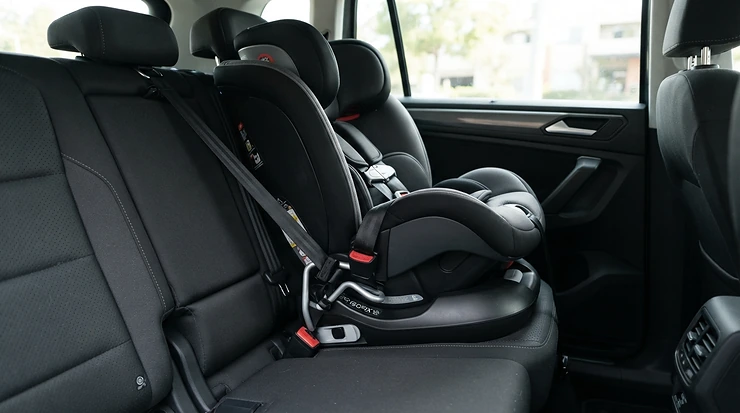
A baby car seat with isofix base is a rear-facing infant carrier that clicks into a separate frame locked straight onto your car’s built-in metal anchor points. Because the base stays put, you only click the carrier in and out. That trims fitting errors, speeds up every journey and keeps the seat braced firmly against the vehicle’s structure.
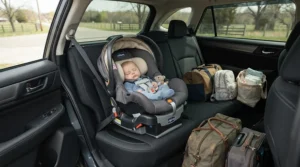
Sounds simple. It is, right up until you stand in a shop staring at forty near-identical shells, each promising to be the safest thing since the seatbelt.
Here’s the useful bit: the law is short. Under UK car seat law, a child must use an approved seat until they turn 12 or reach 135cm. Height-based i-Size seats must face backwards until the child is over 15 months old. Everything else (the base, the swivel, the recline, the price tag) is about making that seat easier to fit correctly and nicer to live with at 6 a.m. on the school run.
This guide compares seven real seats that are currently sold, from the lightest carrier to a four-year rear-facing workhorse. It also tackles two questions parents keep asking: the isofix vs belt-fitted baby car seat debate, and which rear-facing baby car seat for long journeys will make a three-hour drive to the grandparents bearable.
One transparency note first. This article draws on published crash-test results, manufacturer specifications and aggregated parent reviews, not hands-on testing. Prices are ranges at the time of research and they move, so check current price before you buy.
Quick Comparison: Baby Car Seat With Isofix Base at a Glance
Seven seats, three camps. Infant carriers that click onto a base, a baseless carrier with Isofix built in, and bigger rear-facing seats with the base permanently attached.
| Seat | Type | Fitting | Best For |
|---|---|---|---|
| Maxi-Cosi Pebble 360 Pro² | Infant carrier + swivel base | Isofix base or seatbelt | Newborn comfort, lie-flat |
| Cybex Cloud T i-Size | Infant carrier + base | Isofix base or seatbelt | Crash-test scores, recline |
| Cosatto Acorn 2 | Infant carrier + base | Isofix base or seatbelt | Light carrying, road trips |
| Nuna Pipa Urbn | Baseless infant carrier | Built-in Isofix, belt or both | Lowest weight, second cars |
| Joie i-Spin 360 i-Size | Rear-facing seat, integrated base | Isofix only | Mid-budget extended rear-facing |
| Britax Römer Dualfix Plus i-Size | Rear-facing seat, integrated base | Isofix | Space, recline, long rear-facing |
| Graco Turn2Me DLX i-Size | Rear-facing seat, integrated base | Isofix | Tight budgets |
Looking at the table, the first four are “carrier” seats that last roughly 12 to 15 months, while the last three can stay rear-facing to around age four. If you plan to carry a sleeping baby from car to house, a carrier like the Cosatto Acorn 2 wins on practicality. If you want one purchase to cover the whole rear-facing stage, the Joie i-Spin 360 i-Size or Graco Turn2Me DLX i-Size is the better long-term bet.
💬 Just one click — help others make better buying decisions too!😊
Top 7 Baby Car Seat With Isofix Base Options: Expert Analysis
Every seat below is a real, currently sold model. Each is judged on what the specs mean in practice, on published test data, and on the themes that keep surfacing in parent reviews.
1. Maxi-Cosi Pebble 360 Pro² — swivel base and full lie-flat comfort
The headline trick is the swivel. On its FamilyFix 360 Pro base, the seat turns towards the door and slides out to meet you, so you aren’t folding yourself into the footwell with a baby on one arm.
The Maxi-Cosi Pebble 360 Pro² is an i-Size carrier for babies from 40cm up to 87cm or about 13kg, and it weighs 4.7kg without the base. That is a manageable lift for most adults. The full lie-flat position keeps a very young baby less scrunched, both in the car and on compatible pushchair chassis.
Here’s what to weigh: the base is the star. It lights up and sounds an alert if the support leg works loose, which matters more than any marketing gloss. The same base also accepts Maxi-Cosi’s next-stage Pearl Pro², spreading its cost across roughly four years of rear-facing. The base is bulky, so taller drivers may need it behind the passenger seat. Its ADAC rating is Good (2.2), where lower is better. That is the least flattering score of this seven, but still comfortably in the “good” band.
Mumsnet parent testers and forum posters repeatedly praise the swivel and the recline on longer drives. The recurring grumbles are a small built-in canopy and the separate cost of the base.
Pros:
- ✅ Swivel base eases awkward parking-space loading
- ✅ Full lie-flat position, in car and on pushchair
- ✅ Base alerts you if the support leg loosens
Cons:
- ❌ Base is sold separately and costs extra
- ❌ Built-in canopy runs small
The base alone is around £220, and seat plus base typically lands in the £450–£600 range at the time of research. It’s a premium buy that makes most sense if you’ll reuse the base for the next-stage seat.
2. Cybex Cloud T i-Size — lie-flat hinge and standout crash scores
The clever bit hides at the hip. A recline hinge flattens the back and leg support together, so a dozing baby ends up in a gentler, flatter position rather than a slump.
The Cybex Cloud T i-Size covers babies from 45cm to 87cm and weighs 4.5kg. It rotates 180° on its T base, which is enough to face the door. It also has 12 headrest positions that raise the harness with them, so there’s no rethreading as your baby grows.
Based on the published figures, this is the strongest crash performer of the seven. Mumsnet reports an ADAC result of 1.7 overall, with a safety sub-score of 1.3 on the T base, plus a five-star safety result in Which? testing. The catch is manual side-impact protection. You must flick it out before every journey, and that’s exactly the kind of step that gets forgotten when you’re running late. The base also takes Cybex’s next-stage Sirona T i-Size, which keeps your child rear-facing to around age four.
Mumsnet forum posters describe babies looking cosy in it and say it moves between two cars without drama. Weight is the one repeated note.
Pros:
- ✅ Excellent published crash-test results
- ✅ Hip-hinge recline suits sleepy passengers
- ✅ Base carries over to the next-stage seat
Cons:
- ❌ Base is sold separately and pricey
- ❌ Side-impact protection must be deployed manually
Seat and base are each around £200, so roughly £400 combined at the time of research. Dearer than most carriers, but the spend buys the strongest crash data of the seven.
3. Cosatto Acorn 2 — featherweight carrier made for road trips
At 4kg, this is the carrier you can lift one-handed while the other hand wrangles a changing bag and a front-door key.
The Cosatto Acorn 2 suits babies from 40cm to 87cm (up to 13kg, around 15 months) and comes with a newborn nest. The harness and headrest move together with one hand, and the UPF 100+ canopy adjusts for sunny motorways. In practice that means fewer fiddly adjustments mid-lay-by and less glare on your passenger.
It scores a Good 1.9 from ADAC. You can fit it with a seatbelt or on an Isofix base, either the standard version at around £150 or the rotating one at around £200. The weakness is the lack of recline positions, so baby stays at a fixed angle, which makes the break schedule on long drives matter even more. The rotating base cannot be reused for a toddler seat, so treat it as a 15-month commitment.
Mumsnet’s parent tester found installation straightforward and reassuring thanks to audible clicks and visual indicators. Mumsnet singles the seat out for long-distance travel because it’s so light, while noting the extra cost of the base.
Pros:
- ✅ Genuinely light at 4kg
- ✅ Good ADAC score of 1.9
- ✅ One-hand harness and headrest adjustment
Cons:
- ❌ No recline positions at all
- ❌ Base cannot be reused for next stage
The seat is around £200, and with a base the total is roughly £350–£400. A fair price for a light, well-rated carrier, provided you accept the fixed angle.
4. Nuna Pipa Urbn — baseless Isofix built into the seat
Strictly speaking, this is the rebel of the list: no separate base at all. Rigid Isofix latches live inside the seat and clip straight onto your car’s anchor points.
The Nuna Pipa Urbn weighs just 3.3kg and covers babies from 40cm to 75cm, up to about 13kg. It can be fitted by Isofix, by seatbelt, or by both together. That makes it handy for a second car, the grandparents’ car, or a taxi with Isofix points. Mumsnet also notes it is TÜV certified for aircraft use.
It earns a 1.6 from ADAC, the best score here. The trade-off is that there’s no permanent base, so you repeat the fitting every time you move it between cars. It’s quick, but it brings back a little of the human-error risk that a permanently installed base removes. Recline options are limited too. Mumsnet’s parent tester felt her baby sat more hunched than in a recline-friendly seat, which matters on longer trips.
Reviewers praise the low weight and compact footprint, which frees up rear-seat space. Their main complaints are posture and the lack of recline.
Pros:
- ✅ Lightest seat here at 3.3kg
- ✅ Best ADAC score of the seven (1.6)
- ✅ Fits by Isofix, seatbelt or both
Cons:
- ❌ Limited recline for longer journeys
- ❌ Outgrown at around 75cm or 13kg
Typical pricing is around £300 at the time of research. That’s a premium for a roughly 15-month seat, but you’re paying for no-base convenience across multiple cars.
5. Joie i-Spin 360 i-Size — extended rear-facing without the premium price
One seat from birth to roughly four years means no second purchase when your baby outgrows a carrier.
The Joie i-Spin 360 i-Size covers 40cm to 105cm or 18kg, rotates 360° and has an integrated Isofix base. It offers six recline positions, including lie-flat, and a lock that stops the seat being turned forward-facing too early. At 13.9kg in total, it is a car-resident seat, not something you’ll carry about.
ADAC rates it Good (1.8). Green indicators confirm correct installation, and the support leg has 19 positions so it can be tailored to your car, though some reviewers find that fiddly. Which? lists it as Isofix-only, so check the vehicle fit list before buying.
Mumsnet’s parent testers and forum posters describe it as comfy, with children dropping off to sleep on long journeys. The recurring negatives are the fiddly leg adjustment and the weight.
Pros:
- ✅ Rear-facing up to around four years
- ✅ Green indicators confirm correct fitting
- ✅ Six recline positions including lie-flat
Cons:
- ❌ Support leg adjustment can be fiddly
- ❌ Too heavy to swap between cars
Retail pricing spans roughly £175–£300 at the time of research, depending on retailer and colour. Strong value among extended rear-facing seats.
6. Britax Römer Dualfix Plus i-Size — roomiest rear-facing cocoon
Big wings, big shell, big personality. Think of it as a rear-facing armchair.
The Britax Römer Dualfix Plus i-Size covers 40cm to 105cm or 20kg, with a newborn insert, a 360° swivel and 12 recline positions. It weighs 15kg. The generous recline range suits long journeys, and the deep side wings give a cocooning effect in a side impact. ADAC rates it Good (2.1).
The trade-offs are real. It is a large seat that can crowd smaller cars, and Mumsnet describes the installation as tricky. It isn’t travel-system compatible either, so a sleeping baby gets woken at your destination. Its integrated Isofix base with support leg does make the initial fitting straightforward once you’ve done it, and the harness adjusts with one hand.
Parents on forums cite the safety rating and the swivel as the reasons they chose it, and one notes their son rode rear-facing until four.
Pros:
- ✅ Twelve recline positions for sleepers
- ✅ Deep side wings and Good ADAC 2.1
- ✅ Rear-facing up to 105cm or 20kg
Cons:
- ❌ Huge and heavy at 15kg
- ❌ Installation can be tricky
Expect roughly £260–£375 across retailers at the time of research. Worth it for larger cars and families who want maximum rear-facing time.
7. Graco Turn2Me DLX i-Size — rotating rear-facing on a budget
Proof that rotating seats aren’t only for premium wallets.
The Graco Turn2Me DLX i-Size covers 40cm to 105cm and weighs 13.4kg with its base. It rotates 360° with spin buttons on both sides and offers ten recline positions, five rear-facing and five forward-facing. Colour-coded Isofix indicators, an anti-rebound bar and a no-rethread five-point harness round out the spec. In practice that means quicker daily adjustments and fewer first-time fitting worries.
Mumsnet’s testers scored it 86 out of 100 and named it their best budget pick. The downsides are a side-impact pod that has to be fitted each time and a spin lock that can occasionally stick. The padding is less plush than pricier rivals. I couldn’t find a published ADAC score in the sources used here, so check independent test data before buying.
Testers praised the straightforward installation and clear indicators, and the sticky spin lock is the main criticism.
Pros:
- ✅ Rear-facing up to around four years
- ✅ Clear colour-coded Isofix indicators
- ✅ Ten recline options across both directions
Cons:
- ❌ Side-impact pod must be refitted each time
- ❌ Spin lock can occasionally stick
Pricing sits at roughly £130–£170 at the time of research. Remarkable value if the fit suits your car.
Head-to-Head Specs: Which Baby Car Seat With Isofix Base Wins Where?
| Seat | Weight | Rear-facing to | ADAC (lower is better) | Rotation | Price band | Best For |
|---|---|---|---|---|---|---|
| Maxi-Cosi Pebble 360 Pro² | 4.7kg | 87cm / 13kg | 2.2 | 360° on base | £450–£600 with base | Newborn comfort |
| Cybex Cloud T i-Size | 4.5kg | 87cm | 1.7 | 180° on base | Around £400 with base | Crash scores |
| Cosatto Acorn 2 | 4kg | 87cm / 13kg | 1.9 | Optional rotating base | £350–£400 with base | Light carrying |
| Nuna Pipa Urbn | 3.3kg | 75cm / 13kg | 1.6 | None | Around £300 | Second cars |
| Joie i-Spin 360 i-Size | 13.9kg | 105cm / 18kg | 1.8 | 360° | £175–£300 | Mid-budget rear-facing |
| Britax Römer Dualfix Plus i-Size | 15kg | 105cm / 20kg | 2.1 | 360° | £260–£375 | Space and recline |
| Graco Turn2Me DLX i-Size | 13.4kg | 105cm | Not found | 360° | £130–£170 | Tight budgets |
Read the table in two halves. For crash data, the Nuna Pipa Urbn and Cybex Cloud T i-Size lead, while the Maxi-Cosi Pebble 360 Pro² trails slightly but still scores Good. For lifespan per pound, the three heavier seats win comfortably. The Graco Turn2Me DLX i-Size costs about a third of the Cybex Cloud T i-Size with its base, yet it can stay rear-facing years longer. The trade-off is that you give up the carry-in-the-house convenience.
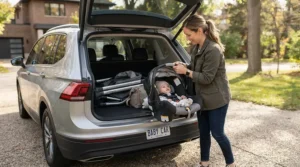
Fitting Your Isofix Base: A Practical Step-by-Step Guide
A perfect seat fitted badly is a bad seat. Here’s the routine that Amazon listings never spell out.
- Check the vehicle fit list. Look up your car and seat position in the manufacturer’s list before you buy. Some car features make a seat incompatible.
- Find the anchors. Isofix points sit in the gap between the seat back and cushion, often marked with small tags. Your handbook will confirm.
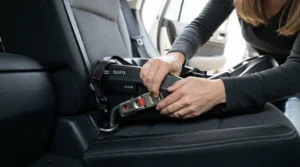
- Click the base in. Extend the connectors and push until both click and the indicators turn green.
- Deploy the support leg or top tether. Follow the manual. Check the floor beneath isn’t a hollow storage compartment unless your car’s fit list allows it.
- Click the carrier on. Listen for the click, then give it an upward tug.
- Set the harness. You shouldn’t be able to pinch spare strap at the shoulder. Take off bulky coats first.
- Recheck regularly. Look at the indicators each time, especially after moving the seat between cars.
The common first-30-day mistakes are forgetting to deploy side-impact protection on the Cybex Cloud T i-Size, trusting an old fit after the car has been valeted, and leaving a sleeping baby in the seat after you arrive.
Real-World Scenarios: Three Families, Three Seats
The city flat, one car, lots of stairs. A family on a budget of £350–£400 makes around 20 short trips a week and carries the baby up two flights. The Cosatto Acorn 2 at 4kg with the standard base is the sensible match. If a second car or relatives’ lifts enter the picture, the Nuna Pipa Urbn and its no-base fitting are worth the extra money.
The monthly three-hour motorway run. One car, grandparents far away, and the baby sleeps best when slightly reclined. The Joie i-Spin 360 i-Size at roughly £250 gives six recline positions and years of rear-facing. The stop schedule matters as much as the seat, which we cover below.
The tight budget with a roomy car. A £150 ceiling points to the Graco Turn2Me DLX i-Size. If the budget stretches and the car is an estate, the Britax Römer Dualfix Plus i-Size offers the deepest wings and the most recline options. Measure boot-to-seat clearance first, because these seats are big.
✨ Ready to Check Your Options?
🔍 Take your baby’s first journeys to the next level with these carefully selected seats. Click on any highlighted product to check current pricing and availability. Match the seat to your car, your budget and your journeys, and you’ll travel with far more confidence!
Problem → Solution: Fixing the Most Common Isofix Headaches
Problem: the indicator won’t turn green. Remove anything wedged between the seat cushion and back, such as folded buckles or crumbs, then re-seat the connectors. If it still refuses, recheck the fit list and ask the retailer. Don’t drive until the indicator confirms a correct fit.
Problem: baby’s head slumps forward. Check the recline setting, the newborn insert and the harness height against the manual. Seats with more recline, like the Britax Römer Dualfix Plus i-Size or the Joie i-Spin 360 i-Size, give more room to adjust.
Problem: the base takes up too much legroom. Try the seat behind the passenger side. The Maxi-Cosi Pebble 360 Pro² base in particular benefits from that placement for taller drivers.
Problem: you only have one seating position that fits. Never fit a rear-facing seat in a front seat with an active airbag. Deactivate the airbag first, as the law requires.
Isofix vs Belt-Fitted Baby Car Seat: What the Evidence Says
Both methods can protect a child. The difference is how often each gets done right.
Which? explains that a true i-Size seat uses only Isofix connectors, although some baby seats can still be belted. Because Isofix gives you indicators and a click, it removes much of the guesswork. One motoring publication quotes figures suggesting around 96% of Isofix installs are correct versus roughly 30% of belted ones. Treat that as an indication rather than gospel, but it fits what fitters say: a belted seat that is fitted perfectly is just as safe, whereas Isofix simply makes perfect more likely.
Isofix isn’t universal. All new cars have been required to carry anchor points since 2013, and one motoring site estimates around 60% of cars on the road have them. Older cars may only suit belted seats.
| Factor | Isofix base system | Belt-fitted baby car seat |
|---|---|---|
| Fitting errors | Lower, with click-in indicators | Higher, from twisted or slack belts |
| Fitting speed | Quick once the base is in | Slower, belt routing each time |
| Car compatibility | Needs anchors and a fit-list match | Works in most cars with a suitable belt |
| Moving between cars | Needs a second base or refitting | Carrier moves easily once you know the routing |
| Cost | Base often adds around £150–£220 | Usually cheaper upfront |
| Best For | Maxi-Cosi Pebble 360 Pro² and Cybex Cloud T i-Size on their bases | Older cars; Maxi-Cosi Pebble 360 Pro², Cybex Cloud T i-Size and Cosatto Acorn 2 can all be belted |
Looking at the comparison, Isofix wins on consistency and speed, while belt fitting wins on flexibility and upfront cost. If your car has anchors, the isofix vs belt-fitted baby car seat choice leans towards Isofix because the daily margin for error is smaller. If you regularly swap cars or drive an older model, a belted fit done carefully remains a perfectly safe route.
How to Choose a Baby Car Seat With Isofix Base
- Check your car first. Use the manufacturer’s vehicle fit list for your exact model and seating position. A great seat that doesn’t fit your car is a waste.
- Decide carrier or extended rear-facing. Carriers last roughly 12–15 months but let you carry a sleeping baby. Extended rear-facing seats last to around four years but stay in the car.
- Compare crash data. Check Which? results and ADAC scores, remembering that lower ADAC numbers are better and that not every seat has been tested.
- Weigh the carry. If you’ll lift the seat daily, 3.3kg to 4.7kg is very different from 13kg-plus.
- Count the base cost. Some bases are reusable with the next stage, spreading the cost. Others, like the Cosatto Acorn 2 rotating base, are not.
- Check the footprint. Big seats like the Britax Römer Dualfix Plus i-Size need space, especially for taller drivers.
- Match the budget to the lifespan. A £150 seat used for four years can beat a £400 seat used for 15 months on cost per month.
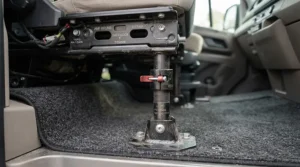
Rear-Facing Baby Car Seat for Long Journeys: What Actually Helps
A rear-facing baby car seat for long journeys needs two things: the right angle and a sensible break schedule.
First, the law. Height-based seats must face backwards until a child is over 15 months, and Which? points to crash tests showing extended rear-facing is safer. That’s why seats such as the Joie i-Spin 360 i-Size, Britax Römer Dualfix Plus i-Size and Graco Turn2Me DLX i-Size appeal to families who drive a lot.
Second, time in the seat. Guidance widely repeated by NHS trusts and manufacturers is not to keep a baby in a car seat for more than two hours at a time. The Lullaby Trust’s car seat factsheet covers the reasoning, which centres on the curled position and the effect on a young baby’s breathing. Mumsnet notes that two hours isn’t a legal rule, and that very young babies are advised shorter spells. So build your trip around the baby, not the satnav.
Practical tips:
- Add a stop at least every two hours, which also suits the Highway Code’s advice to break every two hours of driving.
- Choose a seat with recline, such as the Maxi-Cosi Pebble 360 Pro², Cybex Cloud T i-Size or Joie i-Spin 360 i-Size, to avoid slumping.
- Have a second adult sit in the back where possible.
- Take baby out of the seat the moment you arrive. A sleeping baby should move to a firm, flat surface.
Features That Actually Matter (And Those That Don’t)
Matter: crash-test results, easy-to-read installation indicators, a support leg or top tether, adequate recline, and an adjustable harness that doesn’t need rethreading. These affect safety and daily use every time you drive.
Matter somewhat: swivel and carry weight. A swivel genuinely reduces back strain, but it’s a convenience, not a safety feature. The Maxi-Cosi Pebble 360 Pro² and Graco Turn2Me DLX i-Size both illustrate how swivel is now available across price brackets.
Don’t matter much: colour schemes, designer collaborations and fabric names. A fancy canopy won’t change the outcome of a crash, though a good one, like the Cosatto Acorn 2‘s UPF 100+ sunshade, helps on summer drives.
Watch for hidden costs: bases sold separately, adapters for pushchairs, and side-impact protection that needs manual deployment. Reading the box contents against your budget saves surprises.
Common Mistakes When Buying a Baby Car Seat With Isofix Base
Buying before checking the car. The fit list matters more than the brand. Check seat position, not just model.
Forgetting the base is extra. Several seats here, including the Maxi-Cosi Pebble 360 Pro² and Cybex Cloud T i-Size, are quoted without the base, which can add roughly £150–£220.
Overvaluing newborn comfort over lifespan. A carrier lasts around a year, but a seat like the Joie i-Spin 360 i-Size can last four. Weigh the convenience against the cost.
Ignoring weight. A 15kg Britax Römer Dualfix Plus i-Size is a fixture, not a carrier.
Buying second-hand. Mumsnet reports car seat experts generally advise against it, because you can’t verify the seat’s crash history. Replace any seat after an accident.
Skipping the recheck. Indicators are a help, not a guarantee. Look at them every journey.
Long-Term Cost & Maintenance
Here’s an illustrative bit of maths using round numbers. A £400 seat-and-base combination used for 15 months works out at about £27 a month. A £300 extended rear-facing seat used for four years comes to about £6 a month. The carrier still has a case, since carrying a sleeping baby indoors has real value, but it’s a cost worth knowing.
Maintenance is simple but non-negotiable. Wash covers according to the manual and keep an eye out for frayed straps. Never use harsh chemicals on the harness. Replace the whole seat after any accident, even if it looks fine. Keep the manual, as you’ll need it for each refit.
Reuse is the hidden saver. The Maxi-Cosi Pebble 360 Pro² and Cybex Cloud T i-Size bases can carry on to next-stage seats from the same brands, whereas the Cosatto Acorn 2 rotating base cannot. Meanwhile the integrated bases on the Joie i-Spin 360 i-Size, Britax Römer Dualfix Plus i-Size and Graco Turn2Me DLX i-Size mean there’s nothing extra to buy for years.
Safety, Law & Compliance Guide
In the UK, children must normally use a child car seat until they reach 12 or 135cm, whichever comes first. You can choose by height or weight, and the approval label tells you which. Height-based seats carry an “E” in a circle with R129. Weight-based seats carry ECE R44. Only approved seats are legal here.
Key rules to remember:
- Height-based i-Size seats must be rear-facing until your child is over 15 months.
- Deactivate any front airbag before fitting a rear-facing seat in the front.
- Never fit a child seat in a side-facing seat.
- Which? reports fines of up to £500 for not using the right seat or belt.
Never use a rear-facing baby seat in the front with an active airbag. NHS maternity guidance repeats this and the two-hour limit, and it links long spells in car seats to breathing difficulties in young babies. When in doubt about fit, ask a qualified child seat adviser or the retailer.

FAQ: Baby Car Seat With Isofix Base
❓ Is a baby car seat with isofix base worth the extra money?
❓ Can I buy a baby car seat with isofix base without the base?
❓ Which rear-facing baby car seat for long journeys has the most recline?
❓ Will an isofix base fit every car?
❓ Can I use a second-hand baby car seat with isofix base?
Conclusion: Choosing Your Baby Car Seat With Isofix Base
There’s no single winner, and anyone who claims otherwise is selling something. The Cybex Cloud T i-Size leads for crash data among the carriers. The Cosatto Acorn 2 and Nuna Pipa Urbn win on weight. The Maxi-Cosi Pebble 360 Pro² wins on newborn comfort and its swivel base.
For families who want one seat to see them through the rear-facing years, the Joie i-Spin 360 i-Size offers the best mix of recline and value, the Graco Turn2Me DLX i-Size is the budget answer, and the Britax Römer Dualfix Plus i-Size is the roomy choice for bigger cars. Whatever you pick, a baby car seat with isofix base only protects your child if it’s genuinely compatible with your car and correctly fitted every time.
Check your vehicle’s fit list, check the current price, and recheck the indicators before every journey. If you do just those three things, you’re ahead of most parents.
Recommended for You
- I-Size Infant Car Seat: 7 Best Picks For UK Parents (2026)
- Baby Car Seat That Fits Pushchair: 7 Essential Picks (2026)
- Value Pushchair For Newborn: 7 Smart Budget Picks (2026)
Disclaimer: This article contains affiliate links. As an Amazon Associate, I earn from qualifying purchases. If you purchase products through these links, we may earn a small commission at no additional cost to you.
✨ Found this helpful? Share it with your friends! 💬🤗
