
In This Article
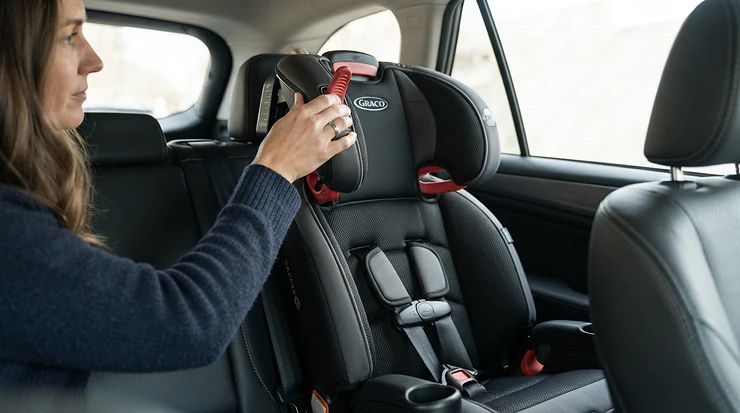
A group 2-3 car seat with isofix is a forward-facing, high-back booster for children of roughly 3 to 12 years (about 100–150cm). Its ISOFIX connectors click onto anchor points in the car, so the empty seat stays put. The adult seat belt, routed through guides on the seat, does the actual restraining.

That one sentence hides a surprising amount of drama. Group 2-3 is the stage where harnesses disappear and “I’m a big kid now” negotiations begin. It’s also when parents discover that the seat which looked perfectly reasonable in the shop is somehow wider than the back bench of a hatchback. Add a lanky nine-year-old, or a third child, and shopping gets properly fiddly.
The rules, at least, are simple. UK law says children must use a car seat until they are 12 years old or 135cm tall, whichever comes first. Only EU-approved seats, either R44 (weight-based) or R129 (height-based), are legal. Everything else in this guide is about choosing wisely within those rules.
Here’s the promise. I’ve pulled together real specifications, aggregated review themes from UK parent-testing panels and retailers, and independent ADAC crash-test scores for seven genuine ISOFIX boosters, from budget to premium. There’s no invented testing and no recycled marketing copy. You’ll also find dedicated advice on choosing a group 2-3 car seat for tall children and a group 2-3 car seat for three across, the two situations that cause the most head-scratching. Prices are ranges only, so check current prices on Amazon UK before you buy. 🚗
Quick Comparison: Group 2-3 Car Seat with ISOFIX at a Glance
| Product | Seat width | Fitting | Price range | Best For |
|---|---|---|---|---|
| Cybex Solution B2 i-Fix | ~52cm | ISOFIX | £70–£110 | Tight budgets, second cars |
| Joie i-Traver | 56cm | ISOFIX or belt | Around £135 | Easy fitting, roomy back seats |
| Britax Römer KidFix i-Size | ~48cm | ISOFIX or belt | £150–£200 | Safety-first families |
| Maxi-Cosi RodiFix Pro² i-Size | 44–51cm | ISOFIX or belt | Around £170 | Growing width, three across |
| Cybex Solution T i-Fix | ~50.5cm | ISOFIX or belt | £175–£200 | Sleepy and taller kids |
| Nuna Aace LX | 45–57cm | ISOFIX or belt | Around £220 | Long-term growth |
| Axkid Up | 43.5cm | ISOFIX | Around £400 | Slimmest fit, premium safety |
Looking at the table, the Cybex Solution B2 i-Fix is the cheapest way into ISOFIX, while the Axkid Up is the slimmest by a clear margin. The Joie i-Traver and Nuna Aace LX are the widest at their maximum settings, so they suit roomier back benches. Everything between them trades a little width for a little comfort, and the sections below explain which trade is worth making.
💬 Just one click — help others make better buying decisions too!😊
Top 7 Group 2-3 Car Seat with ISOFIX Options: Expert Analysis
1. Cybex Solution B2 i-Fix — cheapest route to proper ISOFIX
Premium-brand engineering without the premium-brand invoice is the pitch here, and on paper it holds up.
It covers 100–150cm and 15–50kg, so it takes heavier children than the 36kg-capped seats further down this list. Retailer listings put it at around 52cm wide and somewhere between 5kg and 6kg, which makes swapping cars easy but wins no prizes for slimness. Cybex’s Linear Side-impact Protection and a 12-position headrest come as standard. You also get a cup holder, which its cheaper sibling, the B i-Fix, lacks.
Based on the spec comparison, this suits a car with ISOFIX in both outer rear seats and a household watching its pennies. Think second car or grandparent’s wheels, with no compromise on the basics. What it lacks is the reclining headrest of the pricier Solution T i-Fix, so motorway naps may be less cosy.
Verified retailer reviews are thin on the ground. The ones I found praise the easy ISOFIX click-in and generous seat space, but treat that as a small sample, not a consensus.
Pros:
- ✅ Cybex side-impact protection at a budget price
- ✅ Takes children up to 50kg
- ✅ Cup holder included
Cons:
- ❌ Wider than slimline rivals
- ❌ No reclining headrest like the Solution T
Price range: roughly £70–£110 depending on retailer and offers; check current price. Verdict: the best-value ISOFIX entry on this list.
2. Joie i-Traver — most forgiving installation
Fitting errors cause most booster mistakes, and this seat is designed to make them hard to commit.
It’s i-Size approved for 100–150cm and weighs just 5.6kg, so shifting it between cars won’t wreck your back. You fit it with ISOFIX or the car belt, and green-coded belt guides show exactly where the belt goes. Two recline positions and a one-hand, ten-position headrest (adjustable even while installed) add flexibility. Three seat-depth settings give long legs room as growth spurts arrive. Guard Surround Safety panels and memory-foam padding handle side impacts, and the ADAC score is a “good” 1.9 (lower is better).
Here’s what to weigh: at 56cm wide, it’s the broadest seat on this list. That suits a roomy back bench or a two-child family far better than a three-across set-up. The adjustable depth is the feature that matters most for long-legged children.
MadeForMums gives it 4.6 stars. Comfort, easy fitting and competitive pricing are the recurring themes in its review.
Pros:
- ✅ Colour-coded belt guides simplify fitting
- ✅ Adjustable seat depth for growing legs
- ✅ Light at 5.6kg for car swaps
Cons:
- ❌ Widest seat here at 56cm
- ❌ No cup holder
Price range: around £135; check current price. Verdict: strong mid-range value for two-child families.
3. Britax Römer KidFix i-Size — extra protection for the lap belt
Britax’s trick is a small piece of plastic with a big job.
It’s rated for 15–36kg and 100–150cm, weighs 6.7kg, and is listed at around 48cm wide. It fits via ISOFIX or belt but doesn’t recline. The SecureGuard sits between your child’s legs and adds a fourth contact point to the three-point belt. In practice that helps keep the lap belt low across the pelvis, away from the soft abdomen. A foam pad over the chest cushions jerky movement. Its ADAC score of 1.8 is the best listed in this group, though all seven land in the “good” band. A closely related KidFix M i-Size variant, listed at 44cm wide, was one of the seats What Car used in its three-child-seat tests.
On paper, this is the seat for parents nervous about leaving the harness behind. The 36kg ceiling is the catch for a heavier, taller child.
Reviewers at MadeForMums highlight comfort, washable covers and advanced side-impact protection. One parent mentions feeling reassured by the chest and abdomen padding after moving from a harness seat.
Pros:
- ✅ Best ADAC score in this group
- ✅ SecureGuard protects the abdomen
- ✅ Washable covers
Cons:
- ❌ No recline option
- ❌ 36kg cap limits heavier children
Price range: roughly £150–£200; check current price. Verdict: you’re paying for safety engineering, and it shows.
4. Maxi-Cosi RodiFix Pro² i-Size — the seat that widens with your child
Most boosters ask you to pick a width and live with it, but this one stretches.
At 15–36kg and 100–150cm, it weighs 6.24kg and spans 44–51cm, expanding at the press of a button on the back of the headrest. Three recline positions, G-CELL side-impact protection and an AirProtect headrest cover safety and comfort. ClimaFlow ventilation and Eco-Care fabrics (100% recycled materials) handle temperature and eco-credentials. ISOFIX or belt fitting keeps it flexible.
That narrow starting width is useful for a group 2-3 car seat for three across with a younger child. The widening design means older children don’t feel squeezed. The absence of armrests also helps independent buckling. The 36kg limit is lower than the Cybex alternatives, so check it if you’re raising a tall, sturdy child.
MadeForMums rates it 4.9 stars. Its reviewers describe cushioned covers, a solid structure and comfortable recline options.
Pros:
- ✅ Widens as your child grows
- ✅ Three recline positions
- ✅ Recycled-material covers
Cons:
- ❌ No cup holder
- ❌ 36kg limit, below the Cybex 50kg
Price range: around £170; check current price. Verdict: a clever, comfortable all-rounder.
5. Cybex Solution T i-Fix — the reclining headrest for sleepy passengers
Nobody warns you about “danger naps” until the first long drive with a four-year-old.
The patented three-position reclining headrest tilts the head back slightly to stop it flopping forward. The seat covers 100–150cm and 15–50kg, with 12 headrest heights adjusted one-handed (width adjusts automatically). It weighs 7.2kg and measures around 50.5cm wide. Cybex says the ISOFIX arms can be stowed for belt-only fitting. It also says the Solution T i-Fix was an ADAC test winner in its category in October 2023.
My reading is that the 50kg ceiling matters most here: it’s one of the few mid-priced seats with real headroom for a heavier child. At over 7kg it’s less happy being swapped between cars, and the cup holder is a separate purchase.
MadeForMums rates it 4.4 stars, praising one-hand adjustment, the tilting headrest and washable covers. Its reviewer’s child fell asleep in it regularly, which is the intended effect.
Pros:
- ✅ Reclining headrest supports sleeping heads
- ✅ Up to 50kg weight limit
- ✅ One-hand height and width adjustment
Cons:
- ❌ Cup holder sold separately
- ❌ Heavy for frequent car swaps
Price range: around £175–£200; check current price. Verdict: a premium-feeling seat for families who drive long distances.
6. Nuna Aace LX — grows in three directions
Most seats grow upwards, but this one adds width and depth too.
Nuna’s 3D growth system covers 100–150cm, with 17 headrest positions and a width range of 45–57cm. It also offers adjustable seat depth up to 70cm overall. ISOFIX or belt fitting, a 6.7kg weight, detachable side-impact pods and EPP foam complete the picture. A cup holder is included, the ADAC score is 1.9, and the headrest reaches 85cm, the highest in this group. Machine-washable covers are a plus.
The spec sheet says this is the seat for a group 2-3 car seat for tall children, because seat depth stretches to support long legs and the shoulders get plenty of room. The compromise is size: at its widest setting it needs a bigger back seat, and there are no armrests.
MadeForMums gives it 4.9 stars, praising the easy ISOFIX fitting, the intuitive belt guides and the “grows with the child” design.
Pros:
- ✅ Seat depth, width and height all adjust
- ✅ Cup holder included
- ✅ Tallest headrest range listed
Cons:
- ❌ Pricey for a booster
- ❌ Needs a roomy back bench at widest
Price range: around £220; check current price. Verdict: expensive, but it’s the seat that fits the child at 5 and at 11.
7. Axkid Up — the slimmest premium option
If budget isn’t the main constraint, this is the engineering showpiece.
At 43.5cm wide, it’s the slimmest seat on this list. It’s rated for 15–50kg and 100–150cm, with a patented raisable seat that keeps the belt in the right position as your child grows. An ISOFIX base with a built-in support leg adds stability. It folds, which helps storage and holiday travel, and it weighs 9.55kg. A leg rest and cup holder are included. The ADAC score is 2.0.
There’s a catch worth flagging: the Axkid Up is listed as ISOFIX-only. In many cars the centre seat has no ISOFIX anchors, so it works best in outer positions or in cars with three ISOFIX points. It’s also the heaviest seat here, so it’s one to install and leave.
MadeForMums rates it 4.7 stars, calling it comfortable, well built and easy to fold. Its main criticisms are the price and the limited seat padding.
Pros:
- ✅ Slimmest fit at 43.5cm
- ✅ Foldable with leg rest and cup holder
- ✅ Takes children up to 50kg
Cons:
- ❌ Expensive
- ❌ ISOFIX-only, so needs the right seat position
Price range: around £400; check current price. Verdict: pricey, but nothing else here is this slim and sturdy.
Head-to-Head: Specs, Weights and Value
| Product | Height range | Seat weight | Weight limit | ADAC score | Price range | Best For |
|---|---|---|---|---|---|---|
| Cybex Solution B2 i-Fix | 100–150cm | ~5–6kg | 15–50kg | Not listed | £70–£110 | Budget |
| Joie i-Traver | 100–150cm | 5.6kg | See manual | 1.9 | ~£135 | Easy fitting |
| Britax Römer KidFix i-Size | 100–150cm | 6.7kg | 15–36kg | 1.8 | £150–£200 | Crash-test confidence |
| Maxi-Cosi RodiFix Pro² i-Size | 100–150cm | 6.24kg | 15–36kg | 2.1 | ~£170 | Width flexibility |
| Cybex Solution T i-Fix | 100–150cm | 7.2kg | 15–50kg | 2.0 | £175–£200 | Comfort, heavier kids |
| Nuna Aace LX | 100–150cm | 6.7kg | See manual | 1.9 | ~£220 | Growth range |
| Axkid Up | 100–150cm | 9.55kg | 15–50kg | 2.0 | ~£400 | Slimmest fit |
The numbers show a tight cluster: every seat is in the “good” ADAC band, and the gap between 1.8 and 2.1 is small. The KidFix i-Size leads on crash-test score, but the Solution T i-Fix and Axkid Up pull ahead on weight limits. For most families, then, fit (width, weight cap, car compatibility) should decide the purchase, not marginal ADAC differences.
How to Choose a Group 2-3 Car Seat with ISOFIX: 7 Steps
The short answer: check your car first, then the child’s height and weight, then the seat’s width and fitting method. Here’s the order that avoids expensive mistakes.
- Check your car’s ISOFIX points. Look for the anchor points between the seat cushion and backrest, and use the manufacturer’s compatibility list. Not every seat is approved for every position.
- Look for R129 (i-Size) approval. It’s height-based (100–150cm) and includes side-impact testing, so it’s the better modern standard.
- Measure the back bench. Compare the seat’s widest setting with the space available, not the narrowest.
- Check the weight cap. Some seats stop at 36kg, others at 50kg. A tall, sturdy child may outgrow the lower limit first.
- Inspect the belt guides and indicators. Colour-coded belt paths and visual ISOFIX indicators make correct fitting much easier.
- Weigh up portability. If you swap cars often, a 5–6kg seat is kinder than a 9kg one.
- Consider comfort. Recline, ventilation and washable covers matter more on long journeys than a cup holder does.
Group 2-3 Car Seat for Three Across: Making the Maths Work
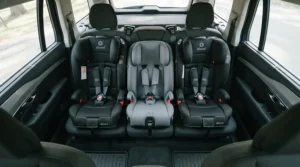
Fitting three children across the back is a puzzle of centimetres. Add the three seat widths, then compare the total with your bench. Seat dimensions are measured at the widest points, and buckle access matters too, because a wide seat can swallow the buckle stalk.
What Car’s three-child-seat test put 16 SUVs and MPVs through the exercise with seats about 44–44.5cm wide. That figure is a good benchmark: seats near 44cm leave room to breathe, while seats above 50cm quickly become a problem.
On that logic, the Axkid Up (43.5cm) and the narrowest setting of the RodiFix Pro² i-Size (44cm) are the strongest candidates. The 48cm KidFix i-Size sits in the middle, and the Joie i-Traver (56cm) and the Cybex Solution B2 i-Fix (52cm) are better in two-child families.
The second puzzle is the ISOFIX points themselves. Most cars have ISOFIX in the two outer rear seats only. The Axkid Up is listed as ISOFIX-only, so it needs an ISOFIX position. Seats that also fit with the belt, such as the RodiFix Pro² i-Size, KidFix i-Size and Solution T i-Fix, are more flexible for the centre seat. Some cars have three ISOFIX points, and carwow’s 2026 list includes the Hyundai Ioniq 9 and Skoda Elroq.
Combining seat types helps too. A slim ISOFIX booster on one side, a belt-fitted seat in the middle and a rear-facing seat on the other side is a common solution.
✨ Don’t Miss These Exclusive Deals!
🔍 Take your search for a group 2-3 car seat with isofix to the next level with these carefully selected seats. Click on any highlighted product name to check current pricing and availability on Amazon UK. The right fit makes every journey calmer for the whole family!
Group 2-3 Car Seat for Tall Children: When Growth Spurts Collide with Safety
Tall children are the best argument for choosing a seat with a high weight cap and generous headroom. R129 boosters cover 100–150cm, but the legal requirement for a child seat ends at 135cm or 12 years, whichever comes first. Which? notes that most children hit the height limit before the age limit, so many never need a booster until 12.
For a group 2-3 car seat for tall children, check three things.
Weight cap first. The KidFix i-Size and RodiFix Pro² i-Size stop at 36kg. The Solution T i-Fix, Solution B2 i-Fix and Axkid Up go to 50kg. That matters for a tall, solidly built child.
Headrest height second. Listed maximum heights are 85cm for the Nuna Aace LX, 83cm for the KidFix i-Size and Axkid Up, 80cm for the Solution T i-Fix and 79cm for the RodiFix Pro² i-Size. These listings aren’t measured on the same basis, so treat them as a guide, not a ruling.
Leg support third. Seat depth adjusts on the Nuna Aace LX and Joie i-Traver, and the Axkid Up has a leg rest. Long legs dangling over the edge are a comfort problem on journeys.
The practical test is the belt position. The shoulder belt should cross the middle of the shoulder, not touch the neck, and the headrest should sit snugly. Cybex says there should be no more than 2cm between the child’s shoulders and the bottom of the headrest. When the belt guide can’t go above the shoulder, it’s time to consider the next stage.
ISOFIX Boosters vs Belt-Only and Backless Alternatives
| Feature | ISOFIX high-back | Belt-only high-back | Backless booster |
|---|---|---|---|
| Side-impact head protection | Yes, wings and headrest | Yes, wings and headrest | None |
| Stable when empty | Yes, ISOFIX anchors | Can slide around | Can slide around |
| Fits cars without ISOFIX | Often, model-dependent | Yes | Yes |
| Typical price range | £70–£400 | £35–£60 | Around £10–£30 |
| Best For | Daily family use | Occasional or travel use | Older, taller children |
The table shows why ISOFIX high-backs dominate the family market: they pair side protection with a seat that doesn’t flop around when empty. Cybex notes that high-back boosters considerably reduce injury risk compared with simple cushions in side impacts. Belt-only models like the Joie i-Trillo or Graco Junior Maxi i-Size are light and cheap, which suits occasional use. Backless boosters have their place only when no better option exists.
Fitting Your Group 2-3 Car Seat with ISOFIX: A First-30-Days Guide
A seat is only as safe as its installation. Here’s a simple routine for the first month.
Day one: read the manual, then check your car’s compatibility list. Push the ISOFIX arms in until the visual indicators show green, then give the seat a firm tug at the base. Colour-coded belt guides (green on the Joie i-Traver and Nuna Aace LX) show the belt path.
Belt routing: the lap belt must sit low across the pelvis, the shoulder belt across the collarbone and chest, and neither should be twisted. Adjust the headrest so the shoulder guide sits at shoulder height.
Week one: check the fit weekly. Seats shift as covers settle, and a child’s clothing changes the belt geometry between summer and winter.
Every couple of months: check headrest height and width, since children grow in bursts. For the Solution T i-Fix or RodiFix Pro² i-Size, widening adjusts automatically or at the press of a button, but check anyway.
Common mistakes in the first month: a belt under the arm, a slack lap belt, ISOFIX arms not fully clicked in, and stowed arms left in place after switching to ISOFIX. Wash covers following the label, and if the seat has been in an accident, replace it. Cybex strongly recommends this for its seats.

Real-World Scenarios: Matching the Right Seat to Your Family
Scenario 1: the two-car family on a budget. You’re a family of four with one car at home and a grandparent’s car for school-run cover. A Cybex Solution B2 i-Fix in the main car and a light Joie i-Traver swapped as needed give ISOFIX stability on a modest budget. Use is daily, so fitting simplicity matters.
Scenario 2: three children in a mid-size hatchback. The bench is narrow and the middle seat has no ISOFIX. A RodiFix Pro² i-Size or KidFix i-Size works best for the middle belt-fitted spot. An Axkid Up can take an outer ISOFIX position if the budget allows. Measure everything first, daily.
Scenario 3: a tall eight-year-old on long motorway trips. Say your child is around 130cm and heavy for their age, with a weekly 200-mile drive. The Solution T i-Fix (50kg limit, reclining headrest) or Nuna Aace LX (adjustable depth) is the logical match. Comfort and weight cap outrank price here.
Features That Actually Matter (And Those That Don’t)
Features that matter: proper side-impact protection, sensible belt-guide geometry, ISOFIX indicators that confirm correct fitting, a generous headrest range and a width that fits your car. A reasonable weight cap matters if your child is tall or sturdy.
Features that matter less: cup holders are nice, but you can buy one separately. “Premium” fabrics help with temperature but don’t change crash performance, and neither do colour names. ADAC scores are useful, but the gap between 1.8 and 2.1 is small when every seat sits in the “good” band.
What to treat with care: marketing claims about injury reduction percentages. They typically compare a seat with and without a specific feature, not with rival seats. Use them as a feature guide, not a league table.
Long-Term Cost: What a Group 2-3 Car Seat with ISOFIX Really Costs per Year
| Product | Price range | Approx. cost per year (8 years) | Best For |
|---|---|---|---|
| Cybex Solution B2 i-Fix | £70–£110 | ~£9–£14 | Lowest cost of entry |
| Joie i-Traver | ~£135 | ~£17 | Mid-range value |
| Maxi-Cosi RodiFix Pro² i-Size | ~£170 | ~£21 | Balanced all-rounder |
| Cybex Solution T i-Fix | £175–£200 | ~£22–£25 | Comfort over long drives |
| Nuna Aace LX | ~£220 | ~£27 | Long growth range |
| Axkid Up | ~£400 | ~£50 | Premium slim fit |
The figures assume use from around age 4 to 12, and the maths is simple division of the price range. The cheapest seat costs the price of a couple of coffees a month over its life. If a more adjustable seat means you never need to replace it early, the premium end narrows the gap. Cybex says the Solution T i-Fix can last nine years, which makes it good value at the mid-£100s to £200 range.
Maintenance costs are minimal: wash covers occasionally, check the fit and replace after any accident.
Safety and Regulations: R44, R129 and UK Law
Two approval standards run in parallel. R44 is weight-based, with Group 2 at 15–25kg and Group 3 at 22–36kg. R129 (i-Size) is height-based, covers 100–150cm for boosters and adds side-impact testing. Both are legal, but most new seats follow R129. Only EU-approved seats can be used in the UK, and the label should show a capital “E” in a circle with either “ECE R44” or “R129”.
The Child Car Seats law guide confirms children aged 3 and over must use the correct restraint until 135cm or 12 years. It also covers the “no room for a third child seat” exception: if two occupied child seats are in the rear and there’s no space for a third, a child over 3 can use the adult belt. That’s a legal fallback, not a safety recommendation, and I’m not a lawyer, so check the current rules for your situation.
Rear seats are generally the safest place for children. If your child’s seat is in the front, check the airbag guidance in your car’s handbook.

FAQ: Group 2-3 Car Seat with ISOFIX
❓ Can I fit a group 2-3 car seat with isofix in a car with no ISOFIX points?
❓ Is ISOFIX safer than a seat belt for a booster?
❓ How long will a group 2-3 car seat for tall children last?
❓ Can a group 2-3 car seat for three across work in a small family car?
❓ Do I need a new booster after a minor bump?
Conclusion: Choosing the Right Group 2-3 Car Seat with ISOFIX
Choosing a group 2-3 car seat with isofix comes down to three questions: does it fit your car, does it fit your child and does it fit your budget?
If money is tight, the Cybex Solution B2 i-Fix is the sensible entry point. For easy fitting in a roomy car, the Joie i-Traver earns its place, and the KidFix i-Size is the pick for families who want the strongest crash-test score. The RodiFix Pro² i-Size is the flexible all-rounder for growing children. For a group 2-3 car seat for tall children, the Solution T i-Fix and Nuna Aace LX have the headroom, with the Nuna Aace LX also offering adjustable seat depth. For a group 2-3 car seat for three across, the Axkid Up is the slimmest option, provided you have the ISOFIX positions for it.
Whatever you choose, measure twice, fit carefully and recheck as your child grows. A well-fitted seat in the right position beats an expensive seat used badly.
Recommended for You
- High-Back Booster Seat: 7 Best Lightweight Picks For UK (2026)
- Group 1-2-3 Car Seat: 7 Best Picks For UK Families (2026)
- Extended Rear-Facing Car Seat: 7 Essential UK Picks (2026)
Disclaimer: This article contains affiliate links. As an Amazon Associate, I earn from qualifying purchases. If you purchase products through these links, we may earn a small commission at no additional cost to you.
✨ Found this helpful? Share it with your friends! 💬🤗
