In This Article
Here’s the thing nobody tells you before your first family flight: the pushchair you already own is probably wrong for it. Too heavy for the jet bridge, too wide for the aisle, too precious to trust to a baggage handler who’s had six coffees and zero sleep. That’s the exact gap a travel stroller under £100 exists to fill, and it’s a bigger, more crowded market than most parents realise until they start looking.
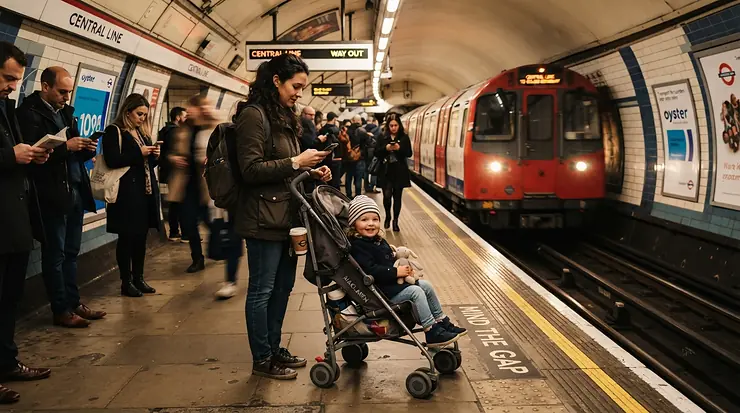
A travel stroller under £100 is a lightweight, compact-folding pushchair — typically 5 to 8kg, with a fabric-and-aluminium build rather than a heavy chassis — designed for portability over plushness, and priced to survive the odd knock at security without ruining your week. It won’t recline flat like a £400 travel system, and it won’t glide over gravel like an all-terrain buggy, but for pavements, planes and packed school runs, that’s rarely what you’re paying for anyway.
We dug into seven real models currently sold on amazon.co.uk, cross-referenced their specs against genuine aggregated review sentiment from UK parenting sites, and worked out which ones earn their keep. This isn’t a rewritten spec sheet — every product below comes with honest commentary on who it actually suits, because a cheap pushchair under £100 that’s wrong for your lifestyle is no bargain at all. Pushchairs are generally allowed through UK airport security and into the cabin once screened, as GOV.UK’s hand luggage guidance confirms, which is exactly why this category exists in the first place: you can wheel your toddler right up to the gate, then hand the buggy over at the last possible second. Let’s find the one that earns a spot in your holiday case.
Quick Comparison Table
| Product | Weight | Recline | Price Range | Best For |
|---|---|---|---|---|
| Cuggl Laurel Stroller | 4.9kg | None | Under £50 | Ultra-budget second buggy |
| Red Kite Push Me 2U | 5.6kg | 2-position | £45-£55 range | Lightest full-size option |
| Hauck Swift Plus | 6.3kg | Lie-flat | £55-£80 range | One-handed fold on the move |
| Joie Nitro | 7.1kg | Full recline | £45-£75 range | Heavier toddlers, high weight limit |
| Kinderkraft TIK | 6.5kg | Lie-flat | £60-£90 range | Naps on the go |
| My Babiie MB02 | 7.9kg | Multi-position | £65-£95 range | Birth-to-4-years longevity |
| Chicco Echo | 7.6kg | 2-position | £75-£99 range | Sturdiest budget build |
Looking at the spread above, the Cuggl Laurel Stroller wins on pure portability but sacrifices recline entirely, while the Chicco Echo sits closest to the £100 ceiling and rewards that with the most robust frame in this line-up. If you’re weighing an umbrella stroller under £100 purely by weight, the Red Kite Push Me 2U and Hauck Swift Plus are your lightest genuinely usable options, but families wanting a stroller to last from birth to preschool should look at the My Babiie MB02 or Joie Nitro instead, since both handle a far higher weight ceiling.
💬 Found a favourite already? Just one click on its name above — help others make faster buying decisions too!😊
Top 7 Travel Strollers Under £100: Expert Analysis
Coverage below spans true budget picks, mid-range all-rounders and the sturdier options that push right up against the £100 mark — plus honest notes on where each one falls down.
1. Cuggl Laurel Stroller — lightest fold in this entire round-up
At 4.9kg, the Cuggl Laurel Stroller is genuinely the lightest thing on this list, and that number matters more than it sounds: anything under 5kg is a stroller you can sling into an overhead locker single-handedly, baby still on your hip. The umbrella fold collapses in a single motion, no levers or buttons, which is exactly what you want when you’re juggling boarding passes and a toddler mid-tantrum. It comes with a five-point harness and a small storage basket, but — and this is the trade-off Amazon’s bullet points won’t spell out — there’s no hood and no raincover included, so you’re buying both separately if the forecast turns.
This is a stroller for one job: getting a toddler from A to B on smooth ground, cheaply and without ceremony. Reviewers on UK parenting retailers consistently describe it as excellent value for occasional use — a grandparents’ house buggy, a beach-holiday spare, a backup for when the main pushchair is in the boot of the wrong car — rather than an everyday runner, and several note the lack of recline as a real limitation for babies under six months. On uneven pavements the small wheels and lack of suspension show their limits quickly, which tracks with what you’d expect at this weight.
Pros:
- ✅ Lightest fold of any stroller in this list at 4.9kg
- ✅ One-motion umbrella fold ideal for tight airport gates
- ✅ Comes with a usable under-seat shopping basket
Cons:
- ❌ No hood or raincover included as standard
- ❌ Fixed forward-facing seat with zero recline
Typically priced under £50, the Cuggl Laurel Stroller is hard to beat as a second buggy, though anyone wanting it as their only travel stroller should budget separately for weather protection.

2. Red Kite Push Me 2U — best budget pick for frequent flyers
The Red Kite Push Me 2U weighs just 5.6kg, which puts it in rare company: light enough to carry up a flight of stairs one-handed, yet still built with a proper two-position recline and a detachable hood that the Cuggl misses out on. What that recline actually buys you is the ability to let a napping toddler lean back mid-walk rather than slumping sideways against the harness straps — a small thing that matters enormously on a six-hour layover. The lockable swivel front wheels help it track straighter than you’d expect from something this featherweight.
Aggregated reviews from UK parenting sites consistently praise its durability relative to its price, with several long-haul travellers reporting it survived multiple flights, cobbled European streets and hold-luggage handling without structural damage — a genuinely reassuring signal for a stroller this cheap. The recurring complaint is the mesh storage basket, which several reviewers note lets smaller items slip through and offers less coverage than a solid-bottomed basket. It’s also not a stroller built for rough terrain; the small wheels and lack of front suspension mean grass, gravel and heavily cobbled streets will feel noticeably harder work than on pavement.
Pros:
- ✅ Just 5.6kg — carries easily with one arm free
- ✅ Detachable hood plus optional rain cover for weather
- ✅ Lockable swivel wheels track well on smooth ground
Cons:
- ❌ Mesh basket lets small items fall through gaps
- ❌ Struggles on gravel, grass and rough cobbles
Sitting in the £45-£55 range, this is arguably the best value entry point if hitting the road (or the runway) as light as possible is your priority.
3. Hauck Swift Plus — fastest one-handed fold for solo parenting
Solo airport runs with a baby on one hip and a stroller in the other hand are where the Hauck Swift Plus earns its keep. Weighing around 6.3kg, its standout trick is a genuine one-handed fold mechanism — twist the handle, push down, and the frame collapses on itself in under two seconds, no second hand required. Add the carrying strap and you’ve got a buggy you can wear like a bag while both arms are otherwise occupied, which is precisely the scenario a lot of these budget travel strollers claim to solve but few actually deliver on.
The seat reclines fully flat, making it one of only two models here genuinely suitable from birth rather than six months onward, and the aluminium frame keeps weight down without feeling flimsy in hand. Real user reviews are candid about the trade-off though: several note that the ride quality on rough or uneven ground feels notably harder than on a heavier pushchair, attributed to the small wheels and minimal suspension, and taller parents sometimes find the handlebar height a touch low for comfortable pushing. As a secondary or travel-only buggy for shorter trips, none of that is disqualifying — it’s simply the honest cost of shaving off that much weight.
Pros:
- ✅ True one-handed fold, ideal for solo travelling parents
- ✅ Lie-flat recline suitable from birth
- ✅ Carrying strap doubles as a hands-free option
Cons:
- ❌ Harder ride on uneven ground versus heavier models
- ❌ Handlebar height can feel low for taller parents
Expect to pay in the £55-£80 range, which puts it firmly mid-table but justified by that fold speed alone.
4. Joie Nitro — best for heavier toddlers who’ve outgrown lighter buggies
Most budget strollers cap out around 15kg, which sounds generous until you remember toddlers hit that weight well before they’re ready to walk everywhere. The Joie Nitro has been tested to 22.5kg — genuinely unusual headroom at this price point — meaning it keeps working for an average child until roughly age four rather than becoming dead weight in the garage at eighteen months. At 7.1kg it’s heavier than the Cuggl or Red Kite, but that extra material buys full four-wheel suspension, which noticeably smooths out bumpy pavements and cobbled town centres.
Genuine reviewer sentiment on this one is unusually consistent: parents repeatedly single out how sturdy it feels relative to its price, and several long-term owners report using it well past the point they expected to retire it, right up to school-age emergencies like a sprained ankle or a kidney infection recovery. The known weak points are a hood that several reviewers describe as smaller than ideal for full sun coverage, and a calf-support panel that resets to its default position every time you fold the stroller, meaning you re-adjust it each time you unfold — a minor irritation rather than a dealbreaker.
Pros:
- ✅ Tested to 22.5kg, well beyond most budget rivals
- ✅ Full wheel suspension smooths cobbled streets
- ✅ Consistently praised for surprising sturdiness
Cons:
- ❌ Hood offers limited shade on bright days
- ❌ Calf-rest position resets on every fold
Priced in the £45-£75 range depending on colourway, the Joie Nitro offers arguably the best cost-per-year of any stroller here.
5. Kinderkraft TIK — best for on-the-go naps
Anyone who’s tried to transfer a sleeping toddler from stroller to car seat without waking them knows the value of a proper lie-flat recline, and the Kinderkraft TIK delivers exactly that at just 6.5kg. The backrest drops to a genuinely flat position rather than the shallow “resting” angle some budget models offer, and the adjustable footrest means the whole seat becomes a proper napping surface rather than a compromise. Puncture-proof wheels are a small but real win for travel — no faff with a pump if a tyre goes soft mid-holiday, because there’s no air in them to lose.
Reviewers who bought it specifically for travel note that the fold genuinely does compress small enough for a typical car boot and most European airline hold-baggage allowances, and the carry handle built into the frame gets repeated praise for making the folded stroller manageable on stairs. Common threads in feedback include a hidden hood window some parents find genuinely useful for checking on a napping child without lifting the fabric. Where it loses points slightly is basket depth — it’s present, but smaller than the My Babiie or Joie Nitro’s, so heavy shopping days aren’t its strong suit.
Pros:
- ✅ Genuine lie-flat recline for proper on-the-go naps
- ✅ Puncture-proof wheels need no maintenance
- ✅ Compact carry handle makes stairs manageable
Cons:
- ❌ Storage basket smaller than rival models here
- ❌ Not rated for children over roughly 3 years
At £60-£90 range, it’s a smart pick for parents whose whole holiday strategy revolves around nap timing (which, let’s be honest, is most of you).

6. My Babiie MB02 — longest usable lifespan from birth to age four
Backed by a design collaboration that includes several well-known UK reality TV personalities, the My Babiie MB02 could easily read as style-over-substance, but the spec sheet says otherwise. Rated from birth right through to 22kg — roughly four years of use — it’s built to be the only stroller some families ever need, travel or otherwise. At 7.9kg it’s the heaviest model in this round-up, but that weight buys front-and-rear suspension, a genuinely large under-seat basket, and multiple recline positions rather than the two or three you get on lighter rivals.
Customers who’ve called out the value for money, appearance and manageable weight relative to what’s included echo what you’d expect from the spec sheet: this is a stroller built to compete with pushchairs costing two or three times as much, trimmed down to hit a sub-£100 price point. The adjustable leg rest and extra-padded seat get particular praise for comfort on longer outings. The honest downside is portability compared to the lighter models here — at nearly 8kg, it’s more of a “keep it in the car” travel stroller than a “carry it through the terminal” one, and its folded footprint is correspondingly larger than the Cuggl or Red Kite.
Pros:
- ✅ Usable from birth to approximately 4 years old
- ✅ Front and rear suspension for a smoother ride
- ✅ Large storage basket handles a proper shopping trip
Cons:
- ❌ Heaviest model here at 7.9kg
- ❌ Bulkier folded size than lighter rivals
Expect to pay in the £65-£95 range, which reflects genuinely more stroller for your money if raw portability isn’t your top priority.
7. Chicco Echo — sturdiest build closest to the £100 ceiling
Chicco built its reputation on affordable-but-durable baby gear, and the Chicco Echo is that philosophy in stroller form. At 7.6kg it sits mid-pack for weight, but the frame and fabric quality consistently get singled out in reviews as feeling more substantial than the price suggests — several long-term owners specifically mention it surviving repeated flights and baggage handling better than pushchairs costing considerably more. The lockable front swivel wheels are genuinely good on mixed terrain, gliding over pavement cracks and shopping centre floors without the jitter you sometimes get on cheaper wheel assemblies.
Reviewers who’ve used it as a dedicated travel buggy specifically call out its robustness as the reason they chose it over lighter, flimsier alternatives — the reasoning being that if a case gets thrown around at baggage reclaim, you want the survivor, not the lightest option on the shelf. The trade-offs are a canopy that some describe as prone to detaching during folding, and a basket that several users describe as smaller than they’d like for a stroller this size. It’s also the priciest model here, edging close to that £100 ceiling depending on colourway.
Pros:
- ✅ Frame quality that consistently outperforms its price
- ✅ Lockable swivel wheels handle mixed terrain well
- ✅ Reputation for surviving rough baggage handling
Cons:
- ❌ Canopy can detach during the folding motion
- ❌ Storage basket smaller than its footprint suggests
At £75-£99 range, it’s the most premium-feeling option here, and arguably the safest bet if durability worries you more than shaving off every last gram.
Practical Usage Guide: Packing a Cabin Bag Stroller for the Airport
Buying the right cabin bag stroller size is only half the battle — using it well on travel day is where most first-timers stumble. Here’s what actually helps in the first month of ownership.
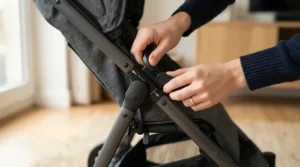
Before you ever reach the airport, fold and unfold your new stroller at home five or six times until it’s muscle memory, not guesswork. Every umbrella stroller under £100 in this guide has a slightly different release mechanism — some are trigger-based, some twist-and-push — and the worst possible moment to learn yours is at a packed departure gate with a queue building behind you. Do this while your child is safely elsewhere, not strapped in, because folding mechanisms and small fingers are a genuinely bad combination.
Weigh your folded stroller at home using bathroom scales, then check it against your specific airline’s cabin baggage allowance rather than trusting general advice, since allowances vary considerably between carriers and even between fare classes on the same airline. Most cabin bag stroller size limits sit somewhere around the 15kg mark for hold allowance if gate-checked, but cabin stowage (rare, and only on emptier flights) has stricter dimension limits again. Tag your stroller with a printed luggage tag before you travel — the flimsy paper tags airline staff sometimes provide at the gate have a habit of falling off during loading, and an untagged buggy on a carousel is a nightmare to reclaim.
A monthly five-minute maintenance check pays off disproportionately for how cheap these strollers are: wipe down the frame joints, check wheel locks still engage properly, and inspect harness stitching for wear, particularly if you’re a frequent flyer putting real mileage on a budget frame. The most common first-30-days mistake we see reported is skipping the rain cover purchase on models like the Cuggl Laurel Stroller that don’t include one — buy it before you need it, not during a downpour in an unfamiliar city.
Real-World Scenarios: Matching Cheap Pushchairs Under £100 to Your Trip
Different trips genuinely call for different strollers, and matching the two properly saves both money and frustration.
Picture a couple flying to Lisbon for a long weekend with their ten-month-old, hand luggage only, budget tight after booking flights. Their priority is raw weight and cabin bag stroller size compliance above everything else — for this profile, the Cuggl Laurel Stroller or Red Kite Push Me 2U make the most sense, since both fold small enough to gate-check confidently and neither costs enough to cause heartbreak if baggage handling is unkind to it.
Now picture a family of four doing a fortnight in Cornwall by car, two-year-old in tow, cobbled harbour towns and uneven coastal paths on the itinerary. Portability through an airport matters far less here than ride comfort and weight capacity, which points toward the Joie Nitro or My Babiie MB02 — both handle rougher ground better thanks to their suspension, and both stretch comfortably to toddler weights without buckling under a determined three-year-old refusing to walk another step.
Finally, consider a grandparent who looks after a grandchild two days a week and wants a lightweight second stroller purely for local errands — no flights, no rough terrain, just pavements and a bit of shopping. Budget matters more than features here, and the Hauck Swift Plus or Kinderkraft TIK fit well: light enough to lift in and out of a car boot repeatedly, simple enough that occasional use doesn’t mean relearning the fold every time.
Problem → Solution: Fixing the Most Common Airport Gate-Check Headaches
The airport gate-check process trips up first-timers in fairly predictable ways, and each one has a straightforward fix.
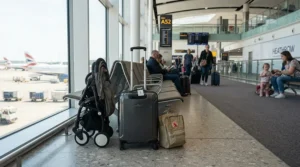
Problem: the stroller doesn’t fit through the X-ray scanner fully assembled. Security staff will generally ask you to fold it before it goes through screening, so practise your fold speed at home rather than fumbling with it under time pressure at the checkpoint — this is exactly the scenario where a model like the Hauck Swift Plus, with its genuine one-handed fold, saves real stress.
Problem: your stroller comes back damaged after gate-check. Budget travel strollers absorb rough handling far better than they get credit for, but a protective travel bag (often under £15) meaningfully reduces scuffing and bent frame pieces, particularly on models with plastic hood joints like the Chicco Echo.
Problem: you’re unsure whether your specific airline allows gate-check versus requiring full hold check-in. Policies vary by carrier and even by route, so always confirm directly with your airline before travel rather than assuming — the CAA’s guidance on what you can bring through security is a useful starting point, but individual airline baggage teams have the final say.
Problem: your toddler won’t sit still during the transfer from stroller to X-ray belt. Practise the routine — lift child out, fold stroller, place on belt — in a low-stakes setting like a supermarket entrance beforehand, so it’s a familiar sequence rather than a stressful surprise on travel day.
How to Choose an Umbrella Stroller Under £100
Picking the right umbrella stroller under £100 comes down to matching a handful of criteria against your actual travel pattern, not just chasing the lowest price tag.
- Check the weight limit against your child’s age realistically. A 15kg cap sounds fine for a baby but gets tight fast with an active three-year-old — models like the Joie Nitro or My Babiie MB02 buy meaningfully more runway.
- Confirm recline suitability if travelling with a baby under six months. Only strollers with genuine lie-flat recline, such as the Hauck Swift Plus or Kinderkraft TIK, are appropriate from birth; others need the child sitting unsupported first.
- Weigh the stroller itself, not just the child capacity. Anything under 6kg, like the Cuggl Laurel Stroller or Red Kite Push Me 2U, transforms one-handed carrying from a struggle into a non-event.
- Check what’s included versus sold separately. Hoods, rain covers and footmuffs vary wildly between these models — factor that extra cost into your real budget before comparing headline prices.
- Look at basket size if you’ll use it for daily errands too, not just travel — the My Babiie MB02 and Joie Nitro offer noticeably more storage than the ultra-light options.
- Read genuine review sentiment on durability, not just star ratings — patterns around canopy attachment, basket material and wheel locking tell you more than an average score alone.
- Decide how much you value fold speed over everything else. If solo travel with a baby on one hip is your reality, the Hauck Swift Plus‘s one-handed mechanism may outweigh every other consideration.
Mumsnet’s independent testing of lightweight strollers offers a useful sanity check here — their reviewers note that even the most basic sub-£100 umbrella strollers remain genuinely functional for short trips and city breaks, provided expectations match the price point.
Compact Budget Fold: Features That Actually Matter (And Those That Don’t)
Marketing copy loves to bury the useful details under the impressive-sounding ones, so here’s an honest filter for a compact budget fold, based on what genuinely changes your day-to-day experience.
Matters a lot: one-hand-operable fold mechanism. If you’re regularly travelling solo with a child, this single feature — present on the Hauck Swift Plus — outweighs almost every other spec on the sheet. Two-handed folds aren’t a dealbreaker, but they mean putting your child down first, every single time.
Matters a lot: genuine standalone fold. A stroller that stays upright once folded (rather than toppling over) is far easier to lean against a wall while you deal with a boarding pass or a nappy change. Most models here manage this, but it’s worth testing in-store or checking review footage before buying online.
Matters somewhat: puncture-proof wheels. The Kinderkraft TIK‘s solid tyres remove one specific travel headache — no pump, no flat tyres mid-holiday — but the trade-off is a slightly firmer ride than air-filled alternatives on rough surfaces.
Matters less than you’d think: multiple recline positions beyond two or three. Marketing sometimes lists five or six recline angles as a headline feature, but in practice most parents settle into one upright and one nap position and rarely touch the others.
Matters less than you’d think: cup holders and phone pockets. Nice-to-haves rather than genuine decision factors — useful if included, not worth paying extra for, and easily solved with an aftermarket clip-on accessory if your chosen model skips them.
Umbrella Stroller Under £100 vs Full-Size Travel System
The comparison that actually matters for most parents isn’t between these seven models — it’s whether a sub-£100 stroller can replace a full travel system for travel purposes at all.
| Factor | Umbrella Stroller Under £100 | Full-Size Travel System |
|---|---|---|
| Typical weight | 5-8kg | 12-16kg |
| Airport portability | Excellent — gate-check friendly | Poor — usually requires hold check-in |
| Newborn suitability | Only lie-flat models (e.g. Hauck Swift Plus) | Yes, via carrycot or car seat adapter |
| Terrain handling | Fair on pavement, weak off-road | Strong across most surfaces |
| Typical lifespan | 1-3 years of heavy use | 3-4 years, often full childhood |
| Best For | Travel, second buggy, short trips | Primary everyday pushchair |
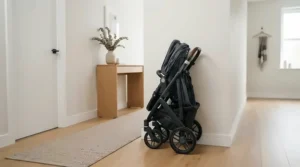
The verdict from that table is fairly clear-cut: a budget travel stroller isn’t trying to replace your main pushchair, it’s solving a different problem entirely. Where a full-size travel system wins on comfort, terrain and newborn suitability, models like the Joie Nitro and My Babiie MB02 win decisively on the thing that actually matters at an airport — getting through security, down a jet bridge and folded into an overhead bin without a second thought. Most families we’ve seen discuss this trade-off online end up owning both, using the £100-and-under option purely for the scenarios where a heavy travel system becomes a liability rather than a help.
Common Mistakes When Buying a Cheap Pushchair Under £100
The same handful of errors crop up repeatedly when parents shop this category, and most are easy to avoid once you know to look for them.
The biggest mistake is buying purely on weight without checking recline suitability, then discovering the stroller can’t be used until baby is sitting unassisted — a frustrating gap of several months for a newborn purchase. A close second is assuming “lightweight” and “cabin-approved” mean the same thing; a stroller can be light yet still fold to dimensions too large for genuine cabin stowage, so always check folded measurements against your airline’s specific figures rather than the word “compact” alone.
Parents also frequently underestimate how much accessories add to the real cost. A Cuggl Laurel Stroller at under £50 sounds like the obvious budget winner until you’ve added a hood, rain cover and footmuff separately, at which point a model like the Red Kite Push Me 2U that includes more as standard may work out cheaper overall. Finally, skipping genuine review research in favour of star ratings alone is a mistake — a 4.5-star average can hide a recurring, specific complaint (a detaching canopy, a mesh basket, a resetting calf rest) that matters enormously to your particular use case but barely dents an average score.
Long-Term Cost & Maintenance of a Budget Travel Stroller
Total cost of ownership on a sub-£100 stroller looks different from a premium pushchair, and it’s worth doing the maths honestly rather than assuming cheap always means cheap overall.
A budget travel stroller typically has a shorter working life than a £400 travel system — expect one to three years of regular use before wheels, fabric or folding mechanisms show real wear, versus three to four years or more from premium alternatives. On a pure cost-per-month basis, though, the numbers still favour the budget route for travel-specific use: even replacing a £70 stroller every eighteen months costs less over three years than the upfront price of most mid-range travel systems, provided you’re not relying on it as your only everyday pushchair too.
Maintenance costs stay low across every model here — occasional wheel lubrication, the odd fabric wipe-down, and harness buckle checks cover most of what’s needed. The one area worth budgeting for upfront is accessories: a rain cover (£10-£20), a travel bag for airport protection (£10-£25) and, for models like the Cuggl Laurel Stroller that ship without one, a hood or parasol. Factor those into your comparison shopping, because a £45 stroller plus £35 of accessories may land at a similar real-world cost to a £75 stroller that includes them from the start.
Safety, Regulations & Airport Compliance for UK Pushchairs
Every stroller in this guide should meet BS EN 1888, the British and European safety standard covering prams and pushchairs sold in the UK — always check the product listing confirms this before buying from a lesser-known seller, since third-party marketplace listings occasionally slip through without proper certification. This standard covers structural stability, harness strength and braking performance, and it’s the baseline you shouldn’t compromise on regardless of budget.
For air travel specifically, UK airport security screens pushchairs the same way they screen other cabin items — your child needs to be lifted out before the stroller goes through the X-ray scanner, and staff may need to inspect it by hand. Beyond security screening, individual airlines set their own rules on whether a stroller can be gate-checked (collected at the aircraft door on arrival) or must go into the main hold at check-in, and those rules genuinely vary by carrier, route and sometimes aircraft type, so confirming directly with your airline before departure remains the safest approach rather than relying on general guidance, including this article’s.
On the ground, always use the five-point harness even for short trips — a fully alert toddler on a moving stroller near roads, escalators or platform edges is exactly the scenario harnesses exist for, and reviewer complaints about “my toddler climbed out” almost always trace back to a harness left unclipped rather than a design fault.
What to Expect: Real-World Performance on UK Streets and Airports
Specs on a page rarely capture how a stroller actually feels underfoot, so here’s the translation from numbers to lived experience.
On smooth UK pavements, every model in this guide performs comfortably — this is genuinely their home turf, and the differences between a 4.9kg Cuggl Laurel Stroller and a 7.9kg My Babiie MB02 shrink to almost nothing once you’re rolling rather than lifting. The gap widens noticeably on cobbles, gravel paths or grass, where suspension becomes the deciding factor rather than weight — the Joie Nitro‘s four-wheel suspension and the My Babiie MB02‘s front-and-rear setup both smooth out bumps that jar noticeably through the more basic wheel assemblies on the Cuggl Laurel Stroller or Red Kite Push Me 2U.
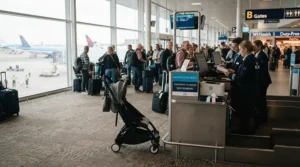
At the airport itself, the experience is less about the stroller’s ride quality and entirely about its fold speed and folded footprint. A stroller that takes fifteen seconds and two hands to collapse feels like an eternity when a queue is building behind you at a security checkpoint — this is precisely where the Hauck Swift Plus‘s one-handed mechanism earns back every gram it doesn’t save elsewhere. Expect a small learning curve regardless of which model you choose; nearly every reviewer across every product here mentions needing two or three attempts before the fold becomes automatic, which is exactly why practising at home beats learning under pressure.
FAQ
❓ Is a travel stroller under £100 worth it for occasional use?
❓ Can I take a cheap pushchair under £100 as hand luggage?
❓ What's the lightest umbrella stroller under £100?
❓ Do budget travel strollers meet UK safety standards?
❓ How long does a compact budget fold stroller typically last?
Conclusion
There’s no single best travel stroller under £100 — there’s only the one that matches how you actually travel. Flying solo with a baby on your hip points toward the Hauck Swift Plus‘s one-handed fold; a toddler who’s outgrown lighter buggies calls for the Joie Nitro‘s higher weight ceiling; a grandparent wanting an occasional second buggy is well served by the featherweight Cuggl Laurel Stroller. What all seven share is the same core promise: real, honestly-sourced value at a price where getting it slightly wrong doesn’t sting.
What we haven’t done here is pretend any of these compete with a £400 travel system on comfort, terrain handling or longevity, because they don’t and Amazon’s own listings won’t tell you that either. What they do is solve a specific, recurring problem — getting through an airport, a train station or a packed high street without lugging a fifteen-kilo pushchair — cheaply, reliably, and without requiring you to gamble your good buggy on a baggage handler’s mercy. Match the model to the trip, budget honestly for the accessories you’ll actually need, and you’ll get genuine mileage out of any option on this list.
Recommended for You
- Second Pushchair Under £100: 7 Best Buys For UK Parents In 2026
- Pushchair Under £100: 7 Genuine Buggy Bargains (2026)
- Stroller For Special Needs Older Child: 7 Best UK Picks (2026)
Disclaimer: This article contains affiliate links. As an Amazon Associate, I earn from qualifying purchases. If you purchase products through these links, we may earn a small commission at no additional cost to you.
✨ Found this helpful? Share it with your friends! 💬🤗
