

In This Article
Somewhere between the birth of your first child and the chaos of a normal Tuesday, you realise one pushchair simply isn’t enough. Maybe it lives permanently in the car boot and you need a second one for the house. Maybe it’s destined for your mum and dad’s hallway so bank holidays don’t turn into a logistical operation. Whatever the reason, a second pushchair under £100 solves a very specific problem: you want something safe, sturdy and genuinely useful, without spending travel-system money on a buggy that’ll spend half its life folded up in a cupboard.
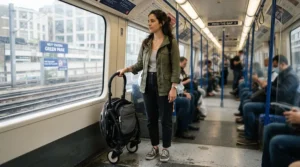
This guide rounds up seven real, currently available options on Amazon UK that sit at or near that £100 ceiling, alongside the honest trade-offs each one makes to hit that price. We’ve dug into verified specs, aggregated review sentiment, and genuine comparison data rather than recycling marketing copy, because a spare buggy still has to hold your child safely, fold in seconds, and survive being flung in and out of a car boot by a slightly frazzled grandparent.
What is a second pushchair under £100? In practice, it’s a lightweight, budget-friendly stroller — usually an umbrella-fold design weighing 6-9kg — bought specifically as a backup to a primary pram or travel system, rather than as the everyday go-to buggy. Whether you’re after a pushchair under £100 for toddler use, a grandparents’ house buggy, or a nursery-friendly stroller that lives at the setting all week, the models below cover every angle. Let’s get into it.
Quick Comparison Table
| Pushchair | Price Range | Weight | Suitable From | Best For |
|---|---|---|---|---|
| Zeta Vooom Stroller | Under £50 | Approx. 7kg | Birth to 20kg | Ultra-tight budgets |
| Red Kite Push Me 2U | Around £45–£55 | Approx. 7kg | 6 months to 15kg | Simple grandparents’ buggy |
| Kinderkraft TIK | Around £55–£75 | 6.5kg | 6 months to 17kg | Nursery-friendly, ultra-light |
| Joie Nitro Stroller | Around £65–£85 | 7.52kg | Birth to 15–22.5kg (model dependent) | High weight-limit all-rounder |
| My Babiie MB02 Stroller | Around £70–£90 | Approx. 7.5kg | Birth to 22kg (4 years) | Styled everyday spare |
| Hauck Swift Plus | Around £75–£95 | Approx. 7kg | Birth to 18–25kg | Smallest fold for storage |
| Cosatto Woosh 3 | Around £90–£110 | 7.2kg | Birth to 25kg | Stretch-budget premium pick |
Looking at the spread above, the honest takeaway is that £100 buys you real choice — you’re not settling for a flimsy toy-shop buggy. The Zeta Vooom and Red Kite Push Me 2U sit comfortably at the bargain end, the Kinderkraft TIK, Joie Nitro and My Babiie MB02 occupy a sensible middle ground with better recline and harness systems, and the Hauck Swift Plus and Cosatto Woosh 3 push toward (and occasionally just past) £100 in exchange for a smaller fold or a higher weight limit. Which one wins depends entirely on where the buggy will actually live and how often it’ll be used.
💬 Found a pick you like already? Bookmark this page — prices on budget buggies shift week to week, so it’s worth checking back before you commit.
Top 7 Second Pushchairs Under £100: Expert Analysis
1. Zeta Vooom Stroller — the rock-bottom budget benchmark
The Zeta Vooom Stroller has been a fixture of the UK budget buggy scene for over a decade, and it’s still one of the cheapest genuinely usable options on Amazon. Reviewers have used it from birth right through to age three or four, which says a lot for something built to a bargain price point.
Under the bonnet, it’s a simple steel-framed umbrella stroller with a four-position recline, a 33cm-wide padded seat, and a hood large enough to double as sun shade on holiday. The recline goes flat enough for early-months naps, and the five-point harness with padded shoulder pads meets the basics parents actually need rather than piling on gimmicks that push the price up.
Based on the spec comparison with pricier rivals, the Zeta Vooom trades weight and polish for sheer value — it’s not the lightest buggy here, but it’s the cheapest by a clear margin, which matters if this pushchair is only coming out a handful of times a year. Reviewers consistently note that it folds and unfolds easily and locks securely by itself, and several long-term owners report getting two or three years of regular use out of it without structural problems, though a small number mention a wobbly wheel on arrival.
Pros:
- ✅ Among the cheapest genuinely functional strollers on Amazon UK
- ✅ Reclines fully flat, so it suits naps from a young age
- ✅ Large extendable hood doubles up as effective sun shade
Cons:
- ❌ Basic steel frame is heavier to lift than premium rivals
- ❌ Occasional reports of a loose or misaligned wheel on delivery
At well under £50, the Zeta Vooom is hard to beat as a true “just in case” buggy — brilliant value if you need a backup without ceremony.

2. Red Kite Push Me 2U Lightweight Stroller — best simple grandparents’ house buggy
If your priority is a no-fuss buggy that lives permanently at a relative’s house, the Red Kite Push Me 2U is built for exactly that. It’s a two-position stroller suitable from around six months up to 15kg, with a padded seat, five-point harness and a detachable hood for warmer weather.
What most buyers overlook about this model is how well it travels — several owners report it holding up through flights and airport handling without falling apart, which is a genuinely useful signal for a buggy that might get shoved into a boot repeatedly rather than treated gently every day. The detachable hood is a smart touch for a grandparents’ house buggy specifically, because it means the same stroller can do sunny park trips in summer and quick dashes to the car in winter without extra kit.
On the flip side, the hood is noticeably shallow, and more than one reviewer has flagged that it doesn’t offer full shade coverage on bright days — something to factor in if it’ll be doing double duty outdoors. Aggregated feedback also praises the stability and the included rain cape, which isn’t a given at this price point.
Pros:
- ✅ Detachable hood suits both hot and cold-weather grandparent visits
- ✅ Reviewers report strong durability through travel and repeated folding
- ✅ Comes with a rain cape included as standard
Cons:
- ❌ Shallow hood gives limited shade coverage in strong sun
- ❌ Two recline positions only, so less flexible for naps than rivals
For a buggy that mostly needs to sit ready by someone else’s front door, the Push Me 2U‘s simplicity is the whole point.
3. Kinderkraft TIK Lightweight Stroller — the nursery-friendly stroller
At just 6.5kg, the Kinderkraft TIK is the lightest pushchair on this list by a clear margin, and that single spec is what makes it such a strong nursery-friendly stroller. Staff moving buggies in and out of a packed nursery porch every day genuinely notice the difference between a 6.5kg umbrella fold and a 9kg full-size frame.
The TIK folds via a straightforward umbrella mechanism designed to collapse in seconds, with a carry handle for stairs and tight corridors — a detail that matters more than it sounds when a setting has limited buggy storage. It reclines to a genuine lie-flat position with an adjustable footrest, suitable from six months up to 17kg, and the puncture-resistant foam wheels mean no one has to worry about a flat tyre holding up the school run. A basket underneath holds up to 2kg, enough for spare clothes and a nappy bag rather than a full shopping trip.
Here’s what to weigh up: the trade-off for that featherweight build is a smaller wheelbase and less suspension than the heavier options further down this list, so it’s noticeably less smooth over cobbles or rough pavement. Reviewers who use it purely for short nursery-to-car journeys rate it highly; those hoping for an all-terrain workhorse are generally less impressed.
Pros:
- ✅ Lightest pushchair on this list at just 6.5kg
- ✅ Genuine lie-flat recline for daytime naps at nursery
- ✅ Puncture-resistant wheels need no maintenance or pumping
Cons:
- ❌ Less stable ride quality on rough or uneven ground
- ❌ Under-seat basket is small compared with rivals
If a setting or childminder has asked for something compact and easy to store, the TIK is the obvious pick.
4. Joie Nitro Stroller — best all-rounder with a high weight limit
The Joie Nitro punches above its price bracket largely because of one number: depending on the model, it’s tested well beyond the usual 15kg ceiling, with some listings certified up to 22.5kg. That’s a meaningful difference for a second pushchair under £100 for toddler use specifically, since many bargain buggies quietly stop being suitable right when your child hits the toddler years.
Weighing 7.52kg, it’s an umbrella-fold stroller with five recline positions including a full lie-flat mode, a five-point SoftTouch harness, and all-wheel suspension that reviewers say noticeably smooths out the ride compared with cheaper rigid-frame alternatives. The adjustable calf support and removable, adjustable hood round out a spec sheet that reads more like a £150 buggy than one regularly found for well under £100 through discount retailers.
Reviewers consistently rate it as excellent value, praising how effortless it is to manoeuvre even one-handed while carrying a newborn in a sling. The main gripe in aggregated feedback is that the calf support resets to its default position every time the buggy is folded, meaning it needs re-adjusting on each use — a minor annoyance rather than a dealbreaker, but worth knowing before you buy.
Pros:
- ✅ Weight-tested well beyond the usual budget-buggy ceiling
- ✅ Five recline positions including a genuine lie-flat setting
- ✅ All-wheel suspension smooths out pavements and grass
Cons:
- ❌ Calf support resets on every fold, needing re-adjustment
- ❌ No parent-facing option or car-seat compatibility
For a toddler who’s outgrown the standard 15kg cut-off, the Nitro is one of the smartest budget buys here.
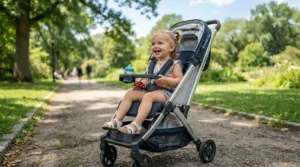
5. My Babiie MB02 Stroller — best styled everyday spare
Backed by Billie Faiers, Dani Dyer and Samantha Faiers, My Babiie‘s MB02 range has built a loyal following among parents who want their spare buggy to actually look good, not just function. The stroller is suitable from birth to 22kg (around four years), with a multi-position recline, adjustable leg rest, and a three-position UPF50+ canopy with a viewing window built in.
What most buyers overlook about the MB02 is how much of the design budget clearly went into the harness and bumper bar rather than the frame — the five-point harness and sturdy bumper bar consistently earn praise in aggregated reviews as reassuringly solid for the price. Reviewers describe it as light to push and easy to fold and unfold one-handed, with several noting it’s proved better value than pushchairs costing twice as much.
The honest caveat here is pricing: the plain colourways (black & grey, blue & grey) regularly sit in the £70–£90 range, but the celebrity-designed prints and quilted “Signature Range” editions routinely creep well past £100, sometimes into the £130–£170 bracket. If style matters more than budget, check which specific colourway you’re looking at before assuming it qualifies as a second pushchair under £100.
Pros:
- ✅ Full recline suitable from birth, unlike many budget rivals
- ✅ Sturdy five-point harness and bumper bar reviewers trust
- ✅ Wide range of on-trend prints and colourways available
Cons:
- ❌ Designer collaboration prints often exceed the £100 mark
- ❌ Rear storage pocket is handy but genuinely small
Stick to the standard colourways and the MB02 is a genuinely stylish spare buggy that doesn’t scream “budget.”
6. Hauck Swift Plus — smallest fold for tight storage
If storage space is the deciding factor, the Hauck Swift Plus deserves serious consideration. Hauck built its reputation on compact folding mechanisms, and the Swift Plus lives up to that: it collapses to an extra-small package with a one-hand fold and an included carrying strap, aimed squarely at parents who need to wedge a buggy into a small car boot, a narrow hallway, or a cupboard under the stairs.
Reviewers consistently single out the weight and ease of folding as the standout strengths — customers report it’s genuinely easy to transport and collapse with one hand, even while managing a squirming toddler. Suitable up to 18kg on the standard Swift Plus (with the Swift X variant rated higher, up to 25kg depending on listing), it also offers a lying position from birth, which is unusual at this size class.
Based on the spec comparison, the trade-off for that ultra-compact fold is stability: some reviewers, particularly on international listings, flag that the wheels and chassis feel less robust than heavier alternatives, especially over several months of daily use. It’s best suited to occasional or short-distance use rather than becoming anyone’s primary everyday buggy.
Pros:
- ✅ Genuinely one of the smallest folds in this price bracket
- ✅ One-hand folding mechanism works well even one-handed
- ✅ Includes a carrying strap for stairs and public transport
Cons:
- ❌ Some reviewers report the frame feels less sturdy long-term
- ❌ Basket and hood are modest compared with rivals
For anyone short on storage space at home or at a second address, the Swift Plus solves a real problem few other buggies on this list address as directly.
7. Cosatto Woosh 3 — the stretch-budget premium pick
The Cosatto Woosh 3 sits right at the edge of this list’s budget, with prices hovering around £90 to just over £100 depending on print and retailer — so it won’t always land under the £100 mark, but it’s worth including because of what you get for the extra few pounds. Suitable from birth up to a substantial 25kg, it weighs 7.2kg and uses fabric made from more than 35 recycled plastic bottles per stroller, alongside a four-year manufacturer guarantee that’s unusually generous for a budget buggy.
What the spec sheet won’t tell you, but Cosatto’s own design pedigree suggests, is that this is a brand that’s picked up genuine industry recognition for its lightweight strollers, including previous Mumsnet “Best Lightweight Pushchair” and “Best Buggy” awards for earlier Woosh generations. The Woosh 3 carries that forward with a telescopic pull handle so you can wheel it behind you like hand luggage, a UPF100+ double-tiered hood, all-round suspension, and lockable front-swivel wheels.
The honest trade-off is price consistency — because Cosatto sells dozens of print variations, exactly where a given colourway lands relative to £100 varies by retailer and by season. If budget is an absolute hard limit, it’s worth checking the current price before assuming it qualifies; if you can stretch slightly, the extra weight capacity and four-year guarantee make a strong case for it as a genuinely long-lasting spare buggy rather than a short-term stopgap.
Pros:
- ✅ Highest weight limit on this list at 25kg
- ✅ Four-year manufacturer guarantee is well above budget-buggy norms
- ✅ Telescopic handle makes it easy to wheel through transport hubs
Cons:
- ❌ Some prints and retailers price it just over £100
- ❌ Seat proportions don’t fully match its generous weight rating
Looking at the seven picks above, three clear patterns emerge: sub-£60 buggies like the Zeta Vooom and Red Kite Push Me 2U win on price but ask you to accept a heavier or less feature-rich frame; mid-range options like the Kinderkraft TIK, Joie Nitro and My Babiie MB02 balance weight, recline and harness quality; and the Hauck Swift Plus and Cosatto Woosh 3 push toward £100 for a meaningfully smaller fold or a higher weight ceiling.
Practical Usage Guide: Storing a Spare Buggy at Home
Buying the buggy is the easy part — storing a spare buggy without it eating your hallway is where most parents actually struggle. Start by folding it immediately after every use rather than leaving it propped open “for later”; a folded umbrella-style stroller like the Kinderkraft TIK or Hauck Swift Plus takes up roughly a third of the floor space of one left open, and repeated leaning against walls when open is a common cause of frame warping over time.
For under-stairs or cupboard storage, measure the folded dimensions before you buy rather than after — most listings state this clearly (the TIK folds to 106 x 28 x 30cm, for example), and a few centimetres can be the difference between a buggy that slides neatly into a cupboard and one that has to live in the hallway permanently. A wall-mounted bike hook or a simple free-standing buggy stand keeps wheels off carpets and stops mud transferring indoors, which matters more with foam or puncture-resistant tyres that pick up grit easily.
Common first-30-days mistakes include storing a folded buggy somewhere damp (garages and unheated porches are the usual culprits, and damp fabric can mildew within weeks), and forgetting to engage the auto-lock mechanism, which on models like the Cosatto Woosh 3 stops the frame springing open unexpectedly while in storage. If the buggy is destined for a car boot long-term, a breathable storage bag — rather than a bin liner — prevents condensation building up against the fabric on humid days, a detail several second-buggy owners learn the hard way after a musty smell develops.

Real-World Scenarios: Grandparents’ House Buggies and Nursery Runs
Picture Sarah, whose parents look after her 14-month-old two days a week. She doesn’t want to load and unload her main travel system from the car every visit, so a lightweight grandparents’ house buggy that lives permanently at their address, folds small enough for their narrow porch, and doesn’t need daily maintenance is the priority. For a scenario like this, the Red Kite Push Me 2U or Zeta Vooom make the most sense — low cost, straightforward operation that grandparents can use confidently without a manual, and a weight low enough that an older relative can lift it into a car boot unassisted.
Now consider Marcus and Priya, whose toddler attends nursery three days a week and is already 16kg at two and a half. Their setting has asked parents to leave a labelled buggy on-site for outings to the local park. Here, weight limit and portability both matter — the Joie Nitro, tested well past the usual 15kg ceiling, or the featherweight Kinderkraft TIK at 6.5kg, both suit a nursery-friendly stroller brief better than a heavier full-size buggy that staff would struggle to manoeuvre through a crowded cloakroom.
Finally, think about Deb, whose primary pram is a premium travel system she’s not willing to risk on a coastal caravan holiday. For her, a genuinely disposable-feeling budget option — something she wouldn’t be devastated to lose to sea air and sand in the wheels — like the Zeta Vooom or Hauck Swift Plus, removes the anxiety entirely while still keeping her child safely harnessed and comfortable.
Problem → Solution: Common Second-Pushchair Headaches Solved
Problem: The buggy sits unused most of the year and the wheels seize up. Solution: before long storage periods, give the wheels a light spin and a drop of silicone-based lubricant (avoid oil-based products, which attract grit) on any axle points, and store the buggy somewhere dry rather than a damp shed.
Problem: Grandparents find the fold mechanism confusing. Solution: choose a model reviewers specifically praise for one-hand folding, such as the Hauck Swift Plus or Joie Nitro, and stick a laminated fold/unfold cheat sheet to the frame — a five-minute job that saves repeated phone calls explaining the mechanism.
Problem: The nursery loses track of whose buggy is whose. Solution: budget buggies are genuinely interchangeable in appearance, so a permanent luggage tag or fabric marker pen on the hood lining solves the mix-up quickly and cheaply.
Problem: A child has outgrown the weight limit faster than expected. Solution: check the tested (not just advertised) weight limit before buying — the Joie Nitro‘s 22.5kg certification and the Cosatto Woosh 3‘s 25kg rating both offer meaningfully more headroom than standard 15kg budget buggies, reducing the chance of needing a third pushchair within a year.
Problem: The spare buggy feels flimsy after a few months of use. Solution: aggregated reviews consistently flag frame stability as the area where cheaper buggies cut corners, so if longevity matters more than absolute rock-bottom price, favour models with a longer manufacturer guarantee, like the Woosh 3’s four-year cover, over the cheapest possible option.
How to Buy a Pushchair Under £100 Without Regretting It
- Decide the primary use case first. A grandparents’ house buggy that mostly does short, flat local walks has very different needs from a nursery-friendly stroller that gets folded and unfolded a dozen times a day — match the buggy’s strengths to the job before comparing prices.
- Check the tested weight limit, not just the advertised age range. As covered above, some budget models are certified well beyond the usual 15kg ceiling, which matters hugely if you’re buying a second pushchair under £100 for toddler use specifically.
- Weigh folded dimensions against your actual storage space. Measure the cupboard, boot or porch before ordering rather than hoping it’ll fit.
- Read aggregated review sentiment on stability, not just price. The cheapest option on paper isn’t always the best value if it needs replacing within a year.
- Confirm the safety standard marking. UK-sold pushchairs and prams must comply with BS EN 1888, and the label should be visible on the frame or seat fabric — the government’s official business guidance on prams and pushchairs sets this out in detail.
- Factor in accessories already included. A raincover, footmuff or cup holder bundled in can offset a slightly higher headline price compared with a cheaper buggy that needs them bought separately.
- Buy from the current model year where possible. Older listings sometimes carry outdated safety markings or have been superseded by improved versions at a similar price.
Common Mistakes When Buying a Second Pushchair Under £100
The single most common mistake is buying on price alone without checking the tested weight limit — a bargain buggy that’s technically fine for a six-month-old becomes a safety and comfort problem fast once a toddler hits 14-15kg. Reviewers across several of the models above specifically flag this as a reason they had to buy again sooner than expected.
A second frequent error is ignoring folded dimensions entirely, then discovering the “compact” buggy doesn’t actually fit the intended cupboard, car boot or porch. Third, some buyers assume all designer or celebrity-branded prints from a range carry the same price as the standard colourways — as the My Babiie MB02 example shows, this genuinely isn’t the case, and it’s worth double-checking the specific listing rather than the product family. Finally, skipping the safety standard check on second-hand or marketplace listings is a real risk; RoSPA specifically advises confirming a valid BS EN 1888 marking and checking for any product recalls before buying, whether new or used.

Second Pushchair vs Full-Size Everyday Pushchair: What’s Actually Different
| Factor | Second Pushchair Under £100 | Full-Size Everyday Pushchair | Baby Carrier / Sling |
|---|---|---|---|
| Typical weight | 6.5–9kg | 10–15kg | Under 1kg |
| Folded storage size | Small to compact | Large, bulky | None needed |
| Suspension & ride comfort | Basic to moderate | Advanced, multi-wheel | N/A |
| Best For | Zeta Vooom, Kinderkraft TIK — backup use | Daily main pram | Very short trips |
| Typical price | Under £100 | £300–£1,200+ | £30–£150 |
The core distinction here isn’t really about quality, it’s about role. A full-size everyday pushchair like a travel system is engineered for daily, all-weather, multi-year use, with the suspension, storage and car-seat compatibility to match — and the price tag reflects that. A second pushchair under £100 is deliberately engineered around a narrower brief: light enough to lift one-handed, cheap enough that a few months of neglect in a hallway doesn’t sting, and simple enough that a grandparent or nursery keyworker can use it without instructions. A sling or carrier fills a third gap entirely — brilliant for very short trips or tight spaces, but no substitute for a seat on a longer outing.
Second Pushchairs for Toddlers, Nurseries and Grandparents
A second pushchair under £100 for toddler use needs to clear one bar the others on this list don’t always have to: a genuinely realistic weight limit for a child who’s already walking, climbing and testing every harness buckle in sight. The Joie Nitro and Cosatto Woosh 3 are the strongest picks here, both tested meaningfully past the standard 15kg mark, which buys real headroom before a second upgrade becomes necessary.
For a nursery-friendly stroller specifically, staff and safeguarding teams generally prioritise three things: low weight for quick manoeuvring through busy corridors, a secure five-point harness that’s simple for multiple different adults to operate consistently, and a compact fold for storage between outings. The Kinderkraft TIK‘s 6.5kg build and umbrella fold make it a standout here, closely followed by the Hauck Swift Plus for settings with genuinely tight storage.
Grandparents, meanwhile, tend to value predictability and low maintenance above all else — a buggy that doesn’t need regular tyre pumping, folds without a knack, and won’t be catastrophic to replace if it takes a knock. The Zeta Vooom and Red Kite Push Me 2U both fit that brief comfortably, offering straightforward mechanisms without the learning curve some more feature-packed models introduce.
Safety, Regulations and Compliance Guide
Every pushchair sold in the UK, new or second-hand, is legally required to be safe, and compliance is typically demonstrated through the BS EN 1888 standard covering wheeled child conveyances. According to official government business guidance on prams and pushchairs, look for a label confirming this standard on the frame or seat fabric, and treat its absence on an older or second-hand listing as a red flag rather than an oversight.
RoSPA’s safety advice highlights several practical checks worth running through before first use: confirm the brakes lock and hold properly, ensure the frame is fully unfolded and both locking mechanisms have engaged, and inspect for sharp edges or torn fabric. A five-point harness is strongly preferable to a three-point one, and non-reclining seats generally aren’t considered suitable for a child under six months old, which is worth bearing in mind if you’re buying a second pushchair specifically for a very young baby rather than a toddler.
Day-to-day, RoSPA also cautions against hanging bags or coats on the handlebars, since this shifts the centre of gravity and increases tipping risk — a genuinely common habit worth breaking, especially on lighter budget frames like the ones featured here, which have less mass to resist tipping than a heavier premium pram.
Long-Term Cost & Maintenance of a Budget Second Buggy
Judged purely on upfront price, all seven options here look similar — a handful of pounds apart at most. The real cost differences emerge over 12-24 months of actual use. A buggy with a longer manufacturer guarantee, such as the Cosatto Woosh 3‘s four-year cover, effectively de-risks a slightly higher purchase price, because a frame or stitching fault within that window gets replaced rather than binned.
Maintenance costs on this category of buggy are genuinely low: puncture-resistant foam wheels, as used on the Kinderkraft TIK, eliminate the small but real cost and hassle of tyre repairs entirely, while pneumatic-tyre alternatives elsewhere on the market can rack up occasional pump or puncture-kit costs over time. Replacement raincovers, typically £10-£20, and footmuffs, often £20-£35, are the most common add-on purchases across this price bracket — worth checking whether your chosen model already includes them, as several here do.
Cost-per-use is the most honest way to think about value here: a £50 Zeta Vooom used twice a month for two years works out to roughly £1 per outing, which is difficult to beat regardless of feature set. The calculation shifts, though, if a cheaper buggy needs replacing after eight months due to a wheel or frame issue — at that point, the mid-range options with stronger aggregated reliability feedback, like the Joie Nitro or My Babiie MB02, arguably represent better long-term value despite the higher sticker price.
Frequently Asked Questions
❓ Is a second pushchair under £100 safe to use?
❓ What's the best pushchair under £100 for a toddler?
❓ How do you buy a pushchair under £100 without it falling apart quickly?
❓ What makes a stroller nursery-friendly?
❓ Where's the best place for storing a spare buggy at home?
Conclusion
A second pushchair under £100 doesn’t have to mean compromise — it means matching the right buggy to a specific, narrower job than your everyday pram was ever designed for. If pure budget is the priority, the Zeta Vooom and Red Kite Push Me 2U deliver genuine functionality for well under £50. If your child’s already outgrowing standard weight limits, the Joie Nitro and Cosatto Woosh 3 buy meaningful extra headroom. And if storage space or nursery use is the deciding factor, the featherweight Kinderkraft TIK and ultra-compact Hauck Swift Plus solve that problem more directly than anything else on this list.
Whichever you choose, the fundamentals matter more than the finish: check the safety standard marking, confirm the tested weight limit suits your child now and in the near future, and measure your actual storage space before you order. Do that, and any of these seven will earn its keep — whether it’s living at a grandparent’s house, folded in a nursery cloakroom, or waiting patiently in the boot for the day you actually need it.
Recommended for You
- Pushchair Under £100: 7 Genuine Buggy Bargains (2026)
- Stroller For Special Needs Older Child: 7 Best UK Picks (2026)
- Pushchair High Weight Limit: 7 Best Sturdy Picks For 2026
Disclaimer: This article contains affiliate links. As an Amazon Associate, I earn from qualifying purchases. If you purchase products through these links, we may earn a small commission at no additional cost to you.
✨ Found this helpful? Share it with your friends! 💬🤗
