
In This Article
A pushchair high weight limit means the frame, seat, brakes and wheels are rated for a child heavier than the standard 15kg buggy ceiling, typically 22kg and occasionally 25kg or more. It matters most for tall, heavy or simply exhausted older children, because the rating reflects safety margins and durability, not just capacity.
Here’s the catch: most parents only discover the number when it stops being theoretical. MadeForMums puts the average 18-month-old boy at around 10.9kg, which sounds harmless until your own three-year-old sits high on the centile chart and treats a 15kg stroller like a deckchair. The RCPCH’s UK-WHO growth charts for 0-4 years show how wide the healthy range is at every age. A big child isn’t a problem. A flimsy pushchair for one is.
So this guide compares seven real models built, or rated, for the job. Whether you need a buggy for heavy toddler duty on the school run or a pushchair for older child long walks that won’t sag by mile three, there’s a pick here. One honest note up front: I haven’t handled any of these. What follows is analysis of manufacturer specifications and aggregated feedback from sources such as Mumsnet, MadeForMums and specialist retailers. Where figures vary by model year, I say so.
Along the way we’ll unpack maximum user weight (and why the headline figure can mislead), what a reinforced frame actually is, and which seat unit dimensions matter for long legs. Prices are ranges only, so check current pricing and availability before you buy.
Quick Comparison: 7 Pushchair High Weight Limit Options at a Glance
Here’s the short version, roughly ordered from lowest to highest spend.
| Pushchair | Max child weight | Approx. price range | Key build feature | Best For |
|---|---|---|---|---|
| Silver Cross Pop | 22kg | around £200-£300 | Lightweight umbrella fold, wide seat | City errands on a budget |
| Out ‘n’ About Nipper Single V5 | 22kg | around £400-£450 | 12-inch air tyres | Muddy paths and parks |
| MobiQuip XL | 50kg (about 10 years) | around £300-£400 | Solid puncture-free tyres | Older children with extra needs |
| Baby Jogger City Sights | 22kg | from around £300 | Adjustable handlebar, 11.3kg | Mixed city and park use |
| Mountain Buggy Urban Jungle | 25kg | roughly £350-£450 | Air tyres, 10kg basket | Big kids on rough ground |
| Thule Urban Glide 3 | 22kg child, 34kg total | roughly £550-£750 | 16-inch air tyres, hand brake | Long walks and hills |
| Bugaboo Fox 5 | 22kg | around £1,000-£1,200 | 30cm rear wheels, 10kg basket | Premium all-rounder |
Read the table as a set of trade-offs, not a league table. The Silver Cross Pop offers the best price-to-headroom ratio for pavement life, while the Mountain Buggy Urban Jungle buys three extra rated kilos in exchange for a chunkier chassis. If your child is closer to 30kg than 20kg, the MobiQuip XL is the only model here rated for it, though it is a specialist product rather than a lifestyle buggy. Note too that the Thule Urban Glide 3 quotes 34kg overall capacity but only 22kg for the child, a distinction we’ll return to. Prices reflect ranges seen at the time of research and may vary.
💬 Just one click — help others make better buying decisions too!😊
Top 7 Pushchair High Weight Limit Picks: Expert Analysis
Each entry below pairs the published specification with what it means in daily use and what reviewers consistently report.
1. Silver Cross Pop — wide seat, lightweight budget-friendly fold
The hook is simple: a roomy seat wrapped in an umbrella-fold frame you can actually carry upstairs. Silver Cross rates it from birth to 22kg (roughly four years), and MadeForMums measured a 50cm backrest with a seat about 35cm wide, so a tall toddler can stretch out instead of curling up. That backrest figure matters more than the weight rating for comfort, because a child can sit well inside 22kg and still find their shoulders above the seat back. Published frame weights range from about 7kg to 9kg depending on source and version, so it stays genuinely portable on buses and stairs.
Based on the spec sheet, it’s a sensible buggy for heavy toddler duty on pavements, but the small wheels (14.5cm on the version MadeForMums measured) make grass and cobbles hard work. Mumsnet’s reviewer called it a great everyday stroller with a sturdy, near lie-flat seat and a big UPF50+ hood, though it doesn’t open one-handed. A MadeForMums parent tester found it heavy to push, a reminder that small wheels plus a big child equals effort.
Pros:
- ✅ Generous 50cm backrest and wide seat
- ✅ Light umbrella fold for buses and boots
- ✅ Three-year warranty and rain cover included
Cons:
- ❌ Small wheels struggle on rough ground
- ❌ Opens with two hands
At around £200-£300 depending on version and retailer, it’s the best-value entry point into pushchair high weight limit territory for city families.
2. Out ‘n’ About Nipper Single V5 — British-built, air-tyred rough-terrain value
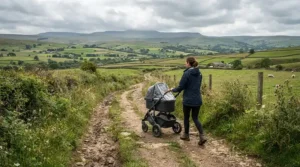
The hook is a three-wheel chassis on 12-inch air-filled tyres, made by a small British family firm that also supplies spare parts and rebuilds, a rarity in a market of throwaway buggies. The listed maximum load is 22kg, the handle adjusts from 90cm to 109cm, and it packs down to roughly 61.5 x 42.5 x 94cm with the wheels on. In practice, air tyres and a swivel-lock front wheel soak up ruts that would rattle a heavy child in a small-wheeled stroller, and the extendable handle suits tall parents.
The spec sheet won’t tell you this, but reviewers note the trade-off: at 9.8kg it isn’t the lightest, so repeated lifting onto trains is a chore. Mumsnet’s reviewer praised the steering and easy one-handed push but flagged the small basket and low-quality foam handlebar padding. MadeForMums judged it lovely to push over rough ground yet a poor fit for people tackling many flights of stairs daily. A V6 has since launched, so check which version you’re buying; the figures here are for the V5.
Pros:
- ✅ 12-inch air tyres and suspension smooth rough ground
- ✅ Lockable swivel front wheel suits paths and jogging
- ✅ Spare parts available from the British maker
Cons:
- ❌ Small under-seat basket, basic handlebar foam
- ❌ Chunky 9.8kg frame for stair-heavy lives
With an RRP around £445, expect £400-£450. As a pushchair high weight limit option for countryside families, the value is strong.
3. MobiQuip XL — 50kg ceiling for genuinely older children
This is the outlier, deliberately. The MobiQuip XL is a disability pushchair rated by its maker for children up to about ten years or 50kg, more than double any mainstream buggy here. It has an aluminium frame, an umbrella fold (Learning SPACE lists closed dimensions of 112 x 30cm), a three-position adjustable footplate, a five-point harness and puncture-proof solid tyres. In plain English: no punctures, an easy boot fit, and a seat a school-age child can still use. The same retailer quotes a 56cm backrest.
Who is it for? Families of older children with fatigue, sensory or mobility needs, and anyone whose child has outgrown the 22kg class. One caveat from ChildFriendlyGear is worth repeating: a weight limit doesn’t confirm postural support, so check the seat against your child’s positioning needs. Amazon UK buyers praise easy folding and a well-fitting footplate, though one reported the foam handle splitting early and another noted it copes less well on very uneven ground, unsurprising with solid tyres.
Pros:
- ✅ 50kg rating covers children up to about ten
- ✅ Umbrella fold fits a car boot easily
- ✅ Adjustable footplate and five-point harness
Cons:
- ❌ Solid tyres jolt on rough terrain
- ❌ Foam handles reported to wear early
Roughly £300-£400 (VAT relief may apply to eligible buyers), it’s outstanding value if the design suits your child’s needs.
4. Baby Jogger City Sights — adjustable handlebar, tall-child friendly seat
The standout is comfort for the person pushing. The Baby Jogger City Sights has a height-adjustable, faux-leather-wrapped handlebar that suited both a 5ft 6in parent and a 6ft 2in partner, according to MadeForMums, which matters on long walks when a fixed handle means stooping or shrugging. The seat is rated to 22kg (about four years), the frame weighs 11.3kg, and it folds with the seat attached to around 80.6 x 59 x 31.7cm. So it’s mid-weight: fine for a car boot, not one to carry up three flights.
Here’s what to weigh. The generous back height suits taller children, and MadeForMums’ tester found her tall three-year-old very comfortable. Mumsnet’s reviewer found it slim enough for train aisles and buses. On the flip side, BabyGearLab found the fold mechanism unintuitive and felt the price demanded easier operation, while Mother & Baby’s tester noted some owners find the suspension underwhelming, though she didn’t. Foam-filled wheels generally mean no punctures but a firmer ride.
Pros:
- ✅ Handlebar suits very different parent heights
- ✅ Folds with the seat attached and stands alone
- ✅ Lifetime warranty on the frame, per Mumsnet
Cons:
- ❌ Fold takes practice to master
- ❌ Firmer ride on rougher ground
From around £300 for the pushchair alone, it’s a well-rounded pushchair high weight limit pick for mixed city and park use.
5. Mountain Buggy Urban Jungle — 25kg rating in a full-size chassis
Most mainstream buggies stop at 22kg. The Mountain Buggy Urban Jungle is rated to 25kg, and its fabric sling seat, 12-inch air-filled tyres and aircraft-grade aluminium chassis (roughly 11kg) are built to carry it. Translation: extra rated headroom for a child who’s already big at three, plus a 10kg under-seat basket so you can shop without hanging bags on the handles, the classic tipping culprit. The handlebar adjusts from 86cm to 117.5cm, one of the wider ranges around, so tall parents aren’t hunched.
Based on the spec comparison, the trade-off is bulk. MadeForMums’ reviewer folded it one-handed with a toddler on her hip but called the 90 x 63 x 33cm folded package chunky, and flagged a retractable leg rest that can trap fingers and a fiddly five-point harness. That review dates from 2018 and also noted Mountain Buggy’s guidance that lie-flat use is for babies up to 9kg, so check current advice before reclining a heavier child for naps. Travel Mad Mum praised the roomy basket and simple click-button brake.
Pros:
- ✅ 25kg rating, above the usual 22kg
- ✅ 12-inch air tyres with lockable front wheel
- ✅ Big 10kg under-seat basket
Cons:
- ❌ Bulky folded size
- ❌ Fiddly harness and leg rest
Reported at roughly £350-£450, it’s the strongest pushchair high weight limit value if you want 25kg without going specialist.
6. Thule Urban Glide 3 — stable long-distance walker on 16-inch tyres
The hook is momentum. The Thule Urban Glide 3 rolls on large 40cm (16-inch) air-filled tyres with suspension, a lockable swivel front wheel and an integrated hand brake, which is why it suits a pushchair for older child long walks better than most small-wheelers. Read the small print, though: reviewers who checked the specification report a 22kg limit for the child within an overall capacity of 34kg (child plus cargo). That gap is the essence of maximum user weight, and it’s the number people misread most often.
The frame weighs around 11.9kg and folds with one hand. MadeForMums’ 2025 reviewer said her six-year-old, at 20.5kg, rode comfortably and that the powder-coated chassis still looked good after hikes and daily car use, though the long, wide shape made a busy train awkward. BabyGearLab was less enthusiastic about the narrow, angled handlebar, which not every tester liked, and noted a lower capacity than some competitors.
Pros:
- ✅ 16-inch air tyres with a hand brake
- ✅ Roomy seat for taller children
- ✅ Chassis reported to wear well
Cons:
- ❌ Long and wide on public transport
- ❌ Angled handlebar divides opinion
Roughly £550-£750 depending on retailer and colour, it’s premium but a superb pick for hills, trails and long distances.
7. Bugaboo Fox 5 — premium all-rounder with a 10kg basket
The hook is engineering polish. The Bugaboo Fox 5 carries up to 22kg on the seat and 10kg in the basket (39 litres with the flaps extended), rolls on 30cm rear wheels, and offers a seat 39cm wide and 50cm long, extendable by 10cm with the canopy and footrest. What that means in practice: the extendable seat and canopy, rather than a higher headline number, are what buy extra life with a tall child. The handlebar spans roughly 92-108cm, and it folds one-handed into a self-standing package.
Mumsnet’s reviewer called it a true workhorse across mud, gravel and woodland, and Tom’s Guide praised its one-hand adjustments and steering. The recurring negatives are price and lifting: Your Baby Club noted the shape gets awkward to lift once the seat is attached, and frame weight is around 12.2kg with the seat. There are also attachment points for a wheeled board, useful if a younger sibling is on the way, per Pushchair Expert.
Pros:
- ✅ Big 10kg basket and 30cm rear wheels
- ✅ Seat and canopy extend for tall children
- ✅ One-hand fold, recline and handlebar adjustment
Cons:
- ❌ Premium price tag
- ❌ Awkward to lift with the seat on
Around £1,000-£1,200 is a lot, yet as a pushchair high weight limit option built to last two children in sequence, it’s a considered spend.
Practical Guide: Setting Up and Looking After a Heavy-Duty Pushchair
A high rating only helps if the pushchair is set up and cared for properly. This routine works for any model above.
Set-up on day one
- Find the rating label (usually near the fold) and note the maximum user weight and the basket limit. For example, the Bugaboo Fox 5 allows 10kg in the basket, while MadeForMums lists about 5kg for the Silver Cross Pop.
- Adjust the harness to the shoulders, raise the handlebar so your arms sit relaxed, and set the footrest or calf support for long legs.
- On air-filled tyres, such as those on the Out ‘n’ About Nipper Single V5 and Thule Urban Glide 3, check pressure against the manual before the first outing.
- Test the parking brake forwards and backwards, and confirm both fold locks click home.
Monthly routine
Wipe frame joints and wheels after wet or gritty days. Aluminium frames resist road-salt corrosion better than steel, but grit still wears bearings. Listen for squeaks, watch for the pushchair pulling to one side, and re-check the brakes on a slope.
Common mistakes in the first 30 days
Hanging shopping on the handles (the classic tipping trigger), reclining a heavy child flat when the manufacturer advises otherwise, and folding with the harness snagged in the hinge.
✨ Don’t Miss These Exclusive Deals!
🔍 Take your search for a sturdier ride to the next level with these carefully selected pushchairs. Click on any highlighted product name to check current pricing and availability. These picks will help you keep family walks going long after standard buggies give up! 🚶♀️
Real-World Scenarios: Which Pushchair for Which Family?
Specs only mean something when matched to a real life. Here are four illustrative profiles, with approximate figures, and the reasoning behind each match.
The city commuter. A three-year-old around 16kg, two buses a day, one flight of stairs at home, budget under £300, used daily. The Silver Cross Pop fits: 22kg leaves headroom, the 50cm backrest suits a tall child, and the light umbrella fold saves your back. Its small wheels mean you’ll want smooth routes.
The rural weekender. A tall four-year-old near 18kg, muddy footpaths most weekends, the occasional beach, budget around £450. The Out ‘n’ About Nipper Single V5 offers air tyres and a lockable front wheel; the Mountain Buggy Urban Jungle adds a 25kg rating and a 10kg basket if you expect the child to keep growing.
The older child with extra needs. A seven-year-old around 26kg who tires quickly, used several times a week on pavements and shopping trips. Only the MobiQuip XL in this list is rated beyond 25kg, so it’s the logical starting point, provided the seat supports your child’s posture.
The active walkers and runners. A five-year-old around 20kg, hilly routes, long days out. The Thule Urban Glide 3 brings big tyres and a hand brake, while the Baby Jogger City Sights suits a mixed household where the pushers vary in height.
How to Choose a Pushchair High Weight Limit: 7 Steps
Work backwards from your child: weigh them, add growing room, then match the rating to that number rather than to a brochure age range. Here are the seven steps in order.
- Weigh your child and add headroom. Stand on the bathroom scales holding them, subtract your own weight, and aim for a limit at least a few kilos above the result. That’s a rule of thumb, not a standard.
- Read the rating carefully. Confirm the maximum user weight covers the child alone, then note the basket limit separately.
- Check the safety marking. Trading Standards South West’s pushchair product guide recommends looking for the BS EN 1888 marking, testing that the parking brake works forwards and backwards, and checking for two safety locks against folding.
- Inspect the frame. Prefer aluminium, firm fold locks and a long warranty over the phrase reinforced frame on the box.
- Measure the seat. Backrest height, hood clearance and footrest length decide comfort for a tall child.
- Match wheels to routes. Air-filled tyres of around 12 inches or more suit paths; small wheels suit pavements.
- Weigh the pusher’s side. Little Essentials suggests under 8kg is easy to lift, under 12kg manageable and 15kg or more heavy for daily use, so test the fold you’ll repeat every day.
Maximum User Weight: What the Number Actually Covers
Two words cause endless confusion: maximum user weight. On a pushchair it normally refers to the child in the seat, and only the child. The basket has its own limit, and the handlebar has an informal one, a couple of kilos at most before tipping risk climbs. The Bugaboo Fox 5 is rated to 22kg on the seat and 10kg in the basket, while the Thule Urban Glide 3 quotes a 22kg child limit inside a 34kg total capacity, so its headline 34kg isn’t the child’s number.
Where do the figures come from? UK pushchairs are tested to the BS EN 1888 family of standards. Bromley Council’s product safety guidance explains that BS EN 1888 covers materials, construction, parking, folding, locking devices and the harness, with tests for entrapment, handling and impact. Part 2 of the standard covers pushchairs for children above 15kg up to 22kg, which neatly explains why so many models stop at 22kg. Ratings beyond that, such as the 25kg Mountain Buggy Urban Jungle or the 50kg MobiQuip XL, appear to rest on the manufacturer’s own testing, going by the published scope, so it’s fair to ask for evidence.
One more trap: Maclaren’s customer-service reply, quoted on ProductReview.com.au, says its limits reflect regional testing, with a lower figure for the EU and UK than elsewhere. Always read the UK specification, not an overseas review.
Reinforced Frame: What Actually Makes One Stronger
Search for a reinforced frame and you’ll find the phrase on everything from budget strollers to £1,000 prams. As far as I can find, there’s no regulated definition, so treat it as a claim to verify, not a spec.
What can you check? Start with material: aluminium resists salt corrosion better than steel, handy through a British winter. The Mountain Buggy Urban Jungle uses aircraft-grade 6060 T52 aluminium, and the MobiQuip XL pairs a lightweight aluminium frame with solid tyres. MadeForMums reported the Thule Urban Glide 3‘s powder-coated chassis still looked as good as new after hikes and daily use.
Warranty is a useful proxy. The Silver Cross Pop carries three years, and Mumsnet lists a lifetime warranty on the Baby Jogger City Sights frame. Then watch for stress signs: wheel wobble, pulling to one side, brakes that creep on a slope, visible flex. Overload rarely fails dramatically; it wears things out quietly, which is exactly why staying inside the rating matters. Neither a heavier frame nor a bigger number guarantees strength, so judge the whole package.
Seat Unit Dimensions: Measure Before You Buy
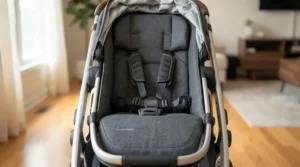
Weight tells you whether the frame copes; seat unit dimensions tell you whether your child does. A tall child within the limit can still be miserable if the backrest ends at their shoulder blades or the hood sits on their head.
| Pushchair | Published seat data | Handlebar / fold data | Best For |
|---|---|---|---|
| Silver Cross Pop | 50cm backrest; seat about 35cm wide, 21cm deep (MadeForMums-measured version) | Folded roughly 107cm long | Tall toddlers on a budget |
| MobiQuip XL | 56cm backrest (retailer figure) | Folded 112 x 30cm | Older, taller children |
| Bugaboo Fox 5 | 39cm wide, 50cm long, extendable by 10cm | Handlebar roughly 92-108cm | Tall parents and children |
| Mountain Buggy Urban Jungle | About 35cm wide; about 58cm from seat base to canopy top | Handlebar 86-117.5cm | Very tall pushers |
Looking at the comparison above, the Bugaboo Fox 5 is the only model that publishes an official seat extension, which is why it copes well with legs that keep growing. The listed 21cm depth on the Silver Cross Pop looks short, so long thighs may lack support; sit your child in one before committing. Figures come from different sources and model years, so verify before buying.
A quick test: your child’s shoulders should sit below the top of the backrest, the hood should clear their head with room to spare, and their feet should rest on the footrest, not dangle.
Pushchair for Older Child Long Walks: What Actually Works
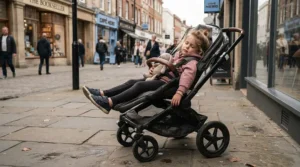
A pushchair for older child long walks is a safety net, not a default. UK guidance for under-fives, summarised on the NHS website, encourages plenty of daily movement and minimising long stretches of sitting or being restrained. So the smart plan is to let them walk the first leg, then ride the return when legs fade.
For that job, wheels beat everything. Large air-filled tyres, like the 16-inch ones on the Thule Urban Glide 3 or the 12-inch tyres on the Out ‘n’ About Nipper Single V5 and Mountain Buggy Urban Jungle, roll over roots and kerbs with less effort, which matters when you’re pushing 20kg-plus. A hand brake helps on descents, and a lockable front wheel tracks straight on paths.
Check the seat next: a footrest that reaches long legs and a hood with clearance for a taller head. Also pack for weight, not just distance: keep heavy items in the basket, never on the handles.
If your child is nearing school age and needs a ride most days, that changes the picture. It may be time to consider a specialist model such as the MobiQuip XL, whose rating is built for that stage.
Buggy for Heavy Toddler: Pushchair vs Buggy Board vs Specialist Option
A buggy for heavy toddler duty doesn’t have to mean a full-size pushchair. Here are the main alternatives.
| Option | Typical rated limit | Strength | Weak spot | Best For |
|---|---|---|---|---|
| Lightweight umbrella stroller | Can be as low as 15kg | Tiny fold, low price | Outgrown early | Short trips and holidays |
| Full-size 22kg pushchair, e.g. Baby Jogger City Sights | 22kg | Suspension, recline, storage | Bulkier | Daily use to about age four |
| Heavy-duty 25kg pushchair, e.g. Mountain Buggy Urban Jungle | 25kg | Extra headroom | Chunky fold | Big children on rough paths |
| Specialist buggy, e.g. MobiQuip XL | Up to 50kg | Grows with the child | Solid tyres, needs-focused | Older children |
| Buggy board | Check the board’s own limit | Cheap, keeps kids walking | Child stands; needs a compatible pushchair | Walkers who tire |
The table shows why weight limit alone shouldn’t drive the decision. A lightweight stroller is cheap but likely to be outgrown, while a 22kg full-size model such as the Baby Jogger City Sights covers most children until about age four. If your child is still tiring at five or six, the choice narrows to a 25kg heavy-duty model or a specialist option like the MobiQuip XL, and a buggy board is a sensible add-on for walkers who just need a rest.
Long-Term Cost & Maintenance: The Real Price of a Big-Kid Buggy
Sticker price is only half the story. A pushchair high weight limit purchase pays back through years of use, resale and fewer replacements.
| Pushchair | Approx. price range | Rated to | Rough cost per year of use* | Best For |
|---|---|---|---|---|
| Silver Cross Pop | £200-£300 | 22kg (about 4 years) | around £50-£75 | Budget city use |
| Out ‘n’ About Nipper Single V5 | £400-£450 | 22kg (about 4 years) | around £100-£115 | Rough terrain |
| MobiQuip XL | £300-£400 | 50kg (about 10 years) | roughly £35-£50 if used from age two | Older children |
| Bugaboo Fox 5 | £1,000-£1,200 | 22kg (about 4 years) | around £250-£300 | Premium, two-child use |
*Approximations assuming use to the rated age. Actual costs vary.
The MobiQuip XL wins on cost per year purely because its rating stretches years further, but only if it suits your child’s needs. The Bugaboo Fox 5 looks pricey per year, though its wheeled-board attachment points and long reputation help if it serves a second child. Maintenance is mostly cheap: wheels and tyres, harness parts and a brake check each month cost far less than replacing an overloaded frame.
Common Mistakes When Buying a Pushchair High Weight Limit
Even careful buyers trip over the same few things.
- Buying by age, not weight. ‘Birth to four years’ assumes an average child, and a tall three-year-old can hit the limit early.
- Trusting the biggest number. The Thule Urban Glide 3‘s 34kg is total capacity, not the child’s limit.
- Reading overseas specs. Regional testing means a US review may quote a bigger figure than the UK rating.
- Forgetting the seat. A child can be under the maximum user weight and still be too tall for the hood or footrest, so check seat unit dimensions.
- Ignoring your own back. A chunky frame such as the Mountain Buggy Urban Jungle folds to roughly 90 x 63 x 33cm, so measure your boot and stairs.
- Buying big too early. Mumsnet’s reviewer found the roomy seat of the Out ‘n’ About Nipper Single V5 overwhelmed a seven-month-old without a carrycot or car seat.
FAQ
❓ What is the highest pushchair weight limit in the UK?
❓ Can a five-year-old still sit in a pushchair?
❓ Are three-wheel pushchairs better for heavier children?
❓ What happens if my child is over the pushchair's weight limit?
❓ Can I go jogging with a heavier child in a pushchair?
Conclusion
A pushchair high weight limit isn’t a luxury feature. It’s the difference between a buggy that grows with your child and one that creaks, wobbles and gets replaced at the worst possible moment. The trick is reading the number honestly: child-only weight, UK specification, and a seat that actually fits.
So who should buy what? For tight budgets and city life, the Silver Cross Pop offers 22kg headroom in a light frame. Muddy footpaths call for the Out ‘n’ About Nipper Single V5 or, for a 25kg rating, the Mountain Buggy Urban Jungle. Mixed households with tall and short pushers will appreciate the Baby Jogger City Sights, long-distance walkers the Thule Urban Glide 3, and families wanting one premium pushchair for years the Bugaboo Fox 5. If your child is well past 22kg, the MobiQuip XL is the only pick here rated for it.
The ideal buggy for heavy toddler use, or a pushchair for older child long walks, is the one that matches your child’s weight, your routes and your own back. Measure, compare, and check current prices before you buy.
Recommended for You
- Pushchair for Older Child: 7 Sturdy Picks Parents Love (2026)
- Buggy for Toddler and Baby: 7 Best Picks for UK Families (2026)
- Buggy for Travel with Toddler: 7 Best Picks for UK Flights (2026)
Disclaimer: This article contains affiliate links. As an Amazon Associate, I earn from qualifying purchases. If you purchase products through these links, we may earn a small commission at no additional cost to you.
✨ Found this helpful? Share it with your friends! 💬🤗
