

In This Article
There’s a moment every parent recognises. Your child is bigger, heavier and longer-legged, but the high street stroller has run out of road. Its weight limit is spent and its footrest is a joke. Yet the school run, the supermarket and the long walk to the park haven’t got any shorter. 🚶♂️

A stroller for special needs older child users is a supportive pushchair or buggy for children who have outgrown standard strollers, which often stop at around 15-22kg. These children still need wheeled mobility because of a disability, fatigue, balance or road-safety needs. It typically offers a stronger frame, a higher weight limit, a harness and, in some models, postural support.
Searching for one is confusing because the market splits into two very different worlds. Lightweight umbrella-fold buggies cost hundreds. Tilt-in-space postural buggies cost thousands and are usually set up by a therapist. The famous Maclaren Major Elite, which anchored this category for years, is now described by UK and Irish suppliers as discontinued. Older search results still point to it, so many parents land on dead ends.
This guide sorts the real options for 2026. It covers seven named buggies, what their specs mean in daily life, and when a buggy board is not enough. It also covers postural support, VAT relief and the grants, loans and NHS budgets that can cover the cost. If your child has a disability or long-term condition, HMRC’s VAT Notice 701/7 explains when you may not need to pay VAT at all.
Prices below are ranges from research time, so check current prices before buying.
Quick Comparison: Seven Buggies at a Glance
| Product | Best For | Max User Weight | Postural Support | Price Range |
|---|---|---|---|---|
| MobiQuip XL | Taller kids, tight budgets | 50kg (listed) | Basic (harness, padded seat) | Check current price (budget tier) |
| Excel Elise Neo | Everyday urban use | 50kg tested (practical ~35kg) | Basic | Mid-£300s |
| Dobuggy Special Needs Buggy | Value plus accessories | 50kg | Basic | £240-£300 range |
| Racer Buggy | Kids needing side and head support | 50kg (Medium), 60kg (Large) | Moderate to high | £850-£900 range |
| Ormesa Bug | Tilt and recline that grows with the child | 45kg (Medium) | High | Price on application (low thousands) |
| Convaid Cruiser | Made-to-order fit, larger users | Up to 113kg (largest size) | High | Quote-based (low thousands) |
| Ottobock Kimba Neo | Children who need to lie flat | 40kg (UK catalogue) | High | Quote-based (low thousands) |
The pattern is clear. The three umbrella-style buggies (MobiQuip XL, Excel Elise Neo, Dobuggy Special Needs Buggy) cover the “can sit well, just can’t walk far” child at the lowest cost. The Racer Buggy sits in the middle for children who need extra side support. The tilt-in-space group (Ormesa Bug, Convaid Cruiser, Ottobock Kimba Neo) is priced like small vehicles because it does a clinical job: repositioning, pressure relief and growth adjustment.
💬 Just one click — help others make better buying decisions too!😊
Top 7 Strollers for Special Needs Older Child: Expert Analysis
Every buggy here is discussed on real specs. I haven’t tested any of them, so read the sentiment lines as “what could and couldn’t be verified” rather than a verdict.
1. MobiQuip XL — roomiest budget seat for taller kids
The headline is space. The listed backrest is roughly 40cm wide and 56cm tall, generous for an umbrella-fold frame. The seat weighs about 6.9kg, has puncture-proof solid tyres, a five-point harness with four shoulder heights, and a footplate with three positions (21cm, 27cm and 40cm).
That 40cm setting matters more than the 50kg headline. Leg length is usually what an older child outgrows first, and a long footplate position buys extra months. Solid tyres mean no punctures, but also no cushioning, so expect every pavement joint to travel up the frame to your child.
On paper it suits a child with decent trunk control who needs distance help rather than clinical positioning. Suppliers describe it as suitable up to about 10 years. I couldn’t verify a meaningful pool of independent reviews, so read current buyer feedback for brake feel and stitching before committing.
Pros:
- ✅ Wide, tall seat for bigger frames
- ✅ Light 6.9kg umbrella fold
- ✅ Puncture-proof tyres, no pumping
Cons:
- ❌ No suspension on rough paving
- ❌ Minimal postural support built in
Price and value: check current price. Expect the budget bracket, and good value if space matters more than support.

2. Excel Elise Neo — the natural Maclaren Major Elite replacement
Suppliers openly pitch this as the replacement for the discontinued Maclaren Major Elite. It shares the umbrella-fold lineage: an aluminium frame, five-point harness, three-position footplate and dual rear parking brakes.
It weighs about 7.5kg with the footplate (6.75kg without). Seven-inch wheels give a tiny footprint that slides into shops, classrooms and lifts, but cobbles and grass will feel like hard work. One UK retailer is candid that the 50kg tested capacity is rarely reachable in practice, because most children outgrow the leg length at around 35kg.
Who is it for? Children who are cooperative occupants and can hold themselves upright. The same retailer warns the seat may be unsuitable where postural management is needed, and that both the warranty and safe working load may drop if the child is not settled in the seat. Independent review evidence was thin when I looked, so treat retailer guidance as guidance, not customer consensus.
Pros:
- ✅ Compact fold around 1.17m long
- ✅ Range of accessories (hood, rain cover, basket)
- ✅ CE marked with parking brakes on both rear wheels
Cons:
- ❌ Small wheels struggle off smooth surfaces
- ❌ Practical limit nearer 35kg for most children
Price and value: around the mid-£300s with VAT relief, which is strong value if your child sits well.
3. Dobuggy Special Needs Buggy — sturdy 8kg budget rival with add-ons
The standout is the accessory family: sunshade, rain cover, framed storm cover, shopping basket and padded boot. Some are described as also fitting the Maclaren Major Elite, which speaks to how tightly this design follows that older benchmark.
At about 8kg it is a touch heavier than the Elise, but suppliers call it sturdy even when a child wriggles, and quote a 50kg passenger limit. It folds compactly, so it’s practical for boots, buses and quick trips. What the spec sheet won’t tell you is how well the seat suits your child’s back. Like the other umbrella-style buggies, it isn’t a postural system, and I couldn’t verify large-scale independent reviews.
It’s a sensible pick for a family that wants a solid everyday buggy with weather protection and basket space sorted from day one. If your child slumps or leans in the seat, look further up this list.
Pros:
- ✅ Sunshade, rain cover and basket options
- ✅ Sturdy build at roughly 8kg
- ✅ Compact fold for boots and buses
Cons:
- ❌ Basic seat with no built-in postural support
- ❌ Heavier than some rivals to lift
Price and value: roughly £240-£300, with VAT usually not charged for a disabled child. Very good value.
4. Racer Buggy — side pads and wedge for extra support
This is the first real step into postural support. It has adjustable side pads, a headrest, backrest, footrest and a wedge positioning system. Harnesses and a removable support rail complete the setup.
In practical terms, a child who tips sideways in an umbrella buggy is held more centrally here. It comes in sizes (Small, Medium, Large). The Medium takes users up to 50kg and about 1.6m tall, and the Large up to 60kg and 1.7m. The backrest declines to around 130-135°, giving a semi-reclined rest. Fabrics are breathable and washable, and it collapses for transport. It’s designed for children, teenagers and adults, which suggests real growth headroom.
One UK supplier showed it as out of stock at research time, so confirm current availability. Independent reviews weren’t verifiable, so I’d lean on a therapist trial rather than star ratings.
Pros:
- ✅ Adjustable side pads and headrest
- ✅ Wedge system plus support rail
- ✅ Larger size handles teens
Cons:
- ❌ Bulkier at about 1.35m long
- ❌ Stock can be patchy
Price and value: about £850-£900 with VAT relief. Reasonable value for the added support.
5. Ormesa Bug — tilt-in-space with independent gas springs
Here’s the standout: tilt and recline are each controlled by an independent gas spring. The seat hinges sit close to the child’s hips, knees and ankles, so posture is preserved as the seat moves. Slow changes of position suit children who need pressure relief or who tire quickly.
Manufacturer figures put the Medium at 45kg and the Small at 35kg. A complete outdoor set-up is heavy, roughly the high teens to low twenties of kilograms in the catalogue, so you’ll feel it when lifting into a boot. Four base options exist (one outdoor, three indoor), and accessories include trunk and lateral supports, headrests, trays and thermal covers. The Bug base has been crash-tested to ISO 7176/19.
I couldn’t verify UK owner reviews, and the model is typically supplied and fitted by specialists. Confirm the UK route with a supplier or your wheelchair service.
Pros:
- ✅ Independent tilt and recline control
- ✅ Wide range of supports and trays
- ✅ Transit crash-test data available
Cons:
- ❌ Heavy compared with umbrella buggies
- ❌ Specialist supply, not an impulse buy
Price and value: price on application, expect low thousands. Value depends on clinical need.

6. Convaid Cruiser — the made-to-measure growth buggy
The Cruiser is built to order, with a 30° fixed tilt and a self-tensioning back (Self-Tensio) that supports the pelvis while still folding like an umbrella buggy. Etac lists five sizes (CX10 to CX18) with capacities from 34kg up to 113kg on the largest.
Two details help older children. Tool-less seat-depth adjustment lets the buggy grow, and a transit option meets WC19 standards for use as a vehicle seat. At 12-15kg it is lighter than most tilting rivals, and it folds to about 43cm high. Optional 7.5″ x 2″ front air tyres are available.
Fixed tilt suits children who benefit from a stable, reclined posture without needing constant adjustment. For those who need variable positioning, the Ormesa or Kimba are the better fit. No verified review pool came up, so ask for a demonstration.
Pros:
- ✅ Five sizes up to 113kg capacity
- ✅ Seat depth grows with the child
- ✅ Folds compactly for a tilting buggy
Cons:
- ❌ Fixed tilt only, not adjustable
- ❌ Made to order, so longer lead times
Price and value: quote-based, low thousands. Strong for long-term growth.
7. Ottobock Kimba Neo — lies flat for changes and rests
The distinctive trick is that the Kimba reclines to lie flat. That matters for changing, sleeping and post-seizure recovery.
The UK catalogue lists tilt from -10° to +35°, base weight of 10.5-11.5kg and a maximum user weight of 40kg. Ottobock’s US launch coverage says the Neo raised capacity by 10% to 121lb (about 55kg) and added adjustable rear suspension and larger rear wheels. Those two figures can differ by configuration, so confirm the exact weight limit for the version quoted to you.
Suspension tension adjustments should soften kerbs and pavement vibration. Ottobock positions the range for home, school and community use, and it is normally recommended and fitted by a professional. I couldn’t verify a meaningful reviews base.
Pros:
- ✅ Reclines to lie flat
- ✅ Adjustable rear suspension tension
- ✅ Wide customisation options
Cons:
- ❌ Weight limit varies by source
- ❌ Professional fitting is essential
Price and value: quote-based, low thousands. Worth it when lying flat is a daily need.
How the Seven Compare on Specs
| Product | Weight | Portability | Tilt / Recline | Wheels |
|---|---|---|---|---|
| MobiQuip XL | 6.9kg | Umbrella fold | None stated | Solid, puncture-proof |
| Excel Elise Neo | 7.5kg (6.75kg without footplate) | 1.17m long folded | None | 7″ hard |
| Dobuggy Special Needs Buggy | About 8kg | Compact fold | None | Not verified |
| Racer Buggy | Not verified | Collapsible | Backrest decline to 130-135° | Pumped wheels with brakes |
| Ormesa Bug | High teens to low 20s kg (outdoor set-up) | Folds | Gas-spring tilt and recline | Outdoor base |
| Convaid Cruiser | 12-15kg | About 43cm high folded | Fixed 30° tilt | Optional 7.5″ x 2″ air tyres |
| Ottobock Kimba Neo | Base 10.5-11.5kg | Folds | -10° to +35°, lies flat | Larger rear wheels |
The lesson is that weight tracks clinical function. Every kilogram above 10 usually buys positioning features, and it is the price you pay when lifting into a boot. If you carry the buggy daily, the umbrella trio stays kinder on your back. If your child needs tilt or lie-flat, the extra kilos are the point, and it’s worth checking that your car boot really fits the folded frame.
How to Choose a Stroller for Special Needs Older Child
Choosing well is mostly about matching the buggy to how your child sits, not to their age.
- Start with sitting ability. Can your child sit upright for 30 minutes without slumping? If yes, an umbrella-fold buggy is plausible. If not, look at postural support.
- Measure leg length. Knee-to-heel length decides how long a footplate will fit, and it’s usually the first thing outgrown.
- Weigh the real weight. A 50kg limit doesn’t mean a 50kg child fits comfortably, and pushing a heavy child up a slope is a workout for you too.
- Map your surfaces. Small wheels suit shops and school corridors. Parks, cobbles and kerbs suit larger or air-filled wheels.
- Check the car. Measure your boot and consider whether the buggy needs a transit-tested option.
- Ask for a trial. A therapist or specialist supplier can adjust and demonstrate, which matters more than any spec sheet.

Adaptive Stroller Features That Actually Matter (And Those That Don’t)
Adaptive stroller features vary enormously, and marketing loves to blur them. Here is what earns its place.
The features worth paying for:
- A five-point harness with adjustable height. Harness fit is what keeps a child safe in the seat.
- An adjustable footplate. Growth headroom is worth more than a fancy canopy.
- Reliable rear brakes. Slopes and kerbs make this non-negotiable.
- Removable, washable fabrics. Accidents happen, and it’s better if the seat can go in the wash.
- A compact fold. If you can’t lift it into the car, you won’t use it.
The features that matter less than they sound:
- Suspension on a buggy that lives on smooth floors. Solid tyres suit school corridors, while the Ottobock Kimba Neo tunes its suspension for rougher use.
- Very high weight limits. The Excel Elise Neo is tested to 50kg, but retailers note that most children outgrow the leg length long before that.
- Extras you’ll never use. A sunshade or rain cover, by contrast, is worth adding for a buggy that lives outdoors.
Adaptive stroller features should fit your daily route, not a brochure. Write down where the buggy actually goes on an average week, then shortlist against that list.
Postural Support Seating: What It Is and When You Need It
Postural support seating means a seat designed to hold the body in a good position. It typically uses lateral supports (side pads), a shaped back, a headrest, a pelvic or chest harness and foot supports. The aim is comfort, breathing, digestion and reducing long-term strain.
The most telling sign that a child needs it is slumping or leaning that you find yourself constantly correcting. If you are propping your child up with cushions on every walk, an umbrella buggy is doing a job it wasn’t built for.
The Racer Buggy offers a mid-level step with adjustable side pads, a headrest and a wedge system. The Ormesa Bug, Convaid Cruiser and Ottobock Kimba Neo provide tilt or recline for pressure relief and repositioning. The Excel Elise Neo retailer guidance specifically warns that the standard seat may be unsuitable where postural management is needed.
Who decides? Not a search engine. A physiotherapist or occupational therapist can assess your child’s needs and recommend a set-up. For independent, non-commercial comparisons of buggies and their accessory options, Living Made Easy’s buggy listings are a helpful UK starting point. Options such as chest belts, abduction blocks, head supports and trays are listed for models such as the Ormesa Novus.
Buggy Board Alternative for Older Child: When a Board Stops Working
Many families first try a ride-on board. The Lascal BuggyBoard Maxi is a well-known example, suitable from around 2 to 6 years and up to roughly 20-22kg according to retailer listings, at under £100 in the UK. For a walking child who just needs a rest, that’s a smart, cheap fix.
But a board isn’t a seat. Your child stands or sits on a saddle attachment with no harness, so it isn’t a buggy board alternative for older child users who can’t balance or tire unpredictably. If you need one, look at the categories below.
| Option | Weight Range | Support | Best For |
|---|---|---|---|
| Lascal BuggyBoard Maxi | About 20-22kg | None, no harness | Walking child with tired legs |
| Umbrella special needs buggy (e.g. Excel Elise Neo) | Up to 50kg tested | Harness, basic seat | Child who can sit but can’t walk far |
| Tilt-in-space buggy (e.g. Convaid Cruiser) | 34-113kg by size | High, adjustable | Child needing positioning support |
If your child is heavier than 22kg or can’t stand safely while moving, a board has run its course. Look for a buggy board alternative for older child use in the umbrella category first. If posture or fatigue is a real issue, the tilt-in-space group is the more appropriate step.
Buy Pushchair for Older Child: Where, How and VAT-Free
If you plan to buy pushchair for older child use, you have three routes. Retail marketplaces such as Amazon stock umbrella-style models. Specialist UK and Irish disability suppliers stock most of the seven above and handle the VAT paperwork. Tilt-in-space models are typically quoted through specialist suppliers, often after a therapist assessment.
VAT relief deserves a careful look. HMRC’s notice sets out three conditions: the customer must be eligible, the goods must be for personal or domestic use, and the goods must qualify for the zero rate. Zero-rating works by the supplier not charging VAT, and you confirm eligibility in writing. Products must be designed solely for disabled people, so a mainstream stroller won’t qualify.
Before you commit, check these four things:
- Trial and returns policy.
- Warranty terms. The Excel Elise Neo carries one year on the frame, and it covers defects rather than wear and tear.
- Whether the quoted price already excludes VAT.
- Delivery lead times. Made-to-order buggies take longer.
Prices vary, so check current prices before buying.
Safety, Standards and Transit
Look for CE or UKCA marking and treat weight limits as maximums, not targets. The Excel Elise Neo is CE marked, and retailers add that both the safe working load and the warranty may reduce if the occupant isn’t settled.
If your child will travel in the buggy on a bus, taxi or accessible vehicle, look for transit-tested options. The Convaid Cruiser offers a transit option meeting WC19, and the Ormesa Bug base has passed ISO 7176/19 crash testing. Ask your therapist how your child should travel in a car, because a buggy is not automatically a car seat.
Finally, check the harness fit every outing, and re-check brakes after any fold and unfold.
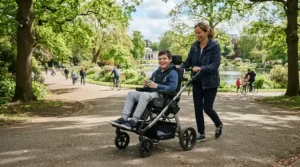
Real-World Scenarios: Three Families, Three Different Buggies
Here are three profiles matched to the best products, with the reasoning shown.
The school-run family. Nine-year-old walks short distances but tires on the mile to school. Budget is modest and the boot is small. The MobiQuip XL or Excel Elise Neo fits: light, compact and manageable in a lobby. The trade-off is minimal postural support, so watch for slumping.
The busy-weekend family. An eight-year-old needs help on long days out, with a sunshade, basket and weather cover. The Dobuggy Special Needs Buggy ticks these boxes, with accessories designed around it and around a £240-£300 budget.
The postural-need family. A twelve-year-old with low tone needs side support and regular repositioning. Trips include long car journeys. The Racer Buggy is the entry step, while the Ormesa Bug or Ottobock Kimba Neo suits stronger tilt needs. A therapist-led assessment comes first, and funding routes below may cover the cost.
If you are shopping for a stroller for special needs older child riders in one of these situations, start with the profile that looks most like yours, then adjust for your child’s specific measurements.
Problem → Solution Guide
Problem: the child slumps sideways. Try side pads or a wedge system such as the Racer Buggy. If tilt is needed, ask for a therapist assessment.
Problem: legs are dangling or knees are cramped. Adjust the footplate. The MobiQuip XL offers a 40cm position, and the Excel Elise Neo offers three settings.
Problem: the buggy is heavy to load. Compare folded dimensions before purchase. The umbrella trio is easiest, and the tilting buggies need a bigger boot.
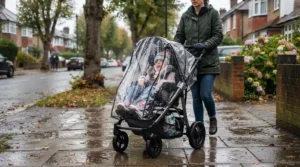
Problem: rain or sun ruins outings. Add a hood and rain cover. Accessories for the Excel Elise Neo and Dobuggy Special Needs Buggy are widely listed.
Problem: rough ground. Small wheels struggle, so consider air-tyre options like the Convaid Cruiser or suspension like the Ottobock Kimba Neo.
Your First 30 Days: Fit Check and Care
Week one, do a full fit check. Sit your child in the buggy, adjust the harness, check the footplate and confirm the brakes hold on a slope. Ask a therapist to review the fit if there are postural concerns.
Week two, walk your real routes. Try the school gate, the shop and the boot of your car, and note anything that sticks.
Week three, check for wear. Wipe-clean fabrics only stay that way if you clean them regularly. Removable upholstery on models like the Convaid Cruiser helps here.
Week four, review growth. Footplate height and seat depth are the first signs your child is outgrowing the fit. Measure again, and write the date on your calendar.
Special Needs Buggy Funding: Every UK Route Worth Trying
Special needs buggy funding isn’t one system. It’s a patchwork, so try several doors.
| Route | Who It Helps | Watch-Out |
|---|---|---|
| VAT relief | Disabled or chronically sick children | Product must qualify, and you sign a declaration |
| NHS wheelchair service and personal wheelchair budget | Children meeting local wheelchair service criteria | Clinical assessment needed |
| Newlife | UK disabled children under 19 | Local services must be contacted first, and it can take months |
| Family Fund and other charities | Low-income families | Grants vary and eligibility is narrow |
NHS England says people who use wheelchair services and meet local criteria have had a legal right to a personal wheelchair budget since 2 December 2019. Options include an NHS chair, adding your own contribution to upgrade, or using the budget with an outside supplier. In that last case, clinicians still need to confirm the chair meets your child’s needs.
Newlife offers equipment grants up to £10,000 for buggies, wheelchairs, beds and car seats. Its eligibility criteria include UK residency, an under-19 child and local services having been contacted first. It also runs an emergency loan service with a fixed six-month loan. Its Nurse Helpline is 0800 902 0095.
Family Fund supports low-income families with grants for items such as sensory toys and computers, though buggies aren’t its main focus. Local authority lists also name Whizz-Kidz, Caudwell Children and Boparan Charitable Trust as mobility-focused options.
These tools work best combined. Special needs buggy funding often means VAT relief plus a grant, or an NHS budget plus a top-up.
FAQ
❓ Is there an age limit on a special needs buggy?
❓ How long does an NHS buggy last?
❓ How long does a Newlife grant take?
❓ Will my child feel babyish in a buggy?
❓ Can I buy a second-hand special needs buggy?
Conclusion
Choosing a stroller for special needs older child riders comes down to three questions. How well does your child sit? What surfaces do you cover? And how will you pay for it?
If your child sits well and needs distance help, the MobiQuip XL, Excel Elise Neo or Dobuggy Special Needs Buggy give the most value for the least money. If posture is the issue, the Racer Buggy is the accessible step up. If tilt, recline or lying flat is the need, the Ormesa Bug, Convaid Cruiser and Ottobock Kimba Neo are worth the conversation with your therapist. And if you started with a buggy board, remember that it’s a rest for tired legs, not a seat for a child who needs support.
Before you buy, chase every funding route, from VAT relief to NHS budgets to charity grants. Then trial the buggy on your actual route, because the best spec sheet won’t beat a child who is comfortable in their seat.
Recommended for You
- Pushchair High Weight Limit: 7 Best Sturdy Picks For 2026
- Pushchair for Older Child: 7 Sturdy Picks Parents Love (2026)
- Buggy for Toddler and Baby: 7 Best Picks for UK Families (2026)
Disclaimer: This article contains affiliate links. As an Amazon Associate, I earn from qualifying purchases. If you purchase products through these links, we may earn a small commission at no additional cost to you.
✨ Found this helpful? Share it with your friends! 💬🤗
