In This Article
Nobody warns you that buying a from birth pushchair will feel like choosing a small vehicle. There are recline angles to weigh up, carrycots that may or may not be “overnight approved,” and a car seat compatibility chart that reads like a crossword. Take a breath — it’s genuinely simpler once you know what actually matters.
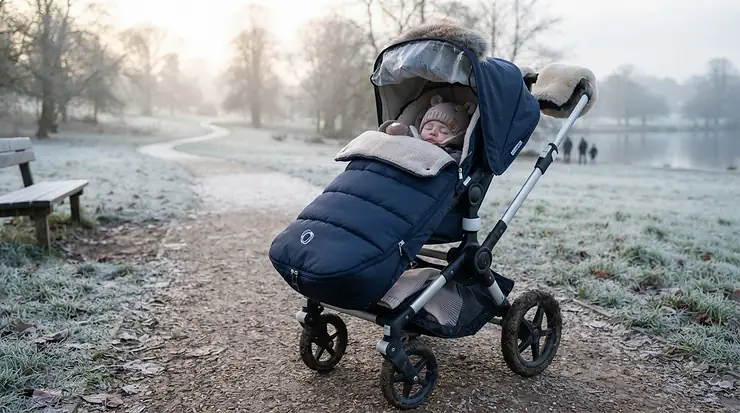
A from birth pushchair is any pushchair that can safely carry a newborn from day one, either because its seat reclines fully flat or because it accepts a compatible carrycot or infant car seat. That’s it. Everything else — the terrain, the fabric, the fold — is personal preference layered on top of that one non-negotiable requirement. 🍼
Here’s what most first-time buyers overlook: the “from birth” label on a listing doesn’t automatically mean the seat itself lies flat. Sometimes it means you’ll need to buy a carrycot separately, and that changes your total spend considerably. Below, we’ve pulled together seven genuinely from-birth-capable pushchairs, spanning budget to premium, based on real specifications and aggregated review sentiment rather than marketing copy. We’ll also walk through recline angles, travel system components, and the difference between “from birth” and “newborn-ready,” because those two phrases get used interchangeably and really shouldn’t be.
Quick Comparison: Best From Birth Pushchairs at a Glance
| Pushchair | Best For | Suitable From | Weight | Price Bracket |
|---|---|---|---|---|
| My Babiie MB450i | Best budget 3-in-1 bundle | Birth to 22kg | 9.25kg | Under £450 |
| Graco Evo XT | Best all-terrain on a budget | Birth to 13kg (seat) | 13.2kg | £350-£450 range |
| Ickle Bubba Stomp Luxe | Best accessory-packed bundle | Birth to 22kg | Around 12kg | £450-£650 range |
| Joie Versatrax | Best lightweight mid-range | Birth to 22kg | 12.98kg | Mid-£300s |
| Mamas & Papas Ocarro | Best style-led all-terrain | Birth to 22kg | 13.5kg | £750-£900 range |
| Silver Cross Reef 2 | Best premium travel system | Birth to 22kg | 13.6kg | £950-£1,050 range |
| Bugaboo Fox 5 | Best premium manoeuvrability | Birth to 22kg | 10.4-12.2kg | £1,100-£1,300 range |
Looking at the table, a clear pattern emerges: weight and price rise roughly together, but not always for reasons that matter to you personally. The My Babiie MB450i undercuts every other bundle here whilst still including a car seat, which on paper looks unbeatable — though, as we’ll get into, “includes everything” and “includes everything good” aren’t quite the same claim. Meanwhile, the Bugaboo Fox 5 sits at the top not because it’s heaviest or flashiest, but because its chassis engineering and one-hand adjustments are what you’re actually paying the premium for.
💬 Found a favourite already? Bookmark this page and compare current prices before you commit — availability shifts fast on popular bundles.
Top 7 From Birth Pushchairs: Expert Analysis
Coverage below spans budget, mid-range and premium brackets, plus a mix of full 3-in-1 travel systems and pushchair-plus-optional-carrycot setups, so you can match the right structure to your actual driving habits rather than an idealised one.
1. My Babiie MB450i — best budget 3-in-1 with car seat included
The standout here is simple: a complete travel system, including an i-Size infant carrier, for well under £450 — a bracket where most competitors sell you the pushchair alone. The aluminium chassis keeps total pushchair weight to 9.25kg, and the carrycot is rated for overnight sleep, which is unusual to find this low down the price ladder.
Specs alone don’t tell the full story, though: the 5-point magnetic harness and multi-position recline mean the seat unit itself is usable from birth even once your baby outgrows the carrycot at around six months, so you genuinely get two “from birth” routes for one price. Based on the spec comparison with rival budget bundles, this is one of the few sub-£450 systems where the car seat isn’t a token afterthought — it’s R129 i-Size certified with a proper newborn inlay.
Reviewers consistently note that it looks noticeably more expensive than its price tag suggests, though a handful flag the fold as slightly less compact than dedicated lightweight strollers. This is the pick for parents who want one purchase to cover the first four years without remortgaging the house.
Pros:
- ✅ Complete 3-in-1 bundle including car seat under £450
- ✅ Overnight-sleep-approved carrycot as standard
- ✅ Front and rear suspension smooths pavement cracks nicely
Cons:
- ❌ Folded footprint larger than dedicated compact strollers
- ❌ Basket access can feel tight with the carrycot fitted
Price sits comfortably under £450 for the full bundle, and given what’s included, this represents outstanding value-for-money for a first pushchair.
2. Graco Evo XT — best all-terrain option on a tight budget
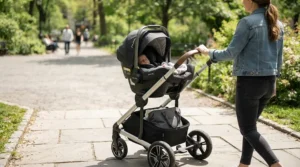
What most buyers overlook about the Graco Evo XT is that its “from birth” claim comes from the seat’s full recline rather than an included carrycot — you’ll need Graco’s matching luxury carrycot separately if you want a true lie-flat pram for the earliest weeks. The long wheelbase and genuine suspension (not just foam padding) mean it handles kerbs and gravel paths with more composure than most pushchairs in its bracket, which matters if you live somewhere with dropped kerbs that aren’t quite level.
At 13.2kg it’s on the heavier side for a budget model, and reviewers frequently mention that assembly out of the box is fiddlier than expected — set aside a proper half hour rather than doing it one-handed with a newborn crying nearby. The three-position recline and adjustable telescopic handle make it comfortable for taller and shorter parents to share pushing duties, which aggregated feedback flags as a genuine strength.
If your daily walks involve parks and uneven pavements rather than smooth shopping centre floors, this earns its keep.
Pros:
- ✅ Genuine suspension copes well with rough pavements
- ✅ Adjustable handle suits parents of different heights
- ✅ Large basket and mudguards for grim weather days
Cons:
- ❌ Carrycot for true lie-flat sold separately
- ❌ Assembly instructions widely reported as unclear
Expect to pay in the £350-£450 range for the pushchair alone, with the carrycot adding to that if you want the full from-birth setup.
3. Ickle Bubba Stomp Luxe — best for accessory-packed bundles
The Ickle Bubba Stomp Luxe wins on sheer inclusion: a ten-to-twelve-piece bundle that typically covers changing bag, car window shades, footmuffs and a spin ISOFIX base, items that cost extra almost everywhere else. The seat reclines through four positions, including a genuine lie-flat setting for newborns, and the puncture-proof rear wheels have a quick-release mechanism for cleaning that reviewers rate highly after muddy walks.
Here’s what the spec sheet won’t tell you: because so much is bundled in, the overall package feels heavier to manoeuvre one-handed than the weight figure alone suggests, since you’re often carrying the changing bag and pushing at the same time.
Aggregated feedback is consistently positive on value for money, with several parents comparing it favourably against systems costing double, though a minority note the carrycot feels a touch shallow for bigger newborns. For parents who’d rather buy once and never think about accessories again, this is hard to beat.
Pros:
- ✅ Ten-plus accessories included, rarely sold as extras elsewhere
- ✅ Four-position recline with a true lie-flat setting
- ✅ 180° spin ISOFIX base speeds up car transfers
Cons:
- ❌ Carrycot feels shallow for larger newborns
- ❌ Bundle bulk makes one-handed carrying trickier
Typically priced in the £450-£650 range depending on the fabric and car seat pairing chosen, which is competitive for what’s included.
4. Joie Versatrax — best lightweight mid-range multimode pram
The Joie Versatrax picked up a Red Dot “Best of the Best” award, and the standout in daily use is the foam-filled, puncture-proof tyres paired with genuine shock-absorbing suspension — you get an all-terrain ride without the all-terrain bulk. The reversible, fully reclining seat unit is suitable from birth on its own, so the Ramble XL carrycot (sold separately) becomes a nice-to-have rather than a requirement, which keeps your entry cost down compared with bundled systems.
On paper this means flexibility: pair it with a carrycot for the newborn stage, then drop the accessory and use the seat unit for years afterwards. Reviewers rate the one-handed fold and large, easy-access basket highly, though a recurring theme in aggregated feedback is that the seat feels snug once toddlers approach the upper weight limit, and there’s no central bumper bar included with the carrycot.
Best suited to parents who want all-terrain composure in a genuinely liftable, mid-£300s package.
Pros:
- ✅ Foam-filled tyres eliminate puncture worries entirely
- ✅ Seat unit alone is usable from birth, no carrycot required
- ✅ One-handed fold genuinely works one-handed
Cons:
- ❌ Seat runs snug for children near the 22kg limit
- ❌ Carrycot sold separately and lacks a bumper bar
Sitting in the mid-£300s for the pushchair, with the carrycot typically adding roughly £100 if you choose that route, this remains one of the more honest value propositions in the mid-range bracket.
5. Mamas & Papas Ocarro — best style-led all-terrain pushchair
What stands out about the Mamas & Papas Ocarro is the dual-suspension chassis combined with genuinely puncture-proof tyres, which reviewers describe as noticeably smoother over cobbles and gravel than rival all-terrain models at this price point. The one-hand, near-flat recline is a favourite feature in aggregated feedback — parents repeatedly mention their baby falling asleep mid-walk thanks to the fully supported lie-back position.
Here’s the honest trade-off: at roughly 13.5kg with a premium leather-trimmed finish, you’re paying for materials and design language as much as functional upgrades over cheaper all-terrain rivals, and it doesn’t convert to a double for a second child. The three recline positions and adjustable handle height (useful if it’s shared between two Honda-Jazz-driving parents of different heights, as one reviewer memorably put it) add genuine day-to-day convenience.
This is the pick for parents who walk daily on mixed terrain and want the pushchair to look as considered as the rest of the nursery.
Pros:
- ✅ Dual suspension smooths cobbles and uneven pavement
- ✅ Near-flat one-hand recline praised consistently by reviewers
- ✅ Compact one-handed fold despite the all-terrain build
Cons:
- ❌ Does not convert into a double pushchair
- ❌ Premium finish commands a premium price versus rivals
Positioned in the £750-£900 range depending on bundle, this sits at the upper-mid tier — a genuine step up from the Versatrax in materials, though not necessarily in day-to-day function.
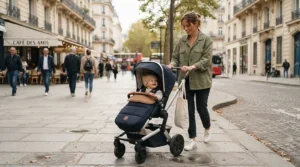
6. Silver Cross Reef 2 — best all-round premium travel system
The Silver Cross Reef 2 earns its premium tag through genuine engineering depth: triple-layer side-impact protection, a carrycot approved for overnight sleeping both on and off the chassis, and compatibility with car seats from Cybex, Nuna, Maxi-Cosi and Clek via adapters. The lie-flat recline plus included newborn apron means the seat itself is from-birth capable without the carrycot, though most parents opt for the carrycot bundle for the earliest months regardless.
What most buyers overlook is the magnetic Genius buckle — reviewers are split on it, with several noting it’s genuinely fiddly to secure with a wriggling newborn, though it becomes second nature within a few uses. Aggregated sentiment is strongly positive on ride quality and build feel, with one tester describing airflow venting in the carrycot as reassuring on a train journey where their baby shifted position slightly.
At 13.6kg it’s not the lightest to lift into a boot, and the fold, while one-handed, has a learning curve worth practising before your baby arrives.
Pros:
- ✅ Triple-layer side-impact protection built into the seat
- ✅ Carrycot overnight-sleep approved on and off the chassis
- ✅ Wide car seat compatibility across four major brands
Cons:
- ❌ Magnetic buckle fiddly with a wriggling newborn
- ❌ Folding mechanism needs practice before relying on it
Bundle pricing typically runs from around £695 for the pushchair-and-carrycot package up to roughly £1,000 with a car seat and ISOFIX base included, positioning it firmly in the premium bracket without reaching flagship-Bugaboo territory.
7. Bugaboo Fox 5 — best premium manoeuvrability and build quality
The Bugaboo Fox 5 is the lightest pushchair in this premium bracket at 10.4-12.2kg depending on configuration, and that weight saving translates directly into one-hand adjustments that feel meaningfully easier than heavier premium rivals when you’re also holding a baby or a bag of shopping. The chassis is built with bio-based materials that reduce production emissions, a detail that matters to environmentally conscious parents without compromising the all-terrain suspension or extra-large puncture-proof wheels.
Based on the spec comparison with the Reef 2 and Ocarro, the Fox 5’s modular design stands out for repairability — individual parts can be swapped rather than replacing the whole unit, which matters for total cost of ownership over four years. Reviewers consistently praise the manoeuvrability in tight spaces, though several note the fold is best suited to larger car boots rather than compact hatchbacks, and the carrycot-to-seat transition can feel fiddly on first attempts.
This is the pick for parents prioritising day-to-day ease of use over accessory count.
Pros:
- ✅ Lightest pushchair in the premium comparison set
- ✅ Modular design allows individual part repairs
- ✅ One-hand adjustments genuinely usable single-handed
Cons:
- ❌ Folded size suits larger boots better than compact cars
- ❌ Carrycot-to-seat transition fiddly for first-time users
Complete pushchair-and-carrycot bundles generally sit in the £1,100-£1,300 range, making this the most expensive pick here — though total cost of ownership arguments (below) complicate a simple price comparison.
From Birth vs Newborn-Ready: What’s the Difference?
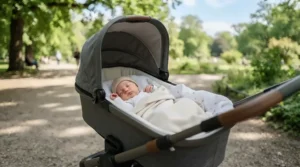
This is where a lot of first-time parents get caught out, so let’s be precise. A pushchair marketed as “from birth” must, at minimum, provide a genuinely flat, supported sleeping surface — either via a seat that reclines completely flat or a separate carrycot. “Newborn-ready” is a softer, unregulated phrase some retailers use more loosely, sometimes describing a seat that reclines to a steep angle rather than fully flat.
The distinction matters because of how newborns’ bodies work. A young baby’s neck muscles and spine aren’t developed enough to safely support an upright or semi-reclined seated position for extended periods; a genuinely flat surface keeps the airway open and supports natural spinal curvature. The NHS gives clear safer-sleep guidance around flat, firm sleep surfaces for young babies, and while that guidance is written primarily for cot and Moses basket sleep, the same physiological logic is why manufacturers and testers treat “fully flat” as the bar for from-birth suitability rather than “reclines a lot.”
In practice, this means: always check whether the recline goes to a genuine 180 degrees, or whether the listing photo is doing some visual heavy lifting on a 150-degree angle that looks flatter than it is. The Silver Cross Reef 2 and Mamas & Papas Ocarro both achieve true lie-flat in the seat itself; the Joie Versatrax does too. Others, like the Graco Evo XT, rely on a separate carrycot to guarantee the fully flat position, with the seat’s recline serving toddlers and older babies instead.
Travel System Components Explained
A travel system sounds like one product, but it’s really three or four components working together, and understanding each one saves you from expensive compatibility mistakes later.
The chassis is the wheeled frame itself — the part that determines ride quality, fold size, weight, and suspension. This is what you’re really buying when you compare My Babiie, Joie or Bugaboo frames against each other, since the chassis usually outlasts everything else attached to it.
The carrycot (sometimes called a bassinet) is a rigid, flat sleeping unit that clips onto the chassis, purpose-built for newborns up to around six months. Not every carrycot is rated for overnight sleep — the Silver Cross Reef 2 and Ickle Bubba Stomp Luxe carrycots are, but always check the specific rating rather than assuming.
The seat unit is the toddler-facing seat used from roughly six months (or from birth, if it fully reclines) through to around four years or 22kg. This is usually reversible between parent-facing and world-facing modes.
The infant car seat clips directly onto the chassis using adapters, letting you move a sleeping baby from car to pushchair without waking them — this is the piece that actually makes it a “travel system” rather than just a pushchair. Compatibility matters enormously here: the Silver Cross Reef 2 works with Cybex, Nuna, Maxi-Cosi and Clek seats via adapters, while Joie’s own chassis pairs natively with Joie’s own car seat range using a Maxi-Cosi-style attachment for cross-brand options.
Recline Angle for Infants: Why It’s Non-Negotiable
Recline angle is one of those specs that sounds boringly technical until you realise it’s doing genuine safety work. A newborn’s head is proportionally heavy and their neck muscles simply aren’t strong enough to hold it upright for long stretches — propped up at even a 45-degree angle, the chin can fall towards the chest and partially restrict the airway, a position sometimes called positional asphyxiation risk in clinical literature.
Here’s the practical takeaway: for the first months, look for pushchairs offering a genuine 165-180 degree recline, not a “multi-position recline” that tops out at a steep-but-not-flat angle. Among the seven featured here, the Silver Cross Reef 2, Mamas & Papas Ocarro and Joie Versatrax all achieve true lie-flat in the seat itself, meaning you’re not locked into buying a carrycot to get safe newborn positioning. The My Babiie MB450i and Ickle Bubba Stomp Luxe achieve it via their included carrycots rather than the seat units. Reviewers of the Graco Evo XT frequently note that whilst the three-position recline is genuinely useful for older babies, parents wanting a true flat newborn position should budget for the matching carrycot from day one rather than an afterthought purchase.
How to Choose the Best 3-in-1 From Birth Pushchair
Faced with dozens of near-identical bundles, here’s the criteria worth actually weighing, in the order we’d recommend tackling them:
- Confirm true from-birth suitability first. Check whether the recline is genuinely flat or whether a carrycot is required — don’t take “suitable from birth” at face value without checking which component achieves it.
- Match the chassis to your terrain. If your daily walk involves parks, gravel or uneven pavements, prioritise suspension and wheel size over folded dimensions.
- Weigh the pushchair yourself if you can. A 3kg difference sounds trivial until you’re lifting it into a boot one-handed with a baby on your hip.
- Check car seat compatibility before falling in love with a chassis. If you already own a car seat, confirm the adapter ecosystem supports it rather than assuming universal compatibility.
- Total the real cost, not just the headline price. Carrycots, adapters, rain covers and footmuffs sold separately can add £150-£300 to an apparently cheaper chassis.
- Test the fold mechanism in-store if possible. One-handed folding claims vary wildly in real-world difficulty, and this is the feature you’ll use most often, several times a day.
- Read aggregated review sentiment, not star ratings alone. A 4.5-star average can hide a recurring complaint (fiddly buckle, shallow carrycot) that matters enormously to your specific circumstances.
The independent testing team at Which? tests pushchairs specifically for newborn suitability, fold mechanism and comfort, and cross-referencing their lab findings against real-parent forums is a genuinely efficient way to shortcut hours of individual product research.
Best From Birth Travel System: Real-World Scenarios
Scenario one — the first-time parent on a tight budget. You want everything included without three separate purchases, and you’re not fussed about premium fabrics. The My Babiie MB450i covers pushchair, carrycot and car seat for under £450, which for many families is genuinely the entire pram budget sorted in one transaction.
Scenario two — the daily dog-walker who lives near unmade paths. Terrain matters more to you than styling. The Graco Evo XT or Joie Versatrax both offer genuine suspension and puncture-proof tyres without premium pricing, though budget separately for a carrycot if you want true lie-flat from day one.
Scenario three — the parent who wants one pushchair to feel considered for four years. You’re willing to spend more upfront to avoid replacing kit as your child grows, and you value build quality and repairability. The Silver Cross Reef 2 or Bugaboo Fox 5 both offer wide car seat compatibility, genuine engineering depth, and (in the Fox 5’s case) a modular design built around long-term repair rather than replacement.
Practical Usage Guide: Setting Up Your From Birth Pushchair
Getting a new pushchair right in the first month makes an enormous difference to daily stress levels, so here’s what the box insert rarely spells out clearly.
Before first use, unfold and refold the chassis at home, without the baby, at least five times until it becomes muscle memory — doing this for the first time on a rainy pavement with a crying newborn is a genuinely common regret reported across parenting forums. Check the harness threading matches your baby’s current height setting rather than the default factory position, since most seats ship set for a taller infant.
In the first 30 days, the most common mistake is over-tightening the recline mechanism lock, which can make later adjustments stiffer than intended — a light touch on release levers is usually all that’s needed. Fit the carrycot mattress correctly (flat side up, following the manufacturer’s diagram) rather than assuming it’s symmetrical, since an incorrectly seated mattress can create an uneven sleeping surface.
Ongoing maintenance is genuinely light for most models: wipe down fabric monthly, check tyre pressure on any air-filled wheels every few weeks, and inspect the harness buckle for grit build-up, particularly if you’ve been to the beach or a muddy park. A five-minute monthly check extends the working life of the chassis considerably and keeps brakes responsive.
Optimisation trick worth knowing: most adapters for car seats and carrycots click on with an audible or visible confirmation — if you’re not hearing or seeing that confirmation, don’t assume it’s “close enough.” A partially seated carrycot is one of the more common near-miss incidents reported in community forums like Mumsnet’s pushchair reviews section, where real parents flag exactly this kind of practical, unglamorous detail that marketing copy skips entirely.

Common Mistakes When Buying a From Birth Pushchair
The single most frequent mistake is buying based on folded dimensions alone without checking unfolded width against your front door or hallway — a pushchair that fits your car boot perfectly can still be a squeeze through a narrow Victorian terrace doorway.
A close second is assuming “from birth” and “fully flat recline” are interchangeable, when — as covered above — many bundles achieve from-birth status via a separate carrycot rather than the seat itself. Skipping this check leads to an unplanned extra £100-£250 purchase weeks before the birth, at the worst possible time for surprise expenses.
Parents also commonly under-budget for accessories. Rain covers, footmuffs and car seat adapters are sometimes included, sometimes not, and the headline chassis price rarely reflects the true out-the-door cost. Finally, many buyers skip testing the fold mechanism before purchase, only to discover weeks in that “one-handed fold” requires a specific two-step sequence that isn’t remotely intuitive under time pressure.
Long-Term Cost & Maintenance
Total cost of ownership matters more than sticker price alone, particularly across a four-year usage window. A £400 budget bundle that needs a £150 replacement seat cover after eighteen months of hard use may end up costing more than a £700 mid-range system built with more durable fabrics from the outset.
Consider cost-per-use: if a pushchair genuinely lasts the full birth-to-22kg window (roughly four years) and gets used daily, even a £1,200 premium system like the Bugaboo Fox 5 works out to under 90 pence per day — arguably reasonable for a product your child sits in constantly. Compare that against a cheaper model that needs partial replacement (a new carrycot, a repaired wheel) at the two-year mark, and the maths shifts considerably. Modular designs that allow individual part repair — a genuine strength of the Bugaboo Fox 5 — tend to hold their resale value better too, which matters if you’re planning to sell on afterwards.
Maintenance costs across the range are generally modest: expect to budget occasionally for replacement wheels (£20-£40 a pair) or a seat liner refresh (£25-£60) rather than any major ongoing expense, provided the chassis itself was well-built from day one.
Safety, Regulations & Compliance Guide
Every pushchair sold in the UK, new or second-hand, must meet the safety standard BS EN 1888, which covers structural integrity, brake performance, harness security and stability testing. Under the General Product Safety Regulations, manufacturers and retailers have a legal duty to supply pushchairs that are safe for normal, foreseeable use, and compliant products should carry a label confirming the standard on the frame or seat covering — always check for this, particularly if buying second-hand.
Infant car seats used as part of a travel system fall under separate i-Size (R129) or ECE R44/04 regulations, and it’s worth confirming which standard your chosen car seat meets, since i-Size generally reflects more recent, side-impact-focused testing. All the car seats referenced in this guide — the included carriers with My Babiie, Ickle Bubba and Joie bundles, plus the compatible third-party seats for Silver Cross and Bugaboo chassis — meet current i-Size standards.
Beyond the regulatory checklist, practical safety habits matter just as much: always use the harness, never hang heavy shopping bags from the handles (this can tip the pushchair backwards), and check the brake engages fully before letting go on any slope.
Features That Actually Matter (And Those That Don’t)
Genuinely worth prioritising: a true flat recline or overnight-approved carrycot, suspension quality if your daily terrain is uneven, and car seat adapter compatibility if you already own one. These three factors affect daily safety and convenience far more than anything else on a spec sheet.
Genuinely overhyped, based on aggregated review sentiment: cup holders (rarely mentioned as a deciding factor, though pleasant to have), an extra-large canopy window (nice, but rarely cited as a purchase-swaying feature), and colour-matched accessory sets, which look appealing in marketing photography but add cost without functional benefit. Basket size sits in an interesting middle ground — reviewers across every price bracket mention it more than almost any other feature, so it’s worth more attention than glossy marketing tends to give it.
Problem → Solution Guide
Problem: the fold feels impossible with a baby in one arm. Solution — practise the fold repeatedly before the birth, and consider models like the Joie Versatrax or Bugaboo Fox 5, both praised in aggregated reviews for genuinely intuitive one-hand mechanisms.
Problem: the pushchair struggles on gravel or grass. Solution — prioritise all-terrain suspension and larger wheels; the Graco Evo XT, Mamas & Papas Ocarro and Bugaboo Fox 5 all perform well here according to real-world feedback.
Problem: budget got eaten by the car seat and carrycot as separate purchases. Solution — a bundled 3-in-1 like the My Babiie MB450i or Ickle Bubba Stomp Luxe locks in the total cost upfront rather than accumulating surprise add-ons.
Problem: baby seems uncomfortable or restless in the seat. Solution — double-check the recline is genuinely flat rather than merely steep, and confirm the harness is threaded at the correct height for current size, not the factory default.
Problem: storage space at home is tight. Solution — check folded dimensions against your actual hallway or car boot before buying, not just against a generic “compact” marketing claim, and consider lighter chassis options like the Bugaboo Fox 5 if lifting into storage is a daily task.

Frequently Asked Questions
❓ Is a carrycot always necessary for a from birth pushchair?
❓ What's the minimum recline angle for newborn safety?
❓ Can I use an infant car seat instead of a carrycot from birth?
❓ How long does a from birth pushchair typically last?
❓ Is it worth paying more for a premium from birth travel system?
Conclusion
Choosing a from birth pushchair really comes down to three honest questions: does it genuinely support a flat, safe newborn position, does its build suit your daily terrain, and does the total cost — accessories included — actually fit your budget? Get those three right and almost everything else, from colour choice to cup holders, is genuinely just personal preference.
Across the seven pushchairs compared here, there’s a workable option at every price point: the My Babiie MB450i for parents wanting one affordable purchase covering birth to toddlerhood, the Joie Versatrax or Graco Evo XT for terrain-focused mid-range buyers, and the Silver Cross Reef 2 or Bugaboo Fox 5 for parents prioritising long-term build quality and resale value. The Ickle Bubba Stomp Luxe and Mamas & Papas Ocarro sit usefully in between, each solving a slightly different priority — accessory count versus styled all-terrain performance.
Whichever you choose, take the time to properly test the fold, confirm the recline angle, and total the real cost before checkout. A little research now saves considerable frustration on the first genuinely rainy day out.
✨ Ready to compare current prices and availability on today’s pick? Click through on any highlighted model above to check the latest listings before they change! 🛒
Recommended for You
- Pram for Newborn Twins: 7 Best UK Picks That Actually Work (2026)
- Best Carrycot Pushchair UK 2026: 7 Expert-Reviewed Picks
- Pushchair for Newborn: 7 Best Buys Tested ; Ranked (2026)
Disclaimer: This article contains affiliate links. As an Amazon Associate, I earn from qualifying purchases. If you purchase products through these links, we may earn a small commission at no additional cost to you.
✨ Found this helpful? Share it with your friends! 💬🤗
