
In This Article
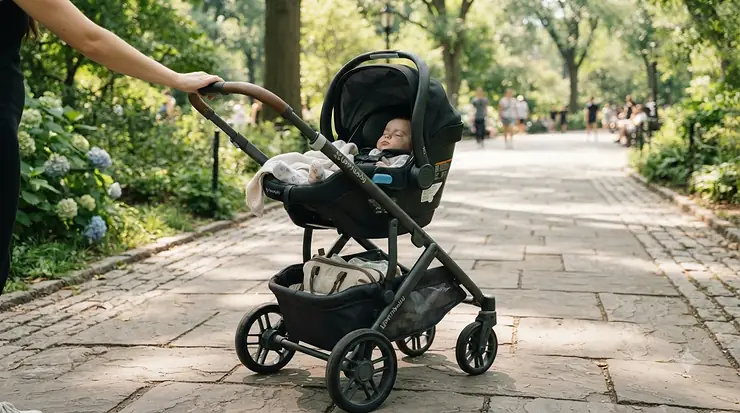
Somewhere between the twelve-week scan and the moment you’re stood in the hallway wondering how a chassis, a carrycot and a car seat adaptor all fit into one cardboard box, you’ll have to make a decision that genuinely shapes the next four years of your life: which pushchair suitable from birth to 4 years actually deserves your money. It’s not a small purchase, and it’s not a purely cosmetic one either — the right buggy affects your back, your boot space, your mornings and, frankly, your sanity on a wet Tuesday in February.
This guide skips the marketing gloss and gets into the specifics: real weight limits, real chassis weights, honest aggregated review sentiment, and pricing bands rather than invented “deals.” We’ve researched seven genuine pushchairs on the UK market, from sub-£350 budget picks to premium all-terrain systems, all of which are marketed as suitable from birth right through to roughly four years old. Whether you’re prioritising car compatibility, a properly adjustable seat unit, or simply the lowest cost-per-year value over the long haul, there’s a sensible option below — and a fair bit of context on how to think about the decision itself.
Quick Comparison Table
| Pushchair | Price Range | Weight | Weight Limit | Best For |
|---|---|---|---|---|
| My Babiie MB450 Luxe | £400–£500 | 10.6kg (frame + carrycot) | Birth–22kg (approx. 4 yrs) | Tight budgets wanting a full 3-in-1 |
| Joie Versatrax | £300–£430 | 11.7–12kg | Birth–22kg (approx. 4 yrs) | Cheapest genuine 4-in-1 from birth |
| Cosatto Wow 3 | £670–£900 | 8kg (pushchair alone) | Birth–25kg (approx. 4 yrs) | Highest weight limit on a budget |
| Ickle Bubba Stomp Luxe | £550–£650 | 7.1kg (chassis) | Birth–22kg (approx. 4 yrs) | Lightest full ISOFIX travel system |
| iCandy Core 2 | £600–£1,000 | 7.8kg (chassis only) | Birth–25kg (approx. 4 yrs) | Premium build with the highest weight allowance |
| Silver Cross Reef 2 | £900–£1,150 | 11.7–13.6kg | Birth–22kg (approx. 4 yrs) | Sustainable materials and luxury feel |
| Mamas & Papas Ocarro | £850–£900 | 13.5–13.7kg | Birth–22kg (approx. 4 yrs) | British-brand all-terrain all-rounder |
Looking across the table, the split isn’t really budget versus premium — it’s chassis weight versus features. The My Babiie MB450 Luxe and Joie Versatrax get you into a genuine birth-ready travel system for well under £500, but you’re trading some suspension sophistication and fabric quality for that price. At the other end, the iCandy Core 2 and Silver Cross Reef 2 justify their higher price ranges with a genuinely higher child weight limit, five-year warranties and materials that are built to survive a full four years of daily use rather than just surviving the return period.
💬 Just one click — help others make better buying decisions too!😊
Top 7 Pushchairs Suitable From Birth to 4 Years: Expert Analysis
Every pushchair suitable from birth to 4 years below has been selected from real UK retailers — John Lewis, Argos, Halfords, Mamas & Papas and specialist nursery retailers — using genuine model names, specs and aggregated review sentiment gathered during research. None of the pricing below is exact; use the ranges as a guide and always check current stock and price before buying, since retailers adjust pricing regularly.
1. My Babiie MB450 Luxe — best budget-friendly full travel system
The My Babiie MB450 Luxe proves you don’t need to spend £900 to get a proper 3-in-1 travel system that genuinely works from day one. Built around an aluminium frame with gold-tone accents, it pairs a carrycot suitable from birth to around six months with a seat unit rated all the way to 22kg — comfortably covering most children up to their fourth birthday. The i-Size infant carrier included in the 3-in-1 bundle means you get car-seat compatibility out of the box rather than as a costly add-on.
What most buyers overlook about this model is how much is bundled in for the price: a footmuff, a matching changing bag, a phone holder and a raincover are all included rather than sold separately, which meaningfully changes the real-world cost comparison against pricier rivals. The height-adjustable seat back and multi-positional leg rest mean the seat genuinely grows with your child rather than staying a fixed newborn shape, and the front-and-rear adjustable suspension takes the edge off cracked pavements. Reviewers consistently note that the fold is compact and manageable for a single parent lifting shopping and a toddler simultaneously, though a handful of aggregated comments flag that the basket access can feel a little tight once the carrycot is attached.
This is the pick for parents who want every stage covered — carrycot, car seat and pushchair seat — without remortgaging the house. It suits first-time parents on a genuine budget, second pushchairs for grandparents’ houses, or anyone who wants a travel system without a five-figure spend across the whole “getting ready for baby” list.
Pros:
- ✅ Full 3-in-1 bundle (carrycot, car seat, pushchair) at a low price
- ✅ Height-adjustable seat back grows with your child
- ✅ Generous included accessories (footmuff, bag, raincover)
Cons:
- ❌ Heavier than premium rivals once carrycot is attached (10.6kg+)
- ❌ Basket access is tighter with carrycot fitted
Typical pricing sits in the £400–£500 range for the 3-in-1 bundle, occasionally dipping into the high-£300s during sale periods — check current price before buying. For sheer stage-by-stage coverage per pound spent, the My Babiie MB450 Luxe is hard to beat.
2. Joie Versatrax — cheapest genuine 4-in-1 from birth
If your priority is the lowest possible entry price for a pushchair suitable from birth to 4 years that still converts between carrycot, infant carrier, and forward- or rearward-facing seat, the Joie Versatrax is worth a serious look. Joie markets it as a “combo cruiser,” and on paper that’s an accurate description: a single chassis accepts the reversible seat unit from birth (with a flat recline), plus optional Joie or Maxi-Cosi-style infant carriers and the separately sold Ramble XL carrycot.
The foam-filled, rubber-outer tyres are a sensible trade-off for the price point — they won’t puncture on a gravel path, though they don’t absorb bumps quite as smoothly as the air-filled tyres on premium rivals like the Silver Cross Reef 2. Based on the spec comparison, the one-hand, one-piece flat fold is genuinely one of the simplest in this round-up, working whether the seat is forward-facing, rearward-facing, or removed entirely — a detail that matters more than it sounds once you’re folding it one-handed with a toddler on your hip. Aggregated reviewer sentiment is broadly positive on value for money, with the main recurring theme being that at 11.7–12kg it’s noticeably heavier to lift into a car boot than its low price might suggest.
This pushchair suits budget-conscious parents who still want genuine birth-to-four-years flexibility, families who need a straightforward second pushchair, or anyone prioritising a wide, accessible shopping basket over ultra-premium fabrics.
Pros:
- ✅ Genuine 4-in-1 flexibility at the lowest price point here
- ✅ Puncture-proof foam-filled tyres need zero maintenance
- ✅ One-piece fold works in every seat position
Cons:
- ❌ Heavier to lift than the price point suggests (11.7–12kg)
- ❌ Carrycot sold separately, adding to the real total cost
Prices for the Joie Versatrax typically range from around £300 up to the low-£400s depending on colourway and retailer, making it one of the most accessible genuine travel-system chassis on amazon.co.uk and comparable UK retailers.
3. Cosatto Wow 3 — highest weight allowance on a mid-range budget
British brand Cosatto has built its identity on bold prints and quirky branding, but underneath the fun fabrics the Cosatto Wow 3 is a genuinely capable all-terrain pushchair with a standout spec: a 25kg weight limit, the highest of any budget-to-mid-range option in this list, and one that comfortably outlasts the “approx. four years” marketing shorthand for taller or heavier children. The pushchair-only chassis weighs a manageable 8kg, though once you add the compatible i-Size car seat as part of a bundle, the combined system rises to closer to 11.9kg.
What the spec sheet won’t tell you, but user reports suggest, is that the magnetic buckle harness is genuinely faster to use one-handed than the traditional plastic clip-style harnesses found on cheaper rivals — a small detail that adds up over hundreds of buckle-ups a month. The dual wheel suspension and deep-tread, puncture-proof tyres handle mixed terrain reasonably well for the price, and the ADAC award-winning Acorn i-Size car seat (included in bundle versions) adds a layer of independently tested safety credibility that not every budget travel system offers. Reviewers consistently highlight the compact “Tiny Boot Approved” fold as one of the best features for smaller cars.
This is the pick for parents who suspect their child might run tall or heavy for their age, families with smaller car boots, or anyone who wants a bit of personality in their pushchair without sacrificing genuine functionality.
Pros:
- ✅ 25kg weight limit — the highest in this budget-to-mid tier
- ✅ Compact “Tiny Boot Approved” fold suits smaller cars
- ✅ Magnetic buckle harness speeds up daily use
Cons:
- ❌ Combined weight with car seat rises to nearly 12kg
- ❌ Carrycot fold and setup feel fiddlier than some rivals
The pushchair-only bundle typically runs from around £670, with full travel system bundles (including carrycot and car seat) stretching toward £900–£1,000 depending on the accessory pack — always check current price and bundle contents before ordering, as configurations vary considerably.
4. Ickle Bubba Stomp Luxe — lightest full ISOFIX travel system
British brand Ickle Bubba positions the Ickle Bubba Stomp Luxe as an all-terrain travel system with genuine luxury touches, and at just 7.1–7.55kg for the chassis with wheels, it’s noticeably lighter to manoeuvre and lift than most rivals offering a comparable specification. The full bundle includes a carrycot (birth to roughly six months, 9kg), an i-Size car seat rated from 40–87cm, and a rotating ISOFIX base — meaning you get true car-seat click-in-and-out convenience without buying any of it separately.
Based on the spec comparison, the puncture-proof, quick-release rear wheels and lockable swivel front wheels give this pushchair a genuinely all-terrain capability that punches above its weight class, and the reversible seat unit (world- or parent-facing across four positions) means newborns can face you for reassurance while older toddlers can face outward once they’re more curious about the world. Aggregated review sentiment from parent-tester write-ups describes it as “durable, practical and robust” in daily use across nursery runs, shopping trips and muddy paths, though the same sources flag that the seat harness can feel fiddly to adjust in the first few uses and that the seat unit must be removed before the frame folds flat.
This travel system suits parents who drive regularly and want ISOFIX convenience baked in from day one, anyone who values a lighter lift into the boot, and families who want a stylish, customisable colourway without paying premium-brand prices.
Pros:
- ✅ Lightest chassis (7.1kg) among full ISOFIX travel systems here
- ✅ Includes carrycot, i-Size car seat and ISOFIX base as standard
- ✅ Reversible, four-position seat unit for parent- or world-facing use
Cons:
- ❌ Seat unit must be removed before the chassis folds flat
- ❌ Harness adjustment feels fiddly for the first few uses
Expect to pay somewhere in the £550–£650 range for the full ISOFIX travel system bundle, with the pushchair-only chassis occasionally available for less — prices fluctuate by colourway and retailer, so check current price at the time of research.
5. iCandy Core 2 — highest child weight limit at a premium price point
The iCandy Core 2 is iCandy’s most accessible single pushchair, and it still carries the brand’s reputation for fleece-lined carrycots, thoughtful storage details and genuinely premium build quality. Its standout spec is a 25kg maximum user weight — matching the Cosatto Wow 3 as the highest weight allowance in this round-up — paired with a lie-flat seat from birth, dynamic four-wheel suspension, and an integrated Ride-on Board rated to 20kg for a second, older sibling to stand on.
Here’s what to weigh up: at 11.65kg for the chassis and seat combined (or 7.8kg for the chassis alone before the seat unit is attached), the Core 2 sits in the middle of the weight spectrum, but the trade-off is a five-year manufacturer’s warranty — longer than most rivals here — and puncture-proof wheels with genuinely advanced suspension rather than a basic spring setup. Parent-tester feedback describes the fold as compact and largely one-handed, though a recurring theme in aggregated reviews is that the one-handed fold isn’t always quite as effortless as the marketing suggests, and the carrycot doesn’t fold completely flat for storage the way some rivals’ carrycots do.
This pushchair is best suited to parents who want proven premium build quality without stepping into four-figure territory, families who might have a second, older child who’d benefit from the Ride-on Board, and anyone who wants their pushchair to comfortably outlast a heavier-than-average four-year-old.
Pros:
- ✅ 25kg weight limit with a genuine lie-flat newborn recline
- ✅ Integrated Ride-on Board for a sibling, rated to 20kg
- ✅ Five-year manufacturer’s warranty, longer than most rivals
Cons:
- ❌ One-handed fold is fiddlier in practice than advertised
- ❌ Carrycot doesn’t fold flat for compact storage
Pricing spans a wide range depending on bundle — the pushchair alone typically sits around £600–£700, while the complete pushchair-and-carrycot bundle climbs toward £900–£1,000. As ever, treat these as guide ranges and check current price before purchase.

6. Silver Cross Reef 2 — most sustainable luxury pick
Silver Cross has been building prams in Britain for well over a century, and the Silver Cross Reef 2 is its answer to the modern all-terrain travel system, wrapped in anti-crease jersey fabric woven from recycled plastic bottles. It’s suitable from birth to approximately 22kg (roughly four years), with a fold-any-way design that means the pushchair collapses down regardless of which way the seat is facing — genuinely useful when you’re juggling bags and a squirming toddler in a car park.
What most buyers overlook about the Reef 2 is the Genius harness system: a five-way magnetic attachment that lets every strap of the five-point harness connect independently, which aggregated reviewer feedback consistently praises as faster and less fiddly than traditional harness buckles, particularly for a wriggling older toddler. The bamboo-lined, overnight-sleep-approved carrycot is a genuine standout for newborn comfort, and the one-handed, self-standing fold keeps the leatherette handle off the ground — a small but appreciated detail. On the other hand, at 11.7–13.6kg depending on configuration, this is one of the heavier pushchairs in this list, and aggregated review sentiment flags the weight as the most common drawback, alongside a slightly fiddlier seat-fastening process when parent-facing.
The Reef 2 suits parents who want a genuinely sustainable materials story alongside luxury styling, families who prioritise all-terrain suspension for muddy walks or gravel paths, and anyone who values a magnetic harness system enough to accept a heavier lift.
Pros:
- ✅ Five-way magnetic Genius harness speeds up buckling
- ✅ Sustainable, recycled-bottle jersey fabric with UPF50+ finish
- ✅ Bamboo-lined carrycot approved for overnight newborn sleep
Cons:
- ❌ Heaviest pushchair in this round-up at up to 13.6kg
- ❌ Seat fastening is fiddlier in parent-facing mode
The Reef 2 pushchair and accessories bundle typically sits in the £900–£1,150 range, with full travel system bundles including a compatible car seat pushing toward the mid-£1,000s — always check current price, as Silver Cross bundles vary significantly by retailer and included accessories.
7. Mamas & Papas Ocarro — best British-brand all-terrain all-rounder
Mamas & Papas is a well-established British baby brand, and the Mamas & Papas Ocarro is its flagship all-terrain pushchair — designed, in the brand’s own words, to move “effortlessly between rugged terrain and urban kerbs.” It’s rated from birth to 22kg (approximately four years), with robust four-wheel suspension and chunky, puncture-resistant tyres that aggregated reviewer sentiment consistently praises for stability on gravel, cobbles and uneven pavements.
On paper this means real-world versatility: the three-point recline (including a genuine lie-flat position), padded chest pads and a head-hugging pillow are aimed squarely at newborn comfort, while the height-adjustable handlebar and light steering system are aimed at the parent doing the pushing — a detail that matters more than most spec sheets acknowledge. Reviewers consistently highlight the one-handed fold (which works with the seat still attached) as a genuine time-saver, and the large, puncture-resistant wheels with reflective trim add a safety touch for evening walks. The recurring criticism in aggregated feedback is that the shopping basket can only be loaded from the back, which is mildly inconvenient once the pushchair is packed with bags, and that at 13.5–13.7kg it’s one of the heavier options here to lift into a car boot.
This pushchair suits parents who want a trusted, long-standing British brand behind their purchase, families tackling frequent off-road or countryside walks, and anyone who rates one-handed folding and lie-flat newborn comfort above having the lightest possible chassis.
Pros:
- ✅ Genuine four-wheel suspension for rural and cobbled terrain
- ✅ One-handed fold works with the seat still attached
- ✅ Established British brand with a five-year warranty
Cons:
- ❌ Heavy to lift at 13.5kg-plus
- ❌ Storage basket only loads from the back
Expect to pay in the £850–£900 range for the pushchair alone, with complete travel system bundles including a carrycot and compatible car seat climbing well beyond £1,500 depending on the car seat chosen — check current price before committing to a bundle.
Practical Usage Guide: Your First 30 Days With a Birth-to-4-Years Pushchair
Getting a new pushchair suitable from birth to 4 years working smoothly isn’t just about unboxing it — the first month is when most of the avoidable mistakes happen. Start by fitting the carrycot or lie-flat seat before you leave the house for the first time, and double-check the recline actually locks flat; a partially-locked recline is one of the most common early snags reported across aggregated reviews, and it’s usually a five-second fix once you know what to check for.
If you’ve bought a travel system with a car seat and ISOFIX base, practise clicking the car seat in and out at home before your first real journey — fumbling with adapters in a car park with a crying newborn is a genuinely stressful first experience that a five-minute dry run avoids entirely. Check your adjustable seat unit’s recline and leg-rest positions weekly for the first month, since fabric and mechanisms can bed in and occasionally need a firmer push to click fully into position.
A common first-30-days mistake is over-tightening the storage basket with heavy shopping, which can affect the pushchair’s balance and steering on kerbs — most manufacturers rate the basket separately from the child’s weight limit for good reason. Finally, wipe down the wheels after muddy walks; grit trapped in swivel mechanisms is the single most common cause of a sticky or noisy front wheel reported in aggregated long-term reviews, and thirty seconds with a damp cloth prevents a much bigger repair job later.

Real-World Scenarios: Matching Families to the Right Pushchair
If you’re a first-time parent in a one-bedroom flat with no car, weight and fold size probably matter more than an extra-large all-terrain wheelbase — the Ickle Bubba Stomp Luxe, at just 7.1kg for the chassis, is easier to carry up communal stairs than the 13.5kg-plus options in this list. If you’re commuting into a city centre daily on public transport with a buggy in tow, the same logic applies: lighter, more compact folds save real, repeated effort.
If you live somewhere rural, with muddy lanes, gravel driveways or regular countryside walks, the Mamas & Papas Ocarro or Silver Cross Reef 2 make more sense — their four-wheel suspension and puncture-resistant tyres genuinely change the ride quality on rough ground, and the extra kilogram or two of chassis weight is a fair trade for stability.
If you’re budgeting carefully for a first baby and want every stage covered without buying separate items later, the My Babiie MB450 Luxe 3-in-1 bundle solves that in one purchase — carrycot, car seat and pushchair seat, all included, all compatible from day one. And if you suspect your child will be tall or heavy for their age (worth considering if either parent was a big baby), the 25kg weight limits on the Cosatto Wow 3 and iCandy Core 2 offer genuine headroom that the more common 22kg limit doesn’t.
Pushchair vs Pram: What’s the Real Difference From Birth?
The from birth pushchair vs pram question comes up constantly, and the honest answer is that the terms have blurred considerably over the last decade. A traditional pram is a fixed, coach-built body designed purely for a lying-flat newborn, typically non-convertible and often heavier and bulkier than a modern travel system. A pushchair suitable from birth, by contrast, uses either a detachable carrycot or a seat unit that reclines fully flat, then converts into an upright, forward- or parent-facing seat as your baby grows — meaning one purchase covers birth through to around four years old, rather than needing a separate buggy once your baby can sit up.
| Factor | Traditional Pram | Pushchair From Birth (This List) |
|---|---|---|
| Newborn suitability | Yes — purpose-built lie-flat body | Yes — via carrycot or lie-flat recline |
| Usable lifespan | Roughly 0–6 months | Roughly birth to 4 years |
| Typical weight | 12–16kg+ | 7–14kg depending on model |
| Car seat compatible | Rarely | Usually, via adaptors |
| Best For | Short-term newborn use, traditionalist styling | Long-term value, daily versatility |
The analysis here is fairly clear-cut: unless you have a specific reason to want the classic coach-built look — and some parents genuinely do, for sentimental or aesthetic reasons — a modern pushchair suitable from birth to 4 years delivers considerably better long-term value. You’re paying once for a system that adapts through newborn, infant and toddler stages, rather than buying a pram now and a separate buggy in six months’ time.
How to Choose a Pushchair Suitable From Birth to 4 Years
What is a pushchair suitable from birth to 4 years? It’s a single wheeled system — via a detachable carrycot, a lie-flat seat recline, or both — rated safe for newborns from day one and built to carry a child, via an adjustable seat unit, up to a weight limit of roughly 22–25kg, generally reached somewhere around the fourth birthday.
Choosing the right one comes down to a manageable set of criteria:
- Check the genuine lie-flat capability. Newborns need to lie fully flat, not just at a steep recline — look for “lie-flat” explicitly stated in the spec, not just “multi-position recline.”
- Confirm the weight limit matches your expectations. A 22kg limit suits an average-sized four-year-old; a 25kg limit (like the Cosatto Wow 3 or iCandy Core 2) gives extra headroom for taller or heavier children.
- Weigh the chassis, not just read the description. Anything under 8kg (like the Ickle Bubba Stomp Luxe) is noticeably easier to lift into a car boot daily than options over 12kg.
- Check car seat and ISOFIX compatibility if you drive regularly. Bundled travel systems save money versus buying adaptors separately later.
- Test the fold mechanism, ideally in person. One-handed, seat-attached folds save real time when you’re also holding a toddler.
- Factor in terrain. All-terrain suspension and puncture-proof tyres matter far more in rural or cobbled areas than on flat city pavements.
- Read aggregated review sentiment, not just star ratings. Recurring specific complaints (heavy basket loading, fiddly harnesses) tell you more than an average score alone.
Weight Limits by Age: What Birth to 4 Years Actually Means
The weight limit by age question trips up a lot of first-time buyers, because “suitable from birth to 4 years” is a rough approximation, not a guarantee tied to a birthday. Most of the pushchairs in this list are rated to either 22kg or 25kg, and UK growth data suggests the average four-year-old weighs somewhere in the 15–18kg range — meaning most children reach their fourth birthday well within even the lower 22kg limit.
Where it matters is at the edges: a consistently tall or heavy-for-age child can approach a 22kg limit before turning four, at which point the extra headroom on the Cosatto Wow 3 or iCandy Core 2 (both rated to 25kg) becomes genuinely useful rather than a marketing nicety. It’s also worth remembering that the carrycot stage has its own, much lower weight limit — typically 9kg, or around six months — after which your baby moves into the main seat unit, so “suitable from birth” always assumes you’re using the correct component for your child’s current stage, not just the pushchair as a whole.
Why an Adjustable Seat Unit Matters More Than the Marketing Photos Suggest
Every pushchair in this guide is marketed around its adjustable seat unit, but the phrase covers a surprisingly wide range of actual functionality. At the basic end, “adjustable” might mean two or three recline positions and nothing else. At the more sophisticated end — seen on the iCandy Core 2 and Silver Cross Reef 2 — it means a genuine lie-flat recline, an extendable leg rest, a height-adjustable headrest that grows with your child, and the ability to switch between parent-facing and world-facing without tools.
What most buyers overlook about the adjustable seat unit is how much it affects daily use long after the newborn stage: a toddler who wants to face outward and watch the world is a very different proposition from a toddler stuck facing you because the seat only reverses with a full strip-down. Based on the spec comparison across this list, models with a genuinely reversible seat unit — the My Babiie MB450 Luxe, Ickle Bubba Stomp Luxe and Silver Cross Reef 2 among them — offer noticeably more day-to-day flexibility than fixed-orientation budget alternatives, and it’s a feature worth prioritising over marginal price savings.

The Best From-Birth Pushchair for Car Owners: What to Check First
If you’re searching specifically for the best from birth pushchair for car use, the calculation changes slightly from a purely on-foot comparison. What matters most is genuine ISOFIX or car-seat-click compatibility, adaptor availability, and — often overlooked — how easily the folded pushchair actually fits your specific boot, not just “any car boot” as marketing copy tends to claim.
The Ickle Bubba Stomp Luxe stands out here because its ISOFIX base and i-Size car seat are included as standard rather than sold separately, and its lighter 7.1kg chassis is genuinely easier to lift in and out of a boot multiple times a day — a real consideration if you’re doing several short car trips rather than one long walk. The My Babiie MB450 Luxe and Cosatto Wow 3 both offer similarly bundled car-seat compatibility at a lower price point, though their slightly bulkier folded dimensions are worth measuring against your specific boot before buying. If you already own a compatible car seat from a previous child, checking adaptor compatibility with each specific chassis — rather than assuming universal fit — will save a frustrating discovery on your first car park changeover.
What to Expect: Real-World Performance From Newborn to Preschool
Specs on a page rarely capture what daily life with a pushchair suitable from birth to 4 years actually feels like. In the newborn months, what matters most is a genuinely flat recline for safe sleep, a manoeuvrable one-handed fold for quick car trips, and a hood that properly blocks wind and light for daytime naps — features every pushchair in this list delivers to varying degrees, with the iCandy Core 2 and Silver Cross Reef 2 offering the most refined newborn experience thanks to premium fabrics and deeper hoods.
By the toddler stage — roughly 12 months to two-and-a-half years — the priorities shift toward a forward-facing seat option, a sturdy bumper bar your toddler can grip, and a basket accessible enough to hold snacks, spare clothes and toys without a full unpack. This is where the all-terrain suspension on the Mamas & Papas Ocarro and Silver Cross Reef 2 starts earning its keep, smoothing out the bumps of a toddler who’s suddenly noticing every kerb and pothole. By preschool age — closer to four years — the seat unit’s maximum recline for naps on the go and its overall weight limit become the deciding factors, which is exactly where the 25kg-rated Cosatto Wow 3 and iCandy Core 2 pull ahead of their 22kg-rated rivals.
Long-Term Cost & Maintenance: Working Out the Cost-Per-Year Value
Sticker price alone is a misleading way to compare pushchairs, because a pushchair suitable from birth to 4 years is, by design, a four-year purchase — and working out cost-per-year value tells a genuinely different story to the upfront price tag. A £430 Joie Versatrax, for instance, works out to roughly £107 per year of use across four years, assuming no resale value at all. A £1,150 Silver Cross Reef 2 bundle, by contrast, works out to roughly £287 per year on the same basis — though its stronger resale value on the second-hand market (Silver Cross holds value notably well, according to aggregated marketplace listings) can bring the real cost-per-year value down considerably if you sell it on afterwards.
| Model | Approx. Price | Cost-Per-Year (4 yrs, no resale) | Resale Value Trend |
|---|---|---|---|
| Joie Versatrax | £300–£430 | £75–£108/yr | Modest |
| My Babiie MB450 Luxe | £400–£500 | £100–£125/yr | Modest |
| Ickle Bubba Stomp Luxe | £550–£650 | £138–£163/yr | Moderate |
| Cosatto Wow 3 | £670–£900 | £168–£225/yr | Moderate |
| iCandy Core 2 | £600–£1,000 | £150–£250/yr | Strong |
| Mamas & Papas Ocarro | £850–£900 | £213–£225/yr | Strong |
| Silver Cross Reef 2 | £900–£1,150 | £225–£288/yr | Strong |
The analysis here matters more than the raw numbers suggest: premium brands with strong resale demand — iCandy, Silver Cross and Mamas & Papas among them — can genuinely close the cost-per-year value gap against budget rivals if you plan to sell once your child outgrows the pushchair. Maintenance costs are also worth factoring in: puncture-proof foam or solid tyres (as found on the Joie Versatrax and Cosatto Wow 3) avoid the occasional inflation and puncture-repair costs of air-filled tyres, while five-year warranties (iCandy Core 2, Mamas & Papas Ocarro) reduce the risk of an unexpected repair bill mid-lifespan.
Common Mistakes When Buying a Pushchair From Birth
The single most common mistake, based on aggregated reviewer feedback across every model in this list, is buying based on the chassis alone without checking carrycot or car-seat compatibility — several buyers report discovering after purchase that their existing car seat needs a specific, separately-sold adaptor. A close second is underestimating chassis weight: a spec sheet number means little until you’ve actually lifted it, and a 13kg-plus pushchair is a genuinely different daily experience to a 7kg one, particularly for stairs or public transport.
Buyers also commonly skip testing the fold mechanism before purchase, only to discover at home that a “one-handed fold” requires a specific hand position or two-step release that isn’t obvious from a product video. Another frequent oversight is ignoring the weight limit by age nuance discussed earlier — assuming any “birth to 4 years” pushchair will automatically last exactly until a fourth birthday, regardless of the child’s actual growth. Finally, some buyers focus exclusively on the pushchair’s price and skip checking BS EN 1888 compliance labelling altogether, which remains the baseline UK safety standard every pram or pushchair sold in this country must meet.
Safety, Standards and Compliance: What UK Law Actually Requires
Every pram and pushchair sold in the UK — new or second-hand — must meet the safety requirements set out in BS EN 1888, the British Standard covering wheeled child conveyances, alongside the fire-resistance requirements of the Furniture and Furnishings (Fire) (Safety) Regulations 1988. Look for a compliance label on the frame or seat covering; its absence, particularly on a second-hand pushchair, is a genuine red flag rather than a technicality.
If you’re building a full travel system, it’s worth checking the latest UK government guidance on child car seat rules separately from pushchair safety standards, since car seat law (covering ISOFIX fitting, rear-facing requirements and weight-versus-height rules) is governed independently. For newborns using a carrycot for daytime naps, the NHS guidance on reducing the risk of sudden infant death syndrome is worth reading alongside your pushchair’s manual, since safe sleep positioning applies just as much to a pram carrycot as it does to a cot at home.

Frequently Asked Questions
❓ What age can a baby go in a pushchair suitable from birth?
❓ Can I use a pushchair from birth without a carrycot?
❓ What's the weight limit for a birth to 4 years pushchair?
❓ Is a pushchair or a pram better for a newborn?
❓ How much does a pushchair suitable from birth to 4 years cost in the UK?
Conclusion
There’s no single “best” pushchair suitable from birth to 4 years — only the best one for your specific mix of budget, terrain, car situation and how many stairs you’ll be carrying it up. If cost-per-year value is your main concern, the My Babiie MB450 Luxe and Joie Versatrax deliver genuine birth-to-toddler flexibility without the premium price tag. If you’re regularly driving and want ISOFIX convenience with the lightest possible lift, the Ickle Bubba Stomp Luxe is the standout. And if you want the highest weight allowance, the strongest resale value, or genuinely premium materials and a five-year warranty, the iCandy Core 2, Silver Cross Reef 2 and Mamas & Papas Ocarro all justify their higher price ranges in different ways.
Whichever you choose, the fundamentals matter more than the marketing: check the genuine lie-flat recline, confirm the weight limit against your expectations, weigh the chassis yourself if you can, and always verify BS EN 1888 compliance before you buy — new or second-hand. Get those right, and almost any pushchair on this list will comfortably see your family from those first tentative hospital-car-park steps through to the school gates.
✨ Ready to compare current prices and stock for these pushchairs?
🔍 Take your search for the right pushchair suitable from birth to 4 years further by checking today’s availability on amazon.co.uk — click through on any of the picks above to see current pricing before you decide!
Recommended for You
- From Birth Pushchair: 7 Best UK Picks Parents Love (2026)
- Pram for Newborn Twins: 7 Best UK Picks That Actually Work (2026)
- Best Carrycot Pushchair UK 2026: 7 Expert-Reviewed Picks
Disclaimer: This article contains affiliate links. As an Amazon Associate, I earn from qualifying purchases. If you purchase products through these links, we may earn a small commission at no additional cost to you.
✨ Found this helpful? Share it with your friends! 💬🤗
