
In This Article
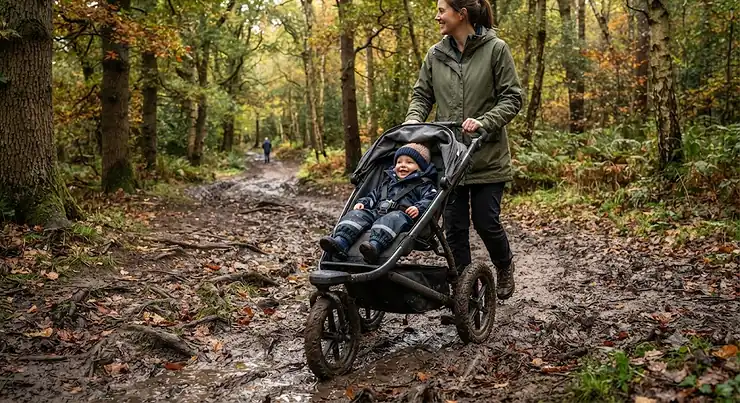
Somewhere between the health visitor telling you to “get outside every day” and the reality of your local footpath turning into a swamp after two days of rain, most parents discover the same uncomfortable truth: the pushchair they bought for pavements is not the pushchair they need for a pushchair for countryside walks. Small plastic wheels sink. Cheap suspension rattles a baby awake. And nothing kills a Sunday walk faster than yanking a stuck front castor out of a rut while your toddler heckles you from the seat.
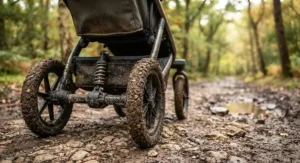
A genuinely capable pushchair for countryside walks is built around three things: big air-filled or puncture-resistant tyres, real suspension travel, and a frame stiff enough not to twist when one wheel drops into a ditch and the other doesn’t. Get those right and a gravel bridleway feels almost as smooth as the high street. Get them wrong and you’ll be carrying the thing more than pushing it.
This guide walks through seven real, currently available buggies — from a £180 budget option to a near-£1,000 flagship — with honest analysis of what each does well, where it falls short, and which type of walker it actually suits. We’ve leaned on aggregated reviewer and owner feedback rather than invented anecdotes, so where the data is thin, we say so rather than guessing. Prices are given as ranges, since retailer pricing shifts constantly — always check current pricing before buying.
Quick Comparison Table
| Pushchair | Wheel Size | Weight | Price Range | Best For |
|---|---|---|---|---|
| Hauck Runner 2 | 12″/16″ air-filled | approx. 12kg | under £200 | Budget first buggy |
| Out n About Nipper V6 | 12″ air-filled | approx. 12.25kg | £300-£400 range | All-round countryside daily driver |
| Out n About Nipper V6 Plus | 14″ air-filled | approx. 12.5kg | £600-£700 range | Hills, running, rough ground |
| Thule Urban Glide 4-Wheel | 12″ foam/air hybrid | approx. 10.5kg | £400-£500 range | Lightweight jogging and trails |
| Silver Cross Cove | Large air-filled | approx. 13kg | £750-£850 range | Style-conscious countryside families |
| Bugaboo Fox 5 Renew | Large puncture-proof | approx. 13kg | £1,150-£1,350 range | Premium all-rounder, town and country |
| Mountain Buggy Terrain | 16″/12″ air-filled (dual set) | approx. 13.5kg | £950-£1,250 range | Serious off-roaders, farm tracks, dog walks |
Looking across the table, there’s a clear split between the budget three-wheelers built almost entirely around big air tyres, and the premium four-wheel travel systems that add suspension engineering, fold sophistication and better resale value on top. If pure ground clearance and mud-shedding ability are your priority, the Mountain Buggy Terrain and Out n About Nipper V6 Plus lead the pack because they were designed around rough terrain first and city convenience second. Families who split their week between the school run and the fields, meanwhile, tend to gravitate toward the Bugaboo Fox 5 Renew or Silver Cross Cove, which trade a little off-road purity for a smoother multi-surface ride and nicer finish.
💬 Just one click — help others make better buying decisions too!😊
Top 7 Pushchairs For Countryside Walks: Expert Analysis
1. Out n About Nipper V6 — best all-round countryside daily driver
The Out n About Nipper V6 has been Mumsnet’s pick for best overall all-terrain pram, and once you’ve pushed one across a muddy field, it’s easy to see why. Its 12-inch air-filled tyres and swivel-lock front wheel mean you get tight manoeuvrability in shops and cafés, then lock the front wheel forward the moment the tarmac runs out and the bridleway begins. At 12.25kg it’s genuinely light for a three-wheeler with this much off-road capability, which matters the day you’re lifting it in and out of a muddy boot with a squirming toddler under one arm.
On the spec sheet, the built-in suspension and one-hand fold sound like marketing filler, but in practice the suspension is what stops a rutted farm track translating into a jarring ride for a napping baby, and the one-hand fold is the difference between a five-second pack-up and a two-minute wrestling match at a car park in the rain. What most buyers overlook about this model is that it’s compatible with a proper carrycot for newborn use, so it doesn’t need replacing the moment your family grows into a second walk-heavy phase.
Reviewers consistently note that the Nipper V6 handles sand, grass, gravel and uneven paths with confidence, and that the swivel-lock system genuinely earns its keep on rough ground rather than being a token gesture. A recurring theme in owner feedback is that the basket, while decent, isn’t huge — something to weigh up if you’re the type to combine a countryside walk with a farm-shop stock-up.
Pros:
- ✅ Lightweight for a genuine all-terrain three-wheeler
- ✅ Swivel-lock front wheel suits both shops and mud
- ✅ Carrycot and car seat compatible for newborn use
Cons:
- ❌ Storage basket is smaller than some rivals
- ❌ No handbrake, so hill control relies on the foot brake
Priced in the £300-£400 range, the Nipper V6 sits comfortably as a mid-tier buy — not the cheapest on this list, but arguably the best value if a genuine pushchair for countryside walks is your only pushchair.
2. Out n About Nipper V6 Plus — best for hills, running and proper rough ground
Take everything above and upgrade the wheels to 14 inches, add a handlebar-mounted handbrake, and you’ve got the Out n About Nipper V6 Plus — currently the only swivel-front buggy in the UK to pass the BS EN1888-3:2023 running test standard. That certification isn’t just a badge; it means the frame, brakes and stability have been independently tested at running speeds, which matters if your countryside walk sometimes turns into a jog to beat the rain.
The bigger 14-inch wheels genuinely change the ride — reviewers who’ve compared it directly to the standard V6 describe noticeably less jiggle for the child and less effort for the person pushing, particularly over tree roots and dirt paths. The handbrake is the standout practical addition: on a steep bridleway descent, having a lever you can feather with your hand rather than relying purely on a foot brake gives real confidence, especially one-handed while holding a dog lead or a second child’s hand.
Based on the spec comparison with the standard Nipper V6, the trade-off is straightforward — you’re paying roughly £250-£300 more for wheels, a handbrake and a running certification that only matters if you actually plan to jog or tackle consistently steep, technical terrain.
Pros:
- ✅ 14″ wheels smooth out roots, ruts and rough tracks
- ✅ Handbrake gives real control on steep descents
- ✅ Officially certified for running under BS EN1888-3:2023
Cons:
- ❌ Noticeably pricier than the standard V6
- ❌ Larger wheels add a little bulk to the fold
Expect to pay in the £600-£700 range for the single Plus pushchair alone, rising if you add the Adventure or newborn bundles.
3. Hauck Runner 2 — best budget off-road pushchair for gravel paths
If your countryside walking is occasional rather than daily, or your budget is tight, the Hauck Runner 2 is the obvious starting point. At an RRP under £200, it undercuts most all-terrain rivals by a wide margin while still offering large air-filled tyres, a lockable 360° swivel front wheel, and a seat that reclines fully flat for naps on the move.
Here’s what to weigh up: the air-filled tyres genuinely glide over grass, gravel and packed dirt in a way that budget foam-wheeled buggies simply can’t, and testers who ran the Runner 2 over “smooth paths and tarmac, to steep inclines with rocky, uneven wet and muddy terrains” reported it held up admirably for the price. What the spec sheet won’t tell you, but owner reviews consistently flag, is that the plastic components — particularly around the brake mechanism — start to feel less sturdy after a year or two of hard use, and the frame is on the long side, which makes it awkward for public transport or airport travel.
Aggregated review sentiment paints a genuinely two-sided picture: several owners praise the value-for-money and terrain handling, while a smaller but consistent group report issues with the seat unit clicking into place and brake reliability over time. That’s a useful signal — buy it expecting a solid two-to-three-year workhorse rather than a decade-long investment.
Pros:
- ✅ Large air-filled tyres handle rough terrain well
- ✅ UPF 50+ canopy with mesh ventilation window
- ✅ Genuinely budget-friendly for a three-wheel all-terrain design
Cons:
- ❌ Build quality feels less robust after heavy use
- ❌ Long folded frame is awkward for public transport
At under £200, this is the pick for parents who want to test whether they actually enjoy off-road walking before committing to a premium buggy.
4. Thule Urban Glide 4-Wheel — best lightweight jogger for trails
The Thule Urban Glide 4-Wheel takes a different approach to countryside capability: instead of maximising wheel size, it minimises weight. At around 10.5kg, it’s the lightest buggy on this list by some margin, which matters enormously if your “countryside walk” also involves lifting the pushchair over stiles, gates or into a car boot on uneven farmyard ground.
Reviewers who’ve taken it running describe the ride as comfortable at pace, with the four-wheel layout (rather than a three-wheeler’s single front castor) adding stability on cambered or uneven paths where a swivel wheel can occasionally catch. Based on the spec comparison with heavier three-wheelers on this list, the Urban Glide trades some outright rough-terrain ground clearance for agility and a noticeably easier push on mixed terrain — woodland paths, towpaths and firm coastal trails suit it well, though genuinely boggy fields will test it more than the bigger-wheeled options above.
What most buyers overlook is that this is fundamentally a running buggy first and an all-terrain pushchair second — the fixed or lockable front wheel and narrower tyre profile are optimised for forward momentum rather than crawling over deep ruts at walking pace. For committed runners who also want one buggy for weekend countryside walks, that trade-off makes sense; for parents whose priority is purely rough-ground crawling, the Mountain Buggy Terrain or Nipper V6 Plus below will serve better.
Pros:
- ✅ Exceptionally light at around 10.5kg
- ✅ Stable four-wheel platform for cambered paths
- ✅ Comfortable ride at both walking and jogging pace
Cons:
- ❌ Less ground clearance than dedicated off-road three-wheelers
- ❌ Not suitable from birth without an additional bassinet
Priced in the £400-£500 range, it’s a strong pick for active parents who want one buggy that does trails, towpaths and the odd parkrun without feeling like hard work to push.
5. Silver Cross Cove — best for style-conscious countryside families
The Silver Cross Cove proves that “built for the countryside” doesn’t have to mean utilitarian. Air-filled tyres deliver genuinely exceptional shock absorption, the hood has multiple adjustable positions for extra headroom as your child grows, and the whole unit folds one-handed — a small detail that becomes a big deal when you’re managing a dog lead, a flask and a toddler at the same time.
What stands out on paper is the carrycot’s overnight-sleep suitability, meaning the Cove can double as a genuine travel system rather than a pushchair you’ll outgrow within a year. Reviewers describe it as “a superb companion for everything from daily school runs to dog walks in the forest,” which is precisely the dual-purpose brief most countryside-dwelling families are shopping for. The machine-washable fabrics at 30°C are a genuinely practical touch too — anyone who has tried to hand-scrub dried mud out of a pushchair seat at 9pm will appreciate not having to.
Here’s what to weigh up: this is a premium product, and the price reflects a brand with 140-plus years of pram-making history rather than a stripped-back off-road specialist. If your countryside walking is genuinely daily and technical — deep mud, steep hills, long distances — the dedicated all-terrain options above may serve you better for less outlay. If you want a buggy that looks as good outside the school gates as it performs on a woodland path, the Cove earns its premium positioning.
Pros:
- ✅ Air-filled tyres deliver excellent shock absorption
- ✅ Carrycot suitable for overnight newborn sleep
- ✅ Machine-washable fabrics simplify muddy-walk clean-up
Cons:
- ❌ Premium pricing compared with dedicated off-road three-wheelers
- ❌ Heavier than lightweight jogging alternatives
Expect a price in the £750-£850 range for the pushchair, with carrycot and newborn accessories adding further cost.
6. Bugaboo Fox 5 Renew — best premium all-rounder for town and country
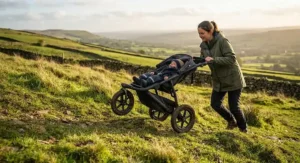
Bugaboo’s flagship, the Bugaboo Fox 5 Renew, is engineered around one core promise: a smooth ride whether you’re navigating a cobbled high street or a gravel forest trail, without switching buggies. Large puncture-proof wheels glide over gravel, grass and uneven ground, while four-wheel suspension irons out the kind of small, constant vibration that makes a long countryside walk tiring for a sleeping baby.
Based on the spec comparison with other premium options here, the Fox 5 Renew’s headline strength is genuine versatility — testers who reviewed the original Fox 5 in depth highlighted the smooth ride and practical features as standout traits, and those core strengths carry through to the Renew update. The robust yet lightweight frame is also easier to manoeuvre in tight spaces than its size might suggest, which matters for parents splitting time between narrow village streets and open fields.
What the spec sheet doesn’t fully convey is the cumulative effect of small design details — from parent-facing options with the bassinet to a frame that copes with genuinely varied terrain without feeling like two different compromises stitched together. The trade-off, unsurprisingly, is price: this sits at the top of our list, aimed squarely at families who want one exceptional buggy rather than a budget option plus a premium upgrade later.
Pros:
- ✅ Four-wheel suspension smooths both streets and trails
- ✅ Puncture-proof wheels reduce maintenance hassle
- ✅ Parent-facing seat option available with bassinet
Cons:
- ❌ Among the most expensive options on this list
- ❌ Folded size is bulky for smaller car boots
Priced in the £1,150-£1,350 range, the Fox 5 Renew is a genuine investment purchase — one many families make once, rather than upgrading through several buggies.
7. Mountain Buggy Terrain — best for serious off-roaders and farm tracks
For parents whose “countryside walk” regularly means dog fields, forest paths and genuinely uneven farm tracks, the Mountain Buggy Terrain is the most purpose-built option on this list. It’s the only buggy here that ships with two complete wheel sets — 16-inch for maximum off-road capability and 12-inch for tighter, more urban use — letting you swap depending on where the day takes you, at no extra cost.
The 16-inch air-filled wheels sit higher off the ground, giving genuinely useful clearance over ruts, tree roots and boggy patches that would catch a smaller-wheeled buggy. Reviewers who’ve used it for daily dog walks in rural areas describe the suspension as excellent and note it “opened up so much exploring” that would otherwise have been impractical with a pushchair. The hand-operated control brake — working alongside a foot brake — gives genuine confidence on the kind of hilly, technical tracks that make up a lot of proper countryside walking, and Mountain Buggy’s signature “kerb pop” engineering means less force is needed to lever the front wheel over obstacles than with comparable rivals.
What most buyers overlook is that this level of off-road capability comes with real weight and bulk trade-offs — at 13.5kg with two wheel sets to store, it’s not the buggy for parents who need to lift it in and out of a small hatchback boot daily. Reviewers who’ve compared it to lighter rivals note the Terrain rewards patience with the fold in exchange for unmatched rough-ground performance.
Pros:
- ✅ Dual wheel sets adapt from farm tracks to city streets
- ✅ Excellent kerb-pop engineering for obstacles and ruts
- ✅ Hand-operated brake adds real hill control
Cons:
- ❌ Among the priciest and heaviest buggies here
- ❌ Bulkier fold than lighter three-wheel rivals
Priced in the £950-£1,250 range depending on wheel colourway and retailer, the Terrain is the clear pick for families who measure their countryside walks in miles rather than minutes.
Practical Usage Guide: Getting The Most From Your Countryside Pushchair
Buying the right buggy is only half the job — how you set it up and maintain it determines whether it lasts three years or ten. Before your first proper countryside outing, check tyre pressure on any air-filled model; underinflated tyres are one of the most common causes of a “sluggish” or “heavy” push that owners mistake for a buggy fault. Most manufacturers print a recommended PSI on the tyre wall itself, and a cheap bicycle pump with a pressure gauge takes the guesswork out of it.
In the first 30 days, the most common mistake new owners make is leaving mud to dry on the frame and folding mechanism rather than rinsing it off after each walk. Dried mud works its way into brake cables and folding joints, and it’s the single biggest driver of the “stiff brake” and “loose feel” complaints that show up in long-term owner reviews. A quick hose-down of the wheels and a wipe of the frame after a muddy walk takes two minutes and adds years to the mechanism’s life.
For maintenance beyond the first month, build a simple seasonal routine: check tyre pressure monthly, lubricate any exposed brake cables every few months (particularly after winter salt exposure on shared paths), and machine-wash removable seat fabrics per the manufacturer’s instructions rather than scrubbing them dry, which can damage waterproof coatings. One optimisation trick that doesn’t appear on any product page: fitting a spare inner tube or puncture repair kit to your car’s boot rather than the buggy itself means you’re never caught out mid-walk with a flat air-filled tyre — a genuinely common issue reviewers flag with rougher off-road use.
Real-World Scenario: Which Pushchair Suits Your Countryside Walks?
Consider three different families, each walking the same footpath network but with very different needs. First, a first-time parent in a village outside a market town, walking daily on a mix of pavement and a single muddy field-edge path to reach the shop. Their priority is affordability and everyday reliability rather than technical off-road capability — the Hauck Runner 2 or standard Out n About Nipper V6 covers this brief comfortably, without the expense of features they won’t use.
Second, a running-keen parent who lives near open countryside and wants to combine baby-wearing exercise with genuine off-road capability — perhaps training for a 10k while also managing regular family walks on bridleways and forest tracks. For them, the Out n About Nipper V6 Plus or Thule Urban Glide 4-Wheel makes far more sense: the running certification and lighter build respectively solve a problem the budget options simply weren’t designed for.
Third, a family living on or near a working farm, walking dogs and children across genuinely rough, rutted ground daily, often in poor weather, with a car boot large enough to accommodate a bigger buggy. Here, the Mountain Buggy Terrain‘s dual wheel sets and superior ground clearance justify the higher price and weight — a lighter, cheaper buggy would likely need replacing within a year under that level of use. Matching the buggy to the actual terrain and frequency of walking, rather than to the biggest marketing claims, is consistently the difference between a purchase that lasts and one that gets swapped out within twelve months.

How To Choose A Pushchair For Countryside Walks
Choosing the right model comes down to weighing a handful of criteria against your actual walking habits, rather than chasing the longest spec sheet. Here’s the reasoning behind each:
- Wheel size and material — larger air-filled or puncture-resistant tyres roll over ruts, roots and gravel with far less resistance than small plastic wheels, directly reducing the effort needed to push.
- Suspension quality — genuine suspension travel, not just padded seating, is what keeps a sleeping baby asleep over a bumpy track.
- Weight versus ground clearance — heavier buggies with big wheels handle rough terrain best but are harder to lift; lighter buggies are easier to carry over stiles but may struggle in deep mud.
- Brake type — a handlebar handbrake gives far more precise control on hills than a foot brake alone, which matters if your local paths include any real gradient.
- Fold size and weight — if you’re loading the buggy into a small car boot daily, a compact one-hand fold matters more than it might seem on a showroom floor.
- Newborn compatibility — check whether a carrycot or car seat adaptor is available if you’ll need the buggy from birth rather than from six months.
- Budget versus expected lifespan — a £180 buggy used daily on rough terrain may need replacing within two years, while a £1,000 buggy used the same way could realistically last through two or three children.
Common Mistakes When Buying An All-Terrain Pram For Muddy Paths
The single most common mistake is buying based on the word “all-terrain” on the box without checking the wheel size and material specifically — some buggies marketed this way still use relatively small plastic wheels that struggle the moment grass turns to mud. Reviewers consistently note that anything under about 10 inches, even with decent tread, will bog down in genuinely soft or boggy ground.
A second frequent error is underestimating weight. Parents drawn to premium four-wheel travel systems for their smooth ride sometimes don’t factor in how heavy they are to lift over a stile, into a car boot, or up a flight of station steps — a lighter three-wheeler may be the more livable daily choice even if its outright ride quality is a notch below a heavier flagship model.
A third mistake is overlooking brake type entirely. Many budget buggies rely solely on a foot-operated parking brake, which is fine on flat ground but offers little active control on a genuine hill descent. If your local countryside includes any real gradient, a handlebar handbrake — as found on the Nipper V6 Plus — isn’t a luxury, it’s a genuine safety feature.
All Terrain Pram For Muddy Paths vs Standard Pushchair: What Actually Changes
The difference between a standard pushchair and a genuine all-terrain pram for muddy paths isn’t cosmetic — it’s structural. Standard pushchairs typically use small, hard plastic wheels designed to roll smoothly on flat, predictable pavement; they’re light and manoeuvrable in shops, but the moment they meet mud, loose gravel or an uneven verge, the small contact patch simply can’t maintain grip or momentum, and pushing becomes noticeably harder.
All-terrain models solve this with larger wheels — typically 10 to 16 inches — often air-filled rather than solid, which absorb impact and maintain a larger, grippier contact patch across soft or broken ground. They pair this with reinforced frames, since rough terrain puts far more lateral stress on a chassis than a flat pavement ever will, and usually with more robust suspension systems that do genuine mechanical work rather than just adding padding.
The trade-off works both ways. Standard pushchairs are typically lighter, cheaper and easier to manoeuvre in tight indoor spaces, so a family who walks almost exclusively on pavement gains little from paying for off-road engineering they’ll never use. Conversely, a family who regularly walks on genuinely rough ground will find a standard pushchair frustrating and, over time, more likely to suffer wheel or frame damage than a purpose-built all-terrain model designed to absorb that stress.
What To Expect: Real-World Performance On Countryside Terrain
Specs only tell part of the story — what actually matters is how a buggy behaves once you’re three fields in and the path has turned to churned mud. On genuinely wet, rutted ground, even the best air-filled tyres will occasionally need a firm push rather than a gentle one; this is normal and not a sign of a faulty buggy, provided the resistance doesn’t verge into the wheels being fully stuck. Reviewers who test buggies across varied UK terrain — tarmac, gravel, tree roots and the odd ambitious hill — consistently report that the difference between a good and mediocre all-terrain buggy shows up most clearly on inclines, where smaller-wheeled or poorly-suspended models transmit far more jolt through to both baby and pusher.
On packed gravel and dry dirt tracks, most of the buggies in this guide perform comparably well — this is genuinely easy terrain for anything with air-filled tyres above about 10 inches. The real separation happens on soft mud, deep grass and technical, root-strewn woodland paths, where wheel size, tyre pressure and suspension travel all compound to make one buggy noticeably easier to push than another covering identical ground. It’s also worth setting expectations around sand: even strong all-terrain buggies typically perform best on sand when pulled backwards rather than pushed forwards, a small technique tweak that several owner reviews specifically flag as making a big practical difference.
Long-Term Cost & Maintenance: What Countryside Use Really Costs
Buying decisions often focus purely on sticker price, but total cost of ownership tells a more useful story for anyone using a pushchair regularly on rough terrain. Air-filled tyres, while offering the best ride quality, do occasionally puncture — budget for an inner tube repair kit (typically under £15) or factor in that some retailers offer puncture-proof foam alternatives at a modest premium. Buggies with solid or foam-filled tyres avoid this cost entirely but sacrifice some of the shock absorption that makes rough terrain comfortable in the first place.
Brake and folding mechanisms are the next most common source of long-term cost, particularly on budget models where reviewers report components loosening or wearing after roughly two years of regular use. This doesn’t necessarily make a budget buggy a false economy — if you only need two to three years of countryside use before your child outgrows the pushchair stage, a lower-cost model that lasts exactly that long represents good value. Families expecting to use one buggy across multiple children, or for five-plus years, generally see better lifetime value from a mid-to-premium model with a stronger frame and more durable componentry, even though the upfront cost is higher.
Fabric maintenance is a smaller but real recurring cost: machine-washable seat units, like those on the Silver Cross Cove, save both money and time compared with buggies requiring specialist cleaning or hand-washing of mud-heavy fabrics after every muddy outing.
Safety, Regulations & Compliance Guide
UK pushchair safety is governed by BS EN 1888, the British and European standard covering structural integrity, braking, stability and, in its newer 2023 running-specific addendum, performance at jogging speeds. Buggies marketed as suitable for running should carry explicit certification to this running standard — as the Nipper V6 Plus does — rather than simply being marketed as “jogger-friendly” without independent testing behind the claim.
Beyond the buggy itself, safe outdoor practice matters just as much. Never cover a pram or pushchair hood with a blanket or additional cover while a baby is inside, since this restricts airflow and increases the risk of overheating — NHS safer sleep guidance is explicit on this point for prams and buggies. If your baby falls asleep in the pushchair during a countryside walk, it’s worth knowing that a lie-flat pram seat is fine for a nap on the move, but shouldn’t become their main separate sleep space once you’re back home.
When it comes to where you’re actually allowed to push a buggy, the government’s official countryside guidance is worth a genuine read before you set off somewhere new: it explains the difference between footpaths, bridleways and open-access land, and the Countryside Code recommends sticking to marked paths even when muddy, both to protect crops and wildlife and because unmarked “shortcuts” are often the ground your all-terrain buggy will struggle with most.
Pushchair For National Park Walks: What To Consider
National parks bring their own specific demands: longer distances, more variable weather, and terrain that can shift from a maintained gravel visitor path to a genuinely technical rocky track within the same walk. For this kind of use, ground clearance and tyre robustness matter more than they would on a typical village walk — the Mountain Buggy Terrain‘s 16-inch wheel option or the Out n About Nipper V6 Plus‘s reinforced build are better suited to sustained rocky or root-heavy ground than lighter jogging-style buggies.
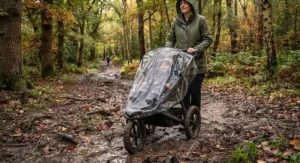
Weather resilience is also worth planning for specifically. National park weather changes fast, and a decent rain cover — usually included or available as an inexpensive accessory — combined with a canopy offering genuine UPF sun protection covers both extremes in a single kit. It’s also worth checking accessibility information before you go; not every National Trust or National Park route is buggy-friendly, and some genuinely require a proper all-terrain pram rather than a standard pushchair to be practical at all. Consulting route descriptions and accessibility notes in advance saves a wasted trip and an uncomfortable retreat halfway round a loop trail.
Features That Actually Matter (And Those That Don’t)
Not every spec on a pushchair listing translates into a meaningfully better countryside walk. Wheel size and material genuinely matter — this is consistently the single biggest driver of how a buggy performs on rough ground, more than almost any other spec. Suspension quality matters too, though it’s harder to assess from a listing alone; aggregated owner reviews are often more reliable here than manufacturer marketing copy, since owners report how a buggy actually behaves after months of real use rather than in a controlled demo.
Genuinely useful but often underrated: a handlebar handbrake for hilly terrain, a one-hand fold for practical daily use, and machine-washable fabrics for anyone walking regularly in mud. Less impactful than marketing suggests: extra cup holders, elaborate colour options, and “lie-flat” seating claimed for models not actually designed as full travel systems from birth — always check the specific age and weight guidance rather than assuming a reclining seat equals newborn suitability.
One feature worth genuinely prioritising if your walks are long: an adjustable, telescopic handlebar. For taller or shorter parents, or when two people share pushing duties, a fixed-height handle that doesn’t suit your natural walking posture becomes a real source of back and shoulder strain over an hour-long countryside walk — a detail that rarely makes it into headline marketing but shows up repeatedly in longer-term owner feedback.
Buyer’s Decision Framework
If your walking is mostly pavement with occasional grass or gravel, choose a lighter three-wheeler like the standard Out n About Nipper V6, because the added weight and cost of a full off-road specialist won’t be justified by your actual terrain.
If your walks regularly include hills, mud or genuinely rutted ground, choose the Out n About Nipper V6 Plus or Mountain Buggy Terrain, because their bigger wheels, hand brakes and reinforced frames are specifically engineered for exactly that use case.
If weight and portability are your top priority — frequent car boot lifting, public transport, or stiles — choose the Thule Urban Glide 4-Wheel, because its lighter build reduces daily physical strain even if outright rough-ground clearance is slightly lower.
If budget is the primary constraint and your countryside walking is occasional rather than daily, choose the Hauck Runner 2, because it delivers genuine air-filled-tyre performance at a fraction of the cost of premium alternatives, accepting a shorter expected lifespan in return.
If you want one buggy to do everything well — daily school run, weekend countryside walks, years of durability — choose the Bugaboo Fox 5 Renew or Silver Cross Cove, because their combination of suspension engineering and finish quality is built specifically around that dual-purpose brief.

FAQ: Pushchair For Countryside Walks
❓ What is the best pushchair for countryside walks?
❓ Do all-terrain pushchairs work on grass and mud?
❓ Are three-wheel or four-wheel pushchairs better for countryside walks?
❓ How much does a good off-road pushchair cost in the UK?
❓ Can I use a jogging pushchair for everyday countryside walks?
Conclusion
Choosing a pushchair for countryside walks ultimately comes down to being honest with yourself about how you’ll actually use it. The Hauck Runner 2 proves you don’t need to spend a fortune to get genuine air-filled-tyre performance, provided you accept a shorter lifespan and the odd creak from the plastics after a couple of years. The Out n About Nipper V6 and Nipper V6 Plus sit at the sweet spot for most rural and semi-rural families, balancing weight, capability and price better than almost anything else in this guide. And for households where rough terrain is a daily reality rather than a weekend treat, the Mountain Buggy Terrain and Bugaboo Fox 5 Renew represent a genuine investment in years of comfortable, capable walking.
Wherever you land, remember that the biggest single upgrade over a standard pushchair is wheel size and quality — get that right, pair it with sensible maintenance, and a proper countryside pushchair should serve your family well beyond a single muddy season. Which?’s independent pushchair lab testing is a useful next stop if you want deeper, hands-on comparative scoring before you commit to a specific model.
✨ Ready to find your perfect countryside companion?
Check current prices and availability on the models above before your next muddy adventure — stock and pricing shift fast on the popular options! 🚼🌳
Recommended for You
- 3 Wheel Pushchair 2026: 7 Best Picks Tested; Compared
- Off Road Pushchair: 7 Best All-Terrain Buggies for 2026 (Muddy-Path Tested)
- 7 Best Rugged Buggies for UK Families 2026 Slug
Disclaimer: This article contains affiliate links. As an Amazon Associate, I earn from qualifying purchases. If you purchase products through these links, we may earn a small commission at no additional cost to you.
✨ Found this helpful? Share it with your friends! 💬🤗
