
In This Article
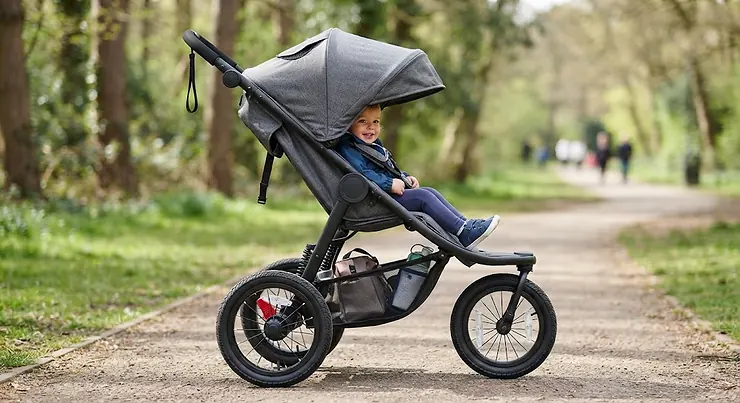
Somewhere between the baby monitor and the changing bag, most new-parent runners hit the same wall: the pram in the hallway was built for shopping trips, not sprint finishes. A lightweight jogging pushchair is a three-wheeled buggy engineered specifically for running, with a fixed or lockable front wheel, air-filled tyres, hand or wrist braking, and a frame light enough that hills and kerbs don’t feel like a training session in themselves. That’s the whole idea in one sentence, but the reality of choosing one is messier, because “lightweight” gets used loosely by manufacturers who bolt the word onto anything under 15kg.
We’ve spent time pulling apart the spec sheets, cross-referencing them against real owner feedback from Mumsnet threads, MadeForMums test panels and specialist running publications, and building out honest, sourced commentary rather than a straight product list. That matters more than it sounds: NHS guidance on keeping fit after having a baby stresses a graded, carefully managed approach to returning to running, and the buggy you choose plays a genuine role in whether that return feels smooth or jarring. If you’re chasing a faster parkrun time, training for your first postnatal 10k, or simply want your morning run back without leaving the baby behind, this guide walks through seven real options across every budget, plus the buying knowledge Amazon’s product pages simply won’t give you.
We’ll get into exact weights, honest pros and cons, and where each buggy actually earns its keep — not just what the marketing copy claims.
Quick Comparison: Lightweight Jogging Pushchairs at a Glance
| Pushchair | Weight | Price Range | Best For |
|---|---|---|---|
| Mountain Buggy Swift | 9.1kg | £350-430 range | Lightest true all-rounder |
| Out’n’About Nipper Sport V5 | 9.8kg | £320-360 range | Best for parkrun and trails |
| Roma Atlas | 10.4kg | £300-330 range | Budget lightweight everyday buggy |
| Hauck Runner 2 | 11.1kg | £180-220 range | Cheapest genuine three-wheeler |
| Thule Urban Glide 3 | 11.9kg | £650-750 range | Premium ride quality |
| Baby Jogger Summit X3 | 12.8kg | £480-540 range | Off-road storage and comfort |
| BOB Revolution Flex 3.0 | 12.9kg | £450-550 range | Smoothest push, imported |
Looking at the weights side by side, there’s a clear pattern: the two lightest models, the Mountain Buggy Swift and the Out’n’About Nipper Sport V5, both sit under 10kg because they strip back accessories and use smaller, purpose-built frames rather than trying to double as an everyday travel system. The pricier options, like the Thule Urban Glide 3 and Baby Jogger Summit X3, add weight through bigger canopies, storage baskets and all-wheel suspension, which is a fair trade-off if smoothness matters more to you than raw kerb weight. Budget doesn’t automatically mean heavier here, either — the Roma Atlas proves a sub-11kg frame can come in under £330, though as we’ll cover in its section, it isn’t marketed as a purpose-built running buggy in the way the others are.
💬 Just one click — help others make better buying decisions too!😊
Top 7 Lightweight Jogging Pushchairs: Expert Analysis
1. Mountain Buggy Swift — lightest true all-terrain jogger
At roughly 9.1kg, the Mountain Buggy Swift is genuinely one of the lightest all-terrain three-wheelers sold in the UK, built from aircraft-grade aluminium that keeps the frame light without making it feel flimsy underfoot. The 10-inch air-filled tyres and a front wheel that swivels for town use but locks for jogging give it a dual personality: nip through café doorways on a Tuesday, then lock the wheel and head out for six miles at the weekend. Based on the spec comparison with heavier rivals like the Phil & Teds Vibe (14.4kg) and Mountain Buggy’s own Terrain (13.5kg), the Swift undercuts both by 4-5kg while retaining true pneumatic suspension, which is the detail that actually separates a running buggy from a shopping trolley on wheels.
Reviewers consistently note the one-handed steering and the buggy’s willingness to be pulled along one-handed while holding a toddler’s hand with the other — a small but telling sign of good weight distribution. What most buyers overlook about this model is that its compact 59cm width, designed for narrow doorways, also means a tighter turning circle at speed, which some fast runners find takes a session or two to adjust to. Aggregated owner feedback on Mumsnet and MadeForMums points to two recurring themes: near-universal praise for how easy it is to lift in and out of a car boot, and occasional early punctures on the air-filled tyres, a known trade-off of any pneumatic-tyre buggy.
Pros:
- ✅ One of the lightest all-terrain joggers sold in the UK
- ✅ Compact fold suits smaller car boots and flats
- ✅ Steers confidently with just one hand
Cons:
- ❌ Narrower footprint takes getting used to at running pace
- ❌ Air-filled tyres need occasional pumping and puncture care
Sitting in the £350-430 range, the Mountain Buggy Swift is genuinely good value for a buggy this light, and for runners who prioritise kerb weight above all else, it’s hard to beat on paper.
2. Out’n’About Nipper Sport V5 — best for parkrun and trails
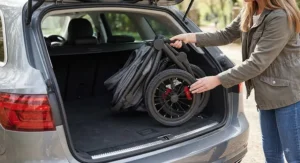
The Out’n’About Nipper Sport V5 weighs 9.8kg and is designed and built as one of the smallest jogging buggies on the market, small enough to fit inside an IKEA bag when folded down. That’s not just a cute stat — it means the boot space argument that puts a lot of parents off running buggies largely disappears. The fixed (not swivelling) 16-inch front wheel is the standout engineering choice here: unlike lock-or-swivel designs, it’s built purely for stability at pace, so there’s no toggle to remember before a run and no wobble to fight through on a fast finish.
Here’s what to weigh up: because the front wheel doesn’t swivel at all, this isn’t the buggy for weaving through a packed supermarket aisle — it’s a specialist. Reviewers who’ve taken it across mud, grass, steep hills and sand at Broadstairs beach consistently describe it handling rough ground with more composure than its light weight would suggest, and one long-distance-runner review from a Yorkshire running blog specifically praised its performance on muddy fell trails. On the flip side, several aggregated reviews mention the storage basket sits low and can brush against kerbs, and the front wheel lock needs manual toggling if you switch between smooth and rough sections mid-route.
Pros:
- ✅ Smallest folded footprint of any major running buggy
- ✅ Fixed front wheel gives excellent high-speed stability
- ✅ Handles mud, sand and hills confidently for its weight
Cons:
- ❌ No swivel wheel option — awkward for tight indoor spaces
- ❌ Storage basket sits low and can catch on kerbs
Priced around £320-360, the Out’n’About Nipper Sport V5 is arguably the best-value pick here for anyone whose running happens mostly off-road or at their local parkrun.
3. Roma Atlas — budget lightweight all-rounder
The Roma Atlas weighs 10.4kg and is built by a British nursery brand that positions it as a lightweight, puncture-proof three-wheeler for city streets and rougher paths alike. Here’s the honest bit that matters more than any spec: the manufacturer markets the Roma Atlas as an all-terrain everyday buggy rather than a dedicated jogging buggy, and its maximum load capacity (15kg) is noticeably lower than the purpose-built joggers on this list, which typically run to 20-25kg. Based on the spec comparison, that makes it a genuinely different category — a lightweight all-rounder that can join you for a brisk power-walk or gentle jog on smooth pavement, rather than a buggy engineered from the ground up for sustained running pace on trails.
Reviewers consistently praise the puncture-proof wheels, a genuine point of difference from the air-filled tyres used by most of the competition on this list, since it removes one of the most commonly reported annoyances with jogging buggies altogether. What most buyers overlook is that puncture-proof foam-filled tyres, while maintenance-free, typically transmit more surface vibration than true pneumatic tyres — reviewers note the ride is noticeably firmer on cobbles or broken tarmac than on the air-tyred models here. If your “jog” is more brisk-paced fitness walking on decent pavement, this trade-off barely registers.
Pros:
- ✅ Genuinely lightweight at 10.4kg for the price point
- ✅ Puncture-proof tyres remove a common jogging-buggy headache
- ✅ One-hand compact fold suits smaller cars
Cons:
- ❌ Not purpose-built or load-rated for serious running use
- ❌ Firmer ride on rough surfaces than air-filled alternatives
At around £300-330, the Roma Atlas earns its place as the pick for parents who want a light, honest all-rounder rather than committed off-road running gear.
4. Hauck Runner 2 — cheapest genuine three-wheeler jogger
At 11.1kg, the Hauck Runner 2 is the most affordable model here that still commits to the classic running-buggy formula: extra-large air-filled tyres, a swivel-or-lock front wheel, and a five-point harness rated to EN 1888. Based on the spec comparison, it undercuts the next cheapest option on this list by well over £100, which explains why it turns up so often in parkrun car parks despite lacking some of the polish of premium rivals. What most buyers overlook is the small-print detail that Hauck’s own manual states the Runner range isn’t officially rated for running — likely a liability disclaimer rather than a genuine performance limit, since owner reviews consistently describe using it for regular jogging without issue.
Reviewers consistently flag the fold mechanism as the buggy’s weakest point: you need to fully recline the seat and push the hood back before folding, which feels fiddly for the first few attempts, though most owners report it becomes second nature within a week or two. On the plus side, aggregated feedback highlights genuinely impressive build quality for the price — thick, water-resistant fabrics and a metal frame that “feels more substantial than some pricier prams,” as one reviewer put it.
Pros:
- ✅ Lowest price of any true three-wheel running buggy here
- ✅ Sturdy build quality that outperforms its price bracket
- ✅ Large air-filled tyres smooth out rough surfaces well
Cons:
- ❌ Multi-step fold takes practice to master
- ❌ Manual technically doesn’t endorse it for running
Sitting around £180-220, the Hauck Runner 2 is the sensible entry point for anyone who wants to try buggy running before committing serious money to it.
5. Thule Urban Glide 3 — premium ride quality
The Thule Urban Glide 3 weighs 11.9kg and has built a reputation among road and track runners as one of the smoothest-pushing buggies available, thanks to a locking front wheel, adjustable-tension suspension, and an ergonomic handlebar with a single-hand flip-flop brake. One running-focused reviewer who logged 1,200 miles behind it called it the lightest of the mainstream performance buggies on the market, and the spec sheet backs that reputation up against similarly premium rivals. Based on the spec comparison, its 22kg child capacity plus 7kg cargo allowance is competitive, and the adjustable handlebar height genuinely matters over long runs, letting taller and shorter runners both maintain good posture.
Here’s the honesty-first detail that deserves its own paragraph: testers at one independent lab found a printed safety notice inside the box stating the buggy is “not suitable for running” under an EU regulatory requirement — Thule confirmed this is a labelling standard rather than a genuine design limitation, and the model continues to be marketed and sold as a jogging stroller. We’re flagging it because a spec sheet won’t tell you this, but it’s worth knowing the label exists before you buy. Aggregated reviewer sentiment otherwise leans strongly positive, with repeated praise for the ride smoothness and criticism reserved mainly for a max child weight that’s lower than some rivals.
Pros:
- ✅ Exceptionally smooth push, praised by dedicated runners
- ✅ Adjustable handlebar suits parents of different heights
- ✅ Award-winning design with strong resale value
Cons:
- ❌ Premium price relative to child weight capacity
- ❌ EU box label states “not suitable for running” (see note above)
At £650-750, the Thule Urban Glide 3 sits at the top of the market, and for parents training seriously, the smoother stride it delivers can genuinely justify the outlay.
6. Baby Jogger Summit X3 — off-road storage and comfort
The Baby Jogger Summit X3 weighs 12.8kg, making it one of the heavier models here, but that weight buys genuine off-road competence: all-wheel suspension, a locking swivel front wheel, and a near-flat recline that makes it as comfortable for naps as it is for running. One trail-running reviewer described it as the “Range Rover” of jogging buggies next to the Thule’s “Ferrari” reputation — heavier and less nimble, but more composed when the terrain turns properly rough. Based on the spec comparison, its 34kg total weight capacity is among the highest on this list, meaning it stays usable for longer as your child grows.
Reviewers consistently note the compact fold once wheels are removed, which suits car boots better than the buggy’s unfolded footprint suggests. What most buyers overlook is that independent lab testing found the tracking needed frequent manual adjustment during a single run on uneven surfaces — a genuine niggle if you regularly switch between tarmac and trail mid-route, though it doesn’t undermine the buggy’s broader off-road capability. Aggregated Mumsnet sentiment is more mixed than most other entries here, with some owners of a newer redesign specifically missing a safety strap feature from earlier models.
Pros:
- ✅ Strong off-road composure thanks to all-wheel suspension
- ✅ High 34kg total weight capacity extends usable years
- ✅ Near-flat recline doubles as a comfortable pram mode
Cons:
- ❌ Heaviest weight on this list at 12.8kg
- ❌ Front-wheel tracking needs occasional manual correction
Priced around £480-540, the Baby Jogger Summit X3 rewards parents who run on genuinely varied terrain and want one buggy that does everything reasonably well.
7. BOB Revolution Flex 3.0 — smoothest push, imported option
The BOB Revolution Flex 3.0 weighs approximately 12.9kg and has built one of the strongest reputations in the jogging-stroller world for sheer push quality — testers have joked you could set it rolling just by blowing on the handlebar. Its 16-inch rear pneumatic tyres, 12-inch locking front wheel, and adjustable suspension combine for a ride that independent lab testers rated among the best for manoeuvrability of any jogger tested. Based on the spec comparison, its 34kg total capacity matches the Baby Jogger Summit X3’s longevity, and its large under-seat storage is a genuine practical advantage for longer runs where you’re carrying nutrition, layers or a spare nappy.
Here’s what to weigh up before buying: BOB is a US brand, so UK stock typically comes via Amazon UK marketplace sellers or specialist importers rather than dedicated high-street stockists, which can mean longer delivery windows and trickier warranty claims than UK-native brands. Independent lab testers also flagged the absence of a hand brake as a real limitation for anyone running regularly on steep hills, relying instead on a foot-operated parking brake. Reviewers consistently praise the smoothness of the ride above almost everything else in this category, which is precisely why it remains a cult favourite among dedicated running parents despite the import friction.
Pros:
- ✅ Rated among the smoothest-pushing joggers in independent testing
- ✅ Large storage and 34kg capacity suit long-term use
- ✅ Adjustable suspension tunes the ride to your terrain
Cons:
- ❌ No hand brake — relies on a foot parking brake
- ❌ Imported stock can mean longer delivery and trickier warranty support
At an estimated £450-550 on the UK market, the BOB Revolution Flex 3.0 is worth the import hassle for runners who rate ride smoothness above all else.
Practical Usage Guide: Getting the Most From Your First 30 Days
Unboxing a jogging buggy is the easy part; the details that actually shape your first month with it rarely make the instruction manual. Start by checking tyre pressure before the very first outing — air-filled tyres on models like the Mountain Buggy Swift, Out’n’About Nipper Sport V5 and Thule Urban Glide 3 lose a small amount of pressure sitting in a box, and an underinflated tyre both rides harshly and wears unevenly. A cheap bike pump with a pressure gauge, kept in the car boot, solves this in under two minutes.
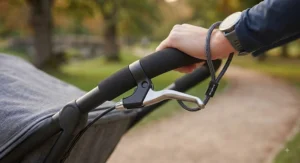
Practise folding and unfolding the buggy indoors, empty, before your first run — every model reviewed here has a slightly different sequence, and the Hauck Runner 2 in particular takes a session or two to master. Always attach the wrist strap before setting off; it’s easy to treat this as optional on a calm pavement run, but it’s the single cheapest safety feature on the buggy and takes two seconds. For the first few outings, walk the route once at pushchair-walking pace before running it, so you know where potholes, dropped kerbs and loose gravel sit — this matters more with a fixed-wheel design like the Nipper Sport V5, where you can’t simply swivel around an obstacle at the last second.
On maintenance: check tyre pressure monthly, wipe down the frame after muddy or coastal runs to stop grit working into the brake cable, and re-torque any quick-release wheel skewers after the first few outings once the frame has settled. Most punctures happen from small debris embedding in the tyre wall rather than dramatic impacts, so a quick visual check before each run catches the majority of problems before they strand you.
✨ Don’t Miss These Exclusive Deals!
🔍 Take Your Runs to the Next Level
Ready to get back out on the road with your little one? Click through on any of the models above to check current pricing and availability on Amazon. A well-matched running buggy is one of the simplest ways to reclaim the training miles you’ve been missing since baby arrived!
Real-World Scenarios: Which Buggy Suits Your Situation?
The parkrun regular. Sarah runs her local parkrun most Saturdays and does two shorter weekday jogs around the park, mostly on tarmac paths with the occasional grassy shortcut. Her budget sits around £350, and her priority is a buggy light enough that hills don’t wreck her pace. The Out’n’About Nipper Sport V5 or Mountain Buggy Swift both fit this profile well — sub-10kg, genuinely built for exactly this use case, and priced within reach without stretching to premium territory.
The trail-and-tarmac all-rounder. Priya splits her running between road sessions during the week and muddy countryside trails at weekends, often over uneven, root-strewn ground. Weight matters less to her than genuine off-road composure and a high load capacity as her toddler grows. The Baby Jogger Summit X3, with its all-wheel suspension and 34kg total capacity, is the better long-term match here, even though it’s the heaviest buggy on this list.
The budget-conscious first-timer. Tom isn’t sure running-with-a-buggy will actually stick as a habit and doesn’t want to gamble £500+ on finding out. He runs mostly on smooth suburban pavements a couple of times a week. The Hauck Runner 2 lets him try the format properly — real air tyres, a real swivel-lock front wheel — without the financial risk of a premium buy he might barely use.
Common Problems and Solutions for New Buggy Runners
Even a great pushchair throws up a handful of predictable snags in the first few months, and most have simple fixes once you know to expect them.
Problem: the buggy pulls to one side. This is almost always uneven tyre pressure rather than a frame fault — check and equalise pressure across all three tyres before assuming anything’s broken.
Problem: your arms ache more than your legs. A too-low handlebar forces you to hunch, which tires your shoulders fast. Models like the Thule Urban Glide 3 and Mountain Buggy Swift offer adjustable handlebar heights specifically to fix this; if yours doesn’t adjust, try running slightly further back from the buggy to straighten your arm angle.
Problem: the front wheel judders at pace. On swivel-front designs like the Baby Jogger Summit X3, this usually means the front wheel isn’t locked. On fixed-wheel designs like the Nipper Sport V5, it more often points to a tracking or alignment issue worth checking against the manual.
Problem: baby seems unsettled on bumpy ground. Parkrun’s own guidance notes that a genuine running buggy typically offers considerably more suspension and support than a standard everyday pushchair, so if this keeps happening on a non-specialist model, it may simply be time to size up to a purpose-built jogger rather than a fault with your technique.
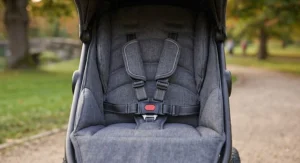
How to Choose a Lightweight Jogging Pushchair
- Confirm your baby’s age against the buggy’s minimum jogging age. Most manufacturers state a minimum of six to nine months for actual running use, regardless of when the buggy can be used for walking.
- Weigh genuine kerb weight against your typical terrain. A sub-10kg model like the Mountain Buggy Swift rewards hill-heavy routes; a heavier all-wheel-suspension model rewards genuinely rough trail running.
- Check the front wheel design. Fixed wheels favour pure running speed and stability; lock-or-swivel wheels favour versatility if the same buggy also does the school run.
- Look at load capacity, not just current weight. A buggy rated to 25-34kg total will outlast one capped at 15-20kg by a year or more of continued use.
- Factor in fold size against your actual car boot, not the average car boot — measure it before you buy, particularly with bulkier premium models.
- Decide how much you value a hand brake. Anyone running regularly on hills should weight this heavily; the BOB Revolution Flex 3.0‘s foot-only brake is a real consideration here.
- Set a realistic budget band and stick close to it. The jump from a genuinely capable budget buggy like the Hauck Runner 2 to a premium model like the Thule Urban Glide 3 is a difference in polish and ride smoothness, not a difference between “works” and “doesn’t work.”
Common Mistakes When Buying a Running Buggy
The single most common mistake is buying based on brand reputation alone rather than checking the specific model’s minimum jogging age and weight limit — these vary significantly even within one brand’s range. A close second is underestimating fold size: a buggy that looks compact on a product photo can still be a genuine squeeze in a supermarket-sized hatchback boot, so always cross-check folded dimensions against your own car rather than trusting “compact” as a marketing word.
Many first-time buyers also skip test-pushing an empty buggy in-store or at a friend’s house before buying online, which means the first time they feel the handlebar height or steering weight is after the return window narrows. Finally, a genuinely underrated mistake is ignoring tyre type entirely — air-filled tyres like those on the Mountain Buggy Swift and Thule Urban Glide 3 ride more smoothly but need occasional maintenance, while puncture-proof designs like the Roma Atlas trade some ride comfort for zero maintenance, and picking the wrong one for your lifestyle is a common source of post-purchase regret.
Sub 10kg Running Pushchair vs Standard Jogging Buggy
A sub 10kg running pushchair like the Mountain Buggy Swift (9.1kg) or Out’n’About Nipper Sport V5 (9.8kg) sits in a genuinely different weight class from the wider “jogging buggy” category, where models regularly run to 12-13kg or more, such as the Baby Jogger Summit X3 and BOB Revolution Flex 3.0. On paper, roughly three extra kilograms sounds trivial, but over a hilly 5k it compounds noticeably, both in how much effort each incline takes and in how tired your arms feel lifting the buggy in and out of a car boot several times a week.
What most buyers overlook is that the weight saving in a sub 10kg running pushchair usually comes from a smaller frame footprint and fewer storage or suspension features, not from cheaper materials — the Mountain Buggy Swift, for instance, uses the same aircraft-grade aluminium construction found in heavier premium models. The trade-off analysis is straightforward: choose the sub-10kg category if your running routes are mostly hilly, if you’re lifting the buggy in and out of a car regularly, or if you’re still building running fitness postnatally and every bit of resistance matters. Choose a standard heavier jogging buggy if your priority is genuine rough-trail suspension, higher load capacity for a growing toddler, or a bigger storage basket for longer outings.
Best Buggy for Parkrun
For anyone specifically asking which buggy suits parkrun, the honest answer depends more on your local course than any single spec. Parkrun’s official guidance points out that course conditions vary hugely between events, and recommends checking the specific course description before deciding whether a buggy is suitable for that route. That said, two clear patterns emerge from the models covered here: lighter, sub-10kg buggies like the Mountain Buggy Swift and Out’n’About Nipper Sport V5 suit the flatter, tarmac-path parkrun courses where speed and manoeuvrability around other runners matter most, while heavier, suspension-focused models like the Baby Jogger Summit X3 come into their own on grassy, root-strewn or muddy parkrun routes.
A detail that trips up a lot of first-time parkrun buggy runners: event teams generally don’t police the pace at which a buggy is pushed around the course, leaving that judgement to the parent or carer, but it’s still good etiquette to start towards the back or side of the field rather than the front, since a buggy needs more room to manoeuvre around slower walkers than a solo runner does. Parkrun’s history and format has grown from a single London event into thousands of weekly 5k courses worldwide, so buggy-friendliness genuinely does vary by location. Whichever buggy you choose, check your specific parkrun’s course notes online first — some venues explicitly restrict buggies on narrower or more technical sections, and this is genuinely easier to check in five minutes than to discover awkwardly on the morning itself.
Lightweight Running Buggy Fold: What to Expect
Fold mechanisms vary more than most buyers expect before their first hands-on session, and this is genuinely one area where reading the spec sheet undersells the real-world experience. The Out’n’About Nipper Sport V5 and Mountain Buggy Swift both use a broadly similar one-hand compact fold that collapses to a genuinely small footprint — small enough, in the Nipper’s case, to fit inside a large shopping bag once the wheels are removed. The Hauck Runner 2, by contrast, requires you to fully recline the seat and push the hood back before the fold will engage, which several reviewers describe as fiddly on the first few attempts, though it becomes routine with practice.
What the spec sheet won’t tell you, but reviewers note, is that quick-release wheels genuinely change how you’ll use the fold day to day: buggies like the Thule Urban Glide 3 and Baby Jogger Summit X3 let you pop the rear wheels off entirely for an even smaller car boot footprint, which matters if you’re regularly loading the buggy into a small hatchback rather than an estate. If a compact fold genuinely matters to your daily routine — flats with narrow hallways, small car boots, frequent public transport use — it’s worth prioritising this over a few hundred grams of raw kerb weight, since a buggy that’s awkward to fold gets used less often regardless of how light it feels mid-run.
Long-Term Cost and Maintenance
Buying price is only part of the real cost of running-buggy ownership. Air-filled tyres, found on the Mountain Buggy Swift, Out’n’About Nipper Sport V5, Thule Urban Glide 3, Baby Jogger Summit X3 and BOB Revolution Flex 3.0, need occasional re-inflation and the odd inner-tube repair or replacement over a few years of regular use — budget roughly £10-20 a year for a pump and occasional puncture kit, plus the very rare replacement tube. Puncture-proof designs like the Roma Atlas avoid this cost entirely, which is a genuine long-term saving worth weighing against its lower load capacity.
On a per-use basis, the maths favours buying once and buying well if you expect to run regularly for two-plus years: a £600 premium buggy used three times a week for two and a half years works out to under £2 per outing, comparable to or cheaper than many parents’ running gear replacement costs over the same period. A budget buggy like the Hauck Runner 2 at under £220 reaches that same per-use value within roughly nine months of similar use. Resale value is also worth factoring in — premium, well-known brands like Thule and Baby Jogger typically hold 40-50% of their original price on the second-hand market after a year or two of good care, softening the effective total cost considerably.
Safety, Regulations and Compliance Guide
UK-sold pushchairs, including every model covered here, must meet BS EN 1888, the British and European safety standard covering structural strength, braking, harness security and stability testing. Beyond the buggy itself, timing matters just as much as the equipment: official postnatal guidance recommends a graded, carefully managed return to running rather than jumping straight back to pre-pregnancy training loads, and most manufacturers separately specify a minimum baby age, typically six to nine months, before their buggy should be used for actual jogging rather than walking, regardless of when it’s cleared for general use from birth.
Always secure the wrist strap before setting off, check the harness is correctly adjusted for your child’s current size rather than last month’s, and avoid jogging with a buggy on icy or heavily uneven ground where a fixed front wheel in particular loses some of its manoeuvring margin. NHS advice on your post-pregnancy body also notes that some local postnatal exercise classes are specifically designed to include your pram or buggy as part of the session, which is worth exploring if you want structured guidance on building back up to running pace safely alongside your baby.

Frequently Asked Questions
❓ How much should a lightweight jogging pushchair weigh?
❓ What age can a baby go in a running buggy?
❓ Do I need a jogging pushchair or will a normal pushchair do?
❓ Is the lightest running buggy always the best choice?
❓ Can I use a lightweight jogging pram for parkrun?
Conclusion
Choosing between these seven buggies really comes down to matching the buggy to your actual running life rather than chasing the lightest spec sheet in isolation. If sheer kerb weight and hill-friendliness top your list, the Mountain Buggy Swift and Out’n’About Nipper Sport V5 remain the strongest sub-10kg picks covered here. If you’re weighing genuine off-road capability and long-term load capacity above all else, the Baby Jogger Summit X3 earns its extra kilograms. And if ride smoothness is your priority and you don’t mind sourcing an imported model, the BOB Revolution Flex 3.0 and Thule Urban Glide 3 both deliver on that front at a premium price.
Whichever you land on, remember that the honest research here points to one consistent truth: every model on this list performs best when matched to real terrain, a realistic budget, and a baby who’s actually old enough to jog with. There’s no single universally “best” lightweight jogging pushchair — just the one that fits your Saturday morning parkrun, your postnatal training plan, or your daily commute best.
✨ Ready to Find Your Perfect Running Companion?
Browse the full lineup above and check current pricing and availability before you buy. The right lightweight jogging pushchair could be exactly what gets your running routine back on track this year!
Recommended for You
- Off Road Jogging Stroller: 7 Best Picks for UK Trails 2026
- Best Running Buggy 2026: 7 Top Jogging Pushchairs Rated
- Compact Double Buggy: 7 Best Picks for Tight UK Boots (2026)
Disclaimer: This article contains affiliate links. As an Amazon Associate, I earn from qualifying purchases. If you purchase products through these links, we may earn a small commission at no additional cost to you.
✨ Found this helpful? Share it with your friends! 💬🤗
