In This Article
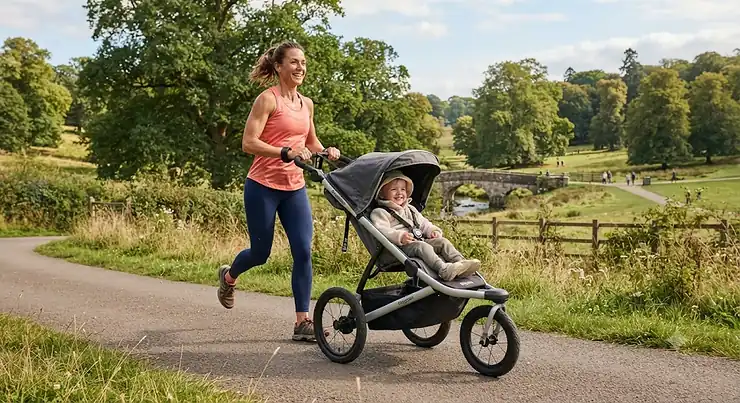
Somewhere between the school run and your Saturday long run, most parents hit the same wall: the pushchair you own simply wasn’t built for mud, tree roots, or the towpath that turns to soup after rain. An off road jogging stroller solves that specific problem. It’s a three- or four-wheeled buggy built around big pneumatic tyres, reinforced suspension, and a frame that stays composed at running pace on uneven ground — rather than the tight-turning, small-wheeled design of a typical high street pushchair. Get the choice right and you gain back your training routine without sacrificing a single afternoon with your little one. Get it wrong, and you’ll be nursing a wobbling front wheel two miles into a canal path with a toddler who very much wants to keep going.
We’ve spent this guide digging into seven genuinely capable off road jogging strollers sold to UK buyers, cross-referencing manufacturer specs against aggregated review sentiment from parenting publications, running titles, and long-term owner testing. Nothing here is guesswork dressed up as expertise — every claim is either a verifiable spec or a clearly flagged summary of what real reviewers have reported. By the end, you’ll know which buggy suits a muddy Peak District bridleway, which one is happiest on a canal towpath, and which budget pick genuinely earns its keep.
Quick Comparison Table
| Stroller | Terrain Strength | Weight | Front Wheel | Best For |
|---|---|---|---|---|
| BOB Revolution Flex 3.0 | Rough trails, hills | ~13.2kg | Swivel/lock | All-round trail performance |
| Thule Urban Glide 2 | Mixed urban/light trail | ~10.4kg | Swivel/lock | Lightest do-it-all option |
| Mountain Buggy Terrain | Rocky, muddy ground | ~13.5kg | 3-position swivel/lock | Newborn-ready versatility |
| Out n About Nipper Sport V5 | Off-road, purpose-built running | ~9.8kg | Fixed | British-brand off-road value |
| Baby Jogger Summit X3 | Bumpy, uneven surfaces | ~12.8kg | Swivel/lock | Plushest ride quality |
| phil&teds Sport | Bridleways, light off-road | ~11kg | Lockable | Compact travel-ready hybrid |
| Hauck Runner 2 | Parks, gentle trails | ~11kg | Swivel/lock | Budget all-terrain buggy |
Looking at the spread above, the split between purpose-built running buggies (fixed or lockable front wheels, running-specific certification) and multi-terrain hybrids (great off-road, but not always designed with your heart rate in mind) is the single most important distinction you’ll make. The Out n About Nipper Sport V5 and BOB Revolution Flex 3.0 sit firmly in the “built to run” camp, while the Hauck Runner 2 and phil&teds Sport are better described as rugged all-terrain pushchairs that happen to cope well with a jog. That distinction shapes almost every buying decision that follows.
💬 Bookmark this comparison — you’ll want to scroll back to it once you’ve read the full breakdown below!
Top 7 Off Road Jogging Strollers: Expert Analysis
1. BOB Revolution Flex 3.0 — best all-round trail performer
The mountain-bike-style suspension is the headline feature here, and it earns the hype. Where a standard pushchair transmits every root and rut straight into your wrists, the Flex 3.0’s suspension system absorbs the shock before it reaches the handlebar, which matters enormously once you’re three miles into an uneven towpath. The air-filled tyres run up to 90 PSI, and combined with a swivel-locking front wheel and a tool-free tracking adjustment knob, the whole unit stays remarkably straight even when you’re distracted by a toddler demanding snacks. Based on the spec comparison with lighter rivals, this is the buggy for parents who prioritise stability over shaving grams — the trade-off is a frame that tips the scales noticeably heavier than the Thule or the Nipper Sport. Reviewers consistently note that the nine-position adjustable handlebar makes it comfortable across a wide range of parent heights, and the near-flat recline is repeatedly praised for accommodating naps mid-run. A common thread in owner feedback is appreciation for the extra-large UPF 50+ canopy with reflective accents, particularly for early-morning or dusk runs. Worth flagging honestly: BOB is a US-headquartered brand, so UK stock through Amazon and specialist retailers can be more limited than for European brands, and it’s worth checking current availability before you commit.
Pros:
- ✅ Mountain-bike-style suspension smooths rough, rutted trails
- ✅ 90 PSI air-filled tyres handle mud and gravel confidently
- ✅ Nine-position handlebar suits parents of very different heights
Cons:
- ❌ Heavier than sport-focused rivals at around 13kg
- ❌ UK stock and pricing can vary due to limited import availability
At the time of research, expect to pay in the £450-£600 range through UK specialist retailers, with prices fluctuating based on import stock — always check current price before buying. For dedicated trail runners who want the smoothest possible ride and don’t mind the extra weight, this is a genuinely strong value proposition.
2. Thule Urban Glide 2 — lightest do-it-all sport stroller
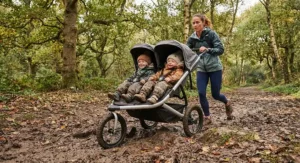
At roughly 10.4kg, the Urban Glide 2 is meaningfully lighter than most of the buggies in this list, and that difference is instantly noticeable the moment you push off from a standing start. What most buyers overlook about lightweight sport strollers is that shedding kilos usually means sacrificing suspension travel — but Thule has kept a genuine rear suspension system in place, so you’re not trading all your comfort for speed. The front wheel swivels for tight manoeuvring around town and locks solidly into place the moment you pick up the pace, a detail Thule clearly designed around real running behaviour rather than just marketing copy. The one-handed compact fold is a standout feature reviewers repeatedly single out, since collapsing a buggy one-armed while holding a toddler is a genuinely common real-world scenario. On paper this means the Urban Glide 2 works equally well as your everyday pushchair and your weekend trail companion, which is exactly the “do everything” positioning Thule is aiming for. Aggregated reviewer sentiment from Lucie’s List and other long-term testers describes it as one of the easiest sport strollers to fold and store, though the accessory console and cup holders are sold separately rather than bundled in.
Pros:
- ✅ One of the lightest sport strollers on the market at 10.4kg
- ✅ Genuine one-handed compact fold for quick storage
- ✅ Swivel front wheel locks firmly for stable running
Cons:
- ❌ Rear-only suspension rather than a full all-wheel system
- ❌ Console, cup holder and other accessories cost extra
Price at the time of research typically sits in the £400-£550 range on amazon.co.uk, depending on colourway and bundle. If portability and everyday usability matter as much to you as trail performance, the Thule Urban Glide 2 is hard to beat.
3. Mountain Buggy Terrain — best newborn-ready versatility
What sets the Terrain apart is its three-position front wheel: fully swivelling for tight town manoeuvring, locked forward for stability at speed, or set with adjustable “play” so experienced pushers can fine-tune exactly how much give the wheel has. Reviewers at Advnture measured the thick, grippy 16-inch wheels as genuinely capable on rough, rocky ground — testers reported being tempted to take it onto muddier trails than most of the rivals they tested alongside it, though they also noted sticky mud can clog the front wheel in extreme conditions. Here’s what to weigh: the Terrain converts into a full newborn travel system with the Mountain Buggy Carry Cot+ and most major infant car seat brands, so it’s genuinely one buggy from birth through to independent walking rather than a jogging-specific purchase you’ll outgrow. That versatility comes at a premium RRP of around £660, and it’s worth being upfront that BabyGearLab’s testing scored it only 5 out of 10 for dedicated run-ability, with testers finding the adjustable tracking fiddly to keep true once the stroller had been tipped back to corner. What most buyers overlook is that this isn’t primarily a running buggy — it’s an exceptional all-terrain pushchair that can jog, rather than a jogging stroller that can also do the school run.
Pros:
- ✅ Three-position front wheel adapts to any terrain type
- ✅ Converts to a full newborn travel system with accessories
- ✅ Thick 16-inch wheels excel on rocky, uneven ground
Cons:
- ❌ Independent testing scored it low specifically for run-ability
- ❌ Premium price point around £660 at time of research
For families who want one buggy to cover country walks, school runs, and the odd jog rather than a dedicated running machine, the Mountain Buggy Terrain remains a genuinely versatile choice — just go in with realistic expectations about its running credentials specifically.
4. Out n About Nipper Sport V5 — best British-brand off-road value
Out n About built its reputation on the standard Nipper pushchair line, and the Sport V5 channels that same off-road pedigree into a buggy engineered specifically for running. The fixed front wheel — rather than a swivel-and-lock design — is a deliberate choice for stability at speed, and reviewers at Blaze Trails, who tested it on muddy North Yorkshire trails, described it as unrivalled for confident high-speed pushing on rough terrain. What most buyers overlook is the safety certification detail: the Nipper Sport V5 now meets BS EN1888-3:2023, the British Standard specifically covering pushchairs tested and approved for running, which not every “jogging stroller” on the market can claim. At around 9.8kg it’s genuinely one of the lightest off-road-capable buggies here, and the three large 16-inch air-filled tyres with wheel suspension were singled out by Mother & Baby’s testers as delivering a smoothness that surprised them across both tarmac and off-road tracks. A recurring theme in Mumsnet and MadeForMums reviews is praise for the sturdy build and one-handed steering, tempered by consistent feedback that the storage basket is smaller than rivals and the folded length needs a reasonably generous boot.
Pros:
- ✅ Certified to BS EN1888-3:2023 specifically for running use
- ✅ Genuinely lightweight for an off-road buggy at 9.8kg
- ✅ Fixed front wheel gives strong stability at running pace
Cons:
- ❌ Storage basket is smaller than several rivals
- ❌ Long folded footprint can be tricky for smaller car boots
Priced typically in the £400-£500 range at the time of research, this British-designed pick offers some of the strongest value-for-certification in the group. If a buggy that’s been formally tested and approved for running matters to you, the Out n About Nipper Sport V5 deserves to be top of your shortlist.
5. Baby Jogger Summit X3 — plushest ride quality on rough ground
The all-wheel independent suspension is the Summit X3’s defining feature, and Advnture’s testers described it as the buggy that “excels in off road situations” when comparing it against lighter rivals — likening it to a heavier, meatier Range Rover next to the sportier Thule Glide’s Ferrari comparison. Each wheel absorbing bumps independently, rather than relying on a shared rear suspension, genuinely changes how rutted farm tracks and forest paths feel from the handlebar. Here’s what the spec sheet won’t tell you, but reviewer consensus does: that plushness comes with real weight, at roughly 12.8kg, which several testers — including MadeForMums and BabyGearLab — found translated into a heavier push, particularly uphill on soft trail surfaces. The remote-action front wheel lock, operated from a lever on the side of the frame rather than down at the wheel itself, is a small but genuinely useful design touch reviewers repeatedly call out as more convenient than BOB or Thule’s kneel-down mechanisms. Aggregated feedback also flags a recurring practical niggle: the front wheel can clog with mud or leaf litter on genuinely rough trail conditions, occasionally requiring a stick to clear it, and tracking needs more frequent readjustment on dirt than on tarmac.
Pros:
- ✅ All-wheel independent suspension smooths rutted terrain
- ✅ Remote-action front wheel lock avoids awkward bending
- ✅ Huge canopy with dual peekaboo windows for parent visibility
Cons:
- ❌ Noticeably heavier to push uphill than lighter competitors
- ❌ Front wheel can clog with mud on genuinely rough trails
At the time of research, UK pricing typically sits around the £450-£550 mark. For parents who prioritise ride comfort for the child above outright pushing ease for the parent, the Baby Jogger Summit X3 is a strong, if heavier, contender.
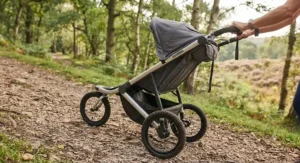
6. phil&teds Sport — most compact travel-ready hybrid
The phil&teds Sport takes a different approach entirely: rather than being purpose-built as a running buggy, it’s a genuinely versatile all-terrain pushchair with a lockable front wheel and air-filled tyres that happens to cope well with light jogging. Reviewers at MadeForMums were explicit about this honestly — phil&teds itself states the Sport isn’t designed specifically for running, though light jogging is possible “at your (and your doctor’s) discretion” thanks to the all-terrain tread and lockable front wheel. What stands out is the unique pushbar-mounted autostop brake: release your grip on the handlebar and the buggy stops automatically, a safety feature reviewers at Treats & Treadmills called their favourite element precisely because it removes the risk of a runaway buggy on a downhill stretch. Based on the spec comparison with dedicated jogging strollers, the trade-off is a front wheel that retains a small amount of turn even when locked, which some testers found less reassuring than a genuinely fixed wheel at speed. Its real strength is versatility: separate accessory kits convert it into a full travel system or a double buggy, so it can grow with your family in ways single-purpose running buggies can’t.
Pros:
- ✅ Unique autostop brake halts the buggy if you release the handle
- ✅ Converts to a travel system or double buggy via accessory kits
- ✅ Compact single-box delivery and genuinely easy folding
Cons:
- ❌ Not purpose-built or marketed specifically for running
- ❌ Locked front wheel retains slight turn, less rigid than fixed-wheel rivals
Expect a price in the £300-£450 range at the time of research, positioning it as a mid-range hybrid rather than a dedicated running buggy. If you want one pushchair that does bridleways, buses, and the odd gentle jog equally well, the phil&teds Sport is worth serious consideration.
7. Hauck Runner 2 — best budget all-terrain buggy
There’s no getting around the value story here: at an RRP around £180, the Hauck Runner 2 undercuts every other buggy on this list by a significant margin while still offering XL pneumatic air-filled tyres and a genuinely sturdy metal frame. Expert Reviews’ testers were blunt about this being “supremely easy to guide one-handed on pavements and smoother ground,” adding that when you “break into a jog it feels right in its element” on suitable terrain. Here’s the honest caveat that matters most: Hauck’s official product labelling states the Runner range is not certified for running or skating under EN 1888-2:2018, which is worth taking seriously even though real-world reviewer experience with light jogging has generally been positive on smooth trails and parkland. What this means in practice is that the Runner 2 is best understood as a rugged, well-priced all-terrain pushchair for parents whose “off road” needs are mostly rough pavements, park paths, and gentle countryside walks, rather than a dedicated fixed-wheel running buggy for serious mileage. Reviewers consistently note the adjustable, height-friendly handlebar and the fact that, despite the low price, nothing about the build feels obviously cut-price.
Pros:
- ✅ Lowest price point in this group by a wide margin
- ✅ XL pneumatic tyres shrug off potholes and rough ground
- ✅ Sturdy metal frame feels well-built for the money
Cons:
- ❌ Official labelling states it isn’t certified for running use
- ❌ Heavier than sport-specific rivals at around 11kg
At the time of research, prices typically sit in the £150-£220 range depending on retailer and generation (Runner 2 vs Runner 3). For budget-conscious families whose priority is a capable all-terrain pushchair rather than serious running credentials, the Hauck Runner 2 remains excellent value.
Practical Usage Guide: Getting Your Off Road Jogging Stroller Trail-Ready
Unboxing day matters more than most buyers expect. Start by checking tyre pressure against the manufacturer’s PSI rating printed on the tyre wall — most pneumatic-tyred buggies, including the BOB Revolution Flex 3.0, run best around 30-40 PSI for everyday off-road use rather than the maximum 90 PSI figure, which is closer to a hard-surface racing setup. Under-inflated tyres drag on soft ground and wear unevenly; over-inflated tyres transmit far more shock straight into the handlebar, defeating the point of the suspension you paid for. In the first 30 days, get into the habit of checking the front wheel’s tracking adjustment after every few outings — nearly every buggy on this list, from the Mountain Buggy Terrain to the Baby Jogger Summit X3, includes a tracking knob precisely because wheels drift slightly out of alignment with regular off-road use.
A common first-month mistake is leaving the front wheel unlocked while jogging on genuinely rough ground; even buggies designed to swivel, like the Thule Urban Glide 2, need that wheel locked forward the moment you pick up pace on anything less than smooth tarmac. Wipe down the frame and wheel axles after muddy runs — grit left in bearings is the single biggest cause of premature wheel wear reported across owner reviews. Finally, adjust the handlebar height before your first run rather than mid-stride: several reviewers, including testers of the Baby Jogger Summit X3, specifically flagged a fixed or poorly adjusted handlebar as a source of shoulder fatigue on longer routes.
Real-World Scenarios: Matching the Buggy to the Runner
Consider a first-time parent training for a local 10K who lives near canal towpaths and gravel parks rather than genuine mud — someone in this situation, prioritising a light push and easy storage in a small hatchback boot, is well served by the Thule Urban Glide 2 or the budget-friendly Hauck Runner 2, provided their expectations of the Runner 2 stay realistic about gentler terrain. Now picture a more experienced trail runner based in a hilly, muddy corner of Yorkshire or the Peak District, running multiple times a week on genuine off-road terrain with a baby from around six months old: the fixed-wheel stability and running certification of the Out n About Nipper Sport V5, or the mountain-bike-style suspension of the BOB Revolution Flex 3.0, will handle that punishment far more confidently than a budget hybrid.
Finally, think about a family that wants a single buggy from newborn through toddlerhood — daily nursery runs on pavement, weekend walks in the countryside, and occasional light jogging, without buying a second pushchair. That’s precisely the use case the Mountain Buggy Terrain and phil&teds Sport were designed around, with their travel-system compatibility and multi-terrain (rather than pure-running) focus. Matching your actual weekly mileage and terrain honestly to the buggy’s design intent, rather than chasing the most expensive option, is the single biggest factor in long-term satisfaction according to aggregated owner feedback across every brand covered here.
Problem → Solution: Fixing Common Off-Road Buggy Running Issues
Front wheel clogging with mud is one of the most frequently reported issues, particularly with the Baby Jogger Summit X3 on genuinely wet trail conditions — the fix reviewers consistently recommend is carrying a small stick or tool to clear debris mid-run, and avoiding the very stickiest mud where possible, as testers of the Mountain Buggy Terrain also discovered. A wandering or drifting front wheel usually means the tracking adjustment needs recalibrating, a five-minute job on most models using the built-in tool-free knob found on the BOB Revolution Flex 3.0 and several rivals. If the buggy feels unstable at speed, check first whether the front wheel is actually locked — this sounds obvious, but it’s the single most common cause of instability flagged in owner reviews of swivel-wheel designs like the Thule Urban Glide 2.
Punctures, while relatively rare on quality pneumatic tyres, do happen; carrying a compact bike-style repair kit or a spare inner tube on longer trail routes is standard practice among experienced buggy runners, and several models, including the BOB range, are sold with compatible tyre pumps. Finally, a folded footprint that won’t fit your boot — a specific complaint about the Out n About Nipper Sport V5 — is usually solved by removing the quick-release front wheel before folding, a genuinely common design feature across this entire category that most first-time buyers simply forget exists.
✨ Don’t Miss These Exclusive Deals!
🔍 Take your off road running to the next level with these carefully selected buggies. Click on any highlighted product name above to check current pricing and availability. The right off road jogging stroller will help you keep training through every muddy season, without ever leaving your little one behind!
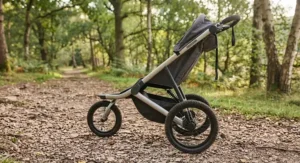
How to Choose an Off Road Jogging Stroller
Choosing the right off road jogging stroller comes down to matching seven key factors to your actual running habits, rather than simply buying the most expensive option on the shelf.
- Front wheel design. Fixed wheels, like the Out n About Nipper Sport V5, give the most stability at speed but sacrifice manoeuvrability; swivel-and-lock designs, like the Thule Urban Glide 2, offer more everyday flexibility.
- Tyre type and size. Larger pneumatic tyres (16 inches or bigger) absorb rough terrain far better than smaller solid wheels, but need occasional pressure checks and carry a small puncture risk.
- Suspension system. All-wheel independent suspension, as fitted to the Baby Jogger Summit X3, delivers the smoothest ride on rutted ground, though it typically adds weight.
- Weight of the frame. A lighter buggy like the Thule Urban Glide 2 is easier to push and store, while a heavier design like the Mountain Buggy Terrain often trades weight for stability and versatility.
- Running certification. If dedicated running is your priority, look specifically for models tested to BS EN1888-3:2023, as the Out n About Nipper Sport V5 now is — not every “jogging” buggy carries this.
- Newborn and age compatibility. Most manufacturers recommend against running with a baby under six months old regardless of buggy design; check minimum jogging age alongside general usage age.
- Fold size and boot compatibility. Longer three-wheeled frames, particularly fixed-wheel models, can be awkward in smaller car boots — check folded dimensions before you buy, not after.
What is an Off Road Jogging Stroller?
An off road jogging stroller is a specially engineered pushchair with large pneumatic tyres, reinforced suspension, and a stable front-wheel system designed to remain controllable at running pace across uneven, unpaved terrain — unlike standard pushchairs built primarily for smooth pavements.
All Terrain Running Buggy vs Standard 3-Wheel Pushchair
The line between an all terrain running buggy and a standard 3-wheel pushchair is thinner than manufacturers sometimes suggest, but it matters enormously once you pick up your pace. A standard 3-wheel pushchair, even one marketed as “all-terrain,” typically uses smaller wheels and lighter-duty suspension optimised for walking speed and everyday manoeuvrability — think supermarket aisles and tight pavement corners. An all terrain running buggy, by contrast, is engineered around stability at running speed specifically: larger pneumatic tyres for shock absorption, a front wheel that locks rigidly (or is fixed outright, as on the Out n About Nipper Sport V5), and a wider wheelbase to resist tipping when you’re moving quickly over uneven ground.
The practical difference shows up fastest on genuinely rough terrain. Push a standard 3-wheel pushchair at jogging pace down a rutted farm track and the small front wheel will judder and potentially lock up on impact; the same route on the BOB Revolution Flex 3.0 or Mountain Buggy Terrain, with their larger tyres and dedicated suspension, feels controlled rather than chaotic. That said, a genuine all-terrain running buggy sacrifices some of the tight-turning convenience of a standard pushchair — you won’t be spinning the Baby Jogger Summit X3 around a crowded café as effortlessly as a compact stroller. If your week is genuinely 90% pavement and 10% trail, a standard all-terrain pushchair like the Hauck Runner 2 may suit you better; if trails are the whole point, invest in a purpose-built running buggy.
Common Mistakes When Buying an Off Road Running Pushchair
The single most common mistake is buying based on marketing language alone — “off road” and “all-terrain” appear on packaging for buggies that were never actually tested or certified for running, as the Hauck Runner 2‘s own safety labelling honestly demonstrates. A second frequent error is ignoring weight entirely; a heavier buggy like the Baby Jogger Summit X3 might offer superior suspension, but if you’re planning to lift it in and out of a small car boot several times a week, that extra weight becomes a genuine daily friction point rather than a minor spec. Buyers also regularly underestimate folded dimensions, assuming any three-wheel buggy will fit their existing car — the Out n About Nipper Sport V5‘s longer folded footprint catches out more than a few first-time buyers according to owner reviews.
Another recurring mistake is buying a dedicated running buggy for a newborn, without checking the manufacturer’s minimum age for jogging specifically — most brands, including phil&teds, recommend waiting until at least six months regardless of what age the buggy is otherwise rated for. Finally, some buyers skip checking tyre maintenance requirements entirely; pneumatic tyres need occasional pressure top-ups and carry a small puncture risk that solid-tyred pushchairs simply don’t, a trade-off worth understanding honestly before you commit rather than discovering it on your first flat.
What to Expect: Real-World Performance on Trails
Specs on a page rarely translate directly into what a genuine trail run actually feels like, so here’s what aggregated reviewer experience suggests you should expect. On smooth gravel and canal towpaths, virtually every buggy in this guide performs well — this is where the difference between a £180 budget pick and a £600 premium model narrows considerably. Once you move onto genuinely rutted farm tracks, root-strewn woodland paths, or wet grass, the gap widens fast: reviewers of the Baby Jogger Summit X3 and Mountain Buggy Terrain both reported strong composure on rough terrain, while testers of standard all-terrain pushchairs like the Hauck Runner 2 found performance solid on rough pavement but noticeably less confident on genuinely off-road ground.
Hills reveal another real difference. Heavier buggies with excellent suspension, like the BOB Revolution Flex 3.0, feel planted and controlled going downhill but demand real effort pushing back up; lighter models like the Thule Urban Glide 2 are easier to push uphill but can feel slightly less stable descending at speed on loose surfaces. Wet, muddy conditions are where fixed and fully-locked front wheels earn their keep — reviewers of the Out n About Nipper Sport V5 specifically praised confident handling on muddy North Yorkshire trails, a scenario where a loosely locked swivel wheel, as found on the phil&teds Sport, can occasionally retain enough play to feel less reassuring.
Off Road Jogging Strollers for Different Runners: Beginners to Ultra Trail Parents
A new-to-running parent easing back into fitness after their six-week or twelve-week postnatal check — timing that the NHS recommends discussing with a GP or midwife before starting high-impact exercise — is generally best served starting with lighter, easier-to-manoeuvre options like the Thule Urban Glide 2, building confidence on smoother routes before tackling genuine trail terrain. Intermediate parents running two or three times weekly on mixed pavement-and-park routes will likely get the most value from a mid-range hybrid like the phil&teds Sport or the certified Out n About Nipper Sport V5, which handle both everyday errands and weekend trail outings competently.
Committed trail and ultra-distance parent-runners — the sort logging serious weekly mileage on genuinely rough terrain — are the audience the BOB Revolution Flex 3.0 and Mountain Buggy Terrain were fundamentally designed around, where the extra weight and premium price buy real stability that lighter buggies simply can’t match at pace on rocky or root-covered ground. Budget-conscious families whose “trail” running is mostly parkland paths and forest tracks rather than technical terrain can reasonably start with the Hauck Runner 2, upgrading later only if their training genuinely outgrows it.
Long-Term Cost & Maintenance of Pneumatic Tyres Running Buggies
Pneumatic tyres running buggies carry a genuine ongoing cost that solid-wheel pushchairs avoid, and it’s worth budgeting for honestly rather than being surprised later. Occasional punctures are the main expense: a basic bike-style repair kit costs relatively little, but replacement inner tubes for larger 16-inch wheels, as used on the Mountain Buggy Terrain and Out n About Nipper Sport V5, typically cost more than a standard bicycle tube due to the wider tyre profile. Regular pressure checks are free but easy to neglect — under-inflated tyres wear unevenly and drag, shortening their lifespan and making every run noticeably harder work.
Bearing maintenance is the other recurring cost across owner reviews: grit and mud worked into wheel bearings during off-road use is repeatedly cited as the leading cause of a buggy needing wheel servicing or replacement within two to three years of regular trail use. Buggies with quick-release wheels, a feature shared by most models in this guide including the BOB Revolution Flex 3.0 and phil&teds Sport, make cleaning and eventual bearing replacement significantly cheaper and easier than sealed, non-removable wheel designs. Total cost of ownership over three to four years of regular off-road running therefore includes the purchase price, occasional tube or tyre replacement, and periodic bearing servicing — factor all three in rather than judging value on sticker price alone.
Safety, Regulations & Compliance Guide for Trail Running Pushchairs
Every pram and pushchair sold in the UK, including trail running pushchairs, must comply with BS EN 1888, the British Standard covering wheeled child conveyances, which sets safety requirements for stability, harness security, and entrapment hazards. However, standard EN 1888 compliance does not automatically mean a buggy is certified for running — a more specific standard, BS EN1888-3:2023, exists precisely to test and approve pushchairs for that use, and the Out n About Nipper Sport V5 is a clear example of a buggy that has achieved this specific certification. By contrast, the Hauck Runner 2‘s own product labelling explicitly states it is not certified for jogging or skating, a distinction worth taking seriously even where real-world reviewer experience with gentle jogging has been broadly positive.
On the health side, timing matters just as much as equipment. Postnatal guidance generally advises waiting until after a six-week (or, per more recent physiotherapy guidance, twelve-week) postnatal check before returning to high-impact exercise like running, and starting gradually thereafter. Always secure your child with the full harness provided, use the wrist strap fitted to most models to prevent runaway buggies on downhill sections, and check tyre pressure and wheel security before every serious outing — small checks that account for the overwhelming majority of prevented incidents according to consumer safety guidance.
Features That Actually Matter (And Those That Don’t)
Suspension quality, front wheel locking mechanism, and tyre size genuinely matter — these three factors, more than any other spec, determine how a buggy actually behaves on rough terrain, and they’re the features every product in this guide has been assessed against. Running-specific safety certification (BS EN1888-3:2023) matters enormously if dedicated running is your goal, since it’s the difference between a manufacturer’s marketing claim and an independently tested approval. Folded dimensions and buggy weight matter more than most first-time buyers expect, because they determine whether the “perfect” buggy actually fits your life on a daily basis, not just on a weekend trail outing.
What matters considerably less: novelty accessory bundles like branded cup holders, phone consoles, or colour-matched rain covers, which are frequently sold separately anyway and rarely influence real-world trail performance. Extremely high maximum PSI ratings, like the 90 PSI figure quoted for BOB tyres, are largely irrelevant to everyday off-road use, since most owners run considerably lower pressures for comfort on rough ground. And while brand heritage stories make for pleasant reading, aggregated review sentiment consistently shows that independently tested suspension and wheel performance — not decades of brand history — is what actually predicts owner satisfaction two years down the line.
Buyer’s Decision Framework: Which Off Road Buggy for Runners Fits You
If you run three or more times a week on genuinely rough, muddy, or rocky terrain, choose a purpose-built, running-certified buggy like the Out n About Nipper Sport V5 or the suspension-heavy BOB Revolution Flex 3.0, because stability and shock absorption at pace matter more than weight or price here. If your routes are mostly smooth parkland paths, canal towpaths, or light gravel and you want the lightest possible push, choose the Thule Urban Glide 2, prioritising manoeuvrability and ease of storage over maximum rough-terrain capability. If you want one buggy for absolutely everything — newborn travel system, daily pavement use, and occasional country walks — choose a versatile hybrid like the Mountain Buggy Terrain or phil&teds Sport, accepting that dedicated running performance is a secondary strength rather than the primary design goal.
If budget is your overriding priority and your “off road” needs are realistically gentle trails and rough pavement rather than technical terrain, choose the Hauck Runner 2 and adjust your running expectations accordingly. And if ride comfort for your child on genuinely bumpy ground matters more to you than the parent’s pushing effort, choose the Baby Jogger Summit X3 for its all-wheel independent suspension, accepting the extra weight as the price of that comfort.
Frequently Asked Questions
❓ What is the difference between an off road jogging stroller and a normal pushchair?
❓ Can you run with a normal all-terrain pushchair off-road?
❓ What age can a baby start using an off road jogging stroller for running?
❓ How much does a good off road jogging stroller cost in the UK?
❓ Do off road jogging strollers fit in a standard UK car boot?
Conclusion
Choosing the right off road jogging stroller ultimately comes down to being honest with yourself about your actual weekly terrain and mileage, rather than buying the buggy with the longest spec sheet. For genuinely committed trail runners tackling rough, rutted ground several times a week, the suspension and stability of the BOB Revolution Flex 3.0 or the running-certified Out n About Nipper Sport V5 earn their higher price tags. For lighter, more everyday use, the Thule Urban Glide 2 offers an excellent balance of weight, fold convenience, and genuine trail capability. Families wanting one buggy for absolutely everything — newborn to toddler, pavement to bridleway — should look closely at the Mountain Buggy Terrain or phil&teds Sport, while budget-conscious parents whose off-road needs are realistically modest will find real value in the Hauck Runner 2.
Whichever you choose, remember that the safest, most enjoyable off-road running experience comes from matching the buggy’s genuine design intent to your real routes — checking tyre pressure, locking the front wheel on rough ground, and respecting manufacturer running certifications where they exist. Do that, and you’ll be back on the trails you love without ever leaving your training routine, or your little one, behind.
🏃 Ready to Hit the Trail?
🔍 Compare current prices and availability on any of the seven off road jogging strollers above, and pick the one that actually matches how — and where — you run. Your next muddy, joyful family run is closer than you think!
Recommended for You
- Best Running Buggy 2026: 7 Top Jogging Pushchairs Rated
- Compact Double Buggy: 7 Best Picks for Tight UK Boots (2026)
- Double Buggy for Newborn and Toddler: 7 Real 2026 Picks
Disclaimer: This article contains affiliate links. As an Amazon Associate, I earn from qualifying purchases. If you purchase products through these links, we may earn a small commission at no additional cost to you.
✨ Found this helpful? Share it with your friends! 💬🤗
