In This Article
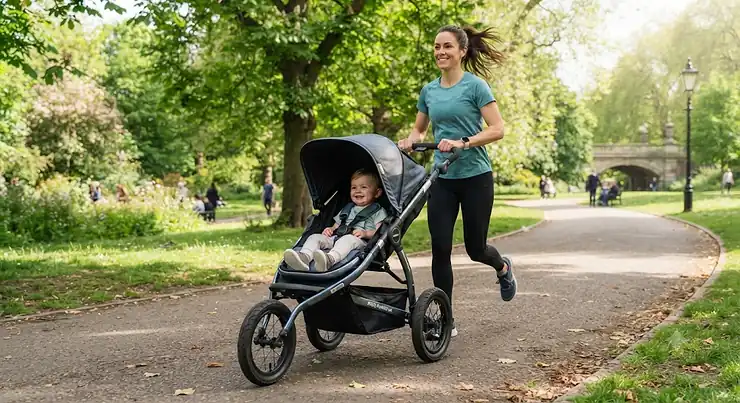
Somewhere between the six-week check-up and the first proper run back, most new parents hit the same wall: the buggy in the hallway simply wasn’t built for pace. A best running buggy is a specific category of pushchair, engineered with a locked or lockable front wheel, air-filled tyres and genuine suspension so it stays stable and controllable while you’re actually moving at a jog or run, unlike a standard everyday pushchair, which will wobble, judder and potentially tip on anything faster than a brisk walk. That distinction matters more than it sounds like it should, because the wrong buggy at the wrong speed isn’t just uncomfortable, it’s a genuine stability risk for the child riding in it.
This guide is built around real, currently available products sold through amazon.co.uk, not marketing copy lifted from a listing page. We’ve dug into verified specifications, aggregated review sentiment from UK and international testers, and the safety standard that actually governs this category (more on that shortly) to help you work out which pushchair for running fits your budget, your terrain, and your running habits. Whether you’re chasing a fixed front wheel for dead-straight parkrun laps or hunting for the best jogging pram that can also handle the school run on a Tuesday, you’ll find a genuinely comparable shortlist below, along with the honest trade-offs each model comes with.
Quick Comparison Table
Before the deep dive, here’s a snapshot of how the seven models stack up on the things that matter most to runners: weight, front wheel type, and where they sit on price.
| Buggy | Best For | Weight | Front Wheel | Price Range |
|---|---|---|---|---|
| Hauck Runner 2 | Tightest budget (all-terrain, not jogging-certified) | 11.1kg | Swivel/lockable | Under £200 |
| Out’n’About Nipper Sport V6 | Lightest true running buggy | 9.8kg | Fixed | £330-£400 |
| Joovy Zoom360 Ultralight | Big canopy on a budget | ~10.5kg | Fixed | £300-£400 |
| Phil&Teds Sport | Flexible single-to-double family use | ~11.5kg | Lockable swivel | £450-£620 |
| Baby Jogger Summit X3 | Smoothest off-road ride | 12.8kg | Lockable swivel | £500-£570 |
| Thule Urban Glide 3 | All-round everyday-plus-running | ~11.9kg | Swivel-lock | £600-£700 |
| Mountain Buggy Terrain | Trail-to-town versatility | 13.5kg | 3-mode | £650-£950 |
Looking at the spread, the gap between budget and premium isn’t just price, it’s genuine engineering difference. Sub-£400 models like the Out’n’About Nipper Sport V6 achieve their low weight and cost by using a fixed front wheel and simpler suspension, while anything above £500 tends to add lockable-swivel front wheels, full three-wheel suspension and heavier-duty frames that hold up to daily off-road mileage. If you only run on smooth pavement a couple of times a week, that premium buys you comfort more than capability; if you’re regularly on trail parkruns, it buys you genuine stability. According to NHS guidance on keeping fit with a baby, it’s worth checking in with a midwife, health visitor or GP before starting any high-impact exercise postnatally, which is worth bearing in mind before you commit to a buggy built specifically for running.
Ready to compare current prices side by side? Tap through to any listing above and see which one fits your budget today.
Top 7 Running Buggies: Expert Analysis
We’ve spread this shortlist deliberately across budget, mid-range and premium, and included variants (wheel sizes, brake types, fixed versus swivel front wheels) so you can match a buggy to how and where you actually plan to run, not just how much you want to spend.
1. Hauck Runner 2 — best budget all-terrain pick (honest caveat: not jogging-certified)
The Hauck Runner 2 is the cheapest genuinely capable three-wheeler in this list, and it’s worth starting here precisely because of an honesty point Amazon’s own listing makes clear. Its extra-large air-filled tyres (39cm rear, 30cm front) and a height-adjustable handle running from 78cm to 112cm mean it comfortably suits parents of very different heights, while the lockable swivel front wheel keeps it steady on uneven paths and kerbs. In practice, those big pneumatic tyres soak up cracked pavements and gravel park paths noticeably better than a budget four-wheeler with hard plastic tyres would, which is exactly why it gets recommended so often as a value all-terrain buggy rather than a value jogging buggy.
Here’s what most buyers overlook: Hauck’s own product listing explicitly states the Runner 2 is “not suitable for jogging or skating” and it’s certified only to EN 1888-2:2018, the everyday pushchair standard, not the leisure-sport running standard. That’s an important distinction for anyone typing “best jogging pushchair review” expecting this model to appear as a true runner. Aggregated UK reviewer sentiment (MadeForMums, Expert Reviews) consistently praises it as fantastic value for park walks, dog walks and rough pavements, rating it around 4.5 out of 5 for everyday all-terrain use, but none of that feedback comes from genuine running conditions.
Pros:
- ✅ Large air-filled tyres handle kerbs and rough pavements smoothly
- ✅ Height-adjustable handle suits both tall and short parents
- ✅ Consistently rated as excellent value by UK parenting reviewers
Cons:
- ❌ Manufacturer states it is not certified or suitable for jogging
- ❌ No dedicated hand brake, only a basic foot-operated parking brake
At around under £200, the Hauck Runner 2 is superb value as an everyday all-terrain pushchair, but budget-conscious runners specifically should treat it as a stepping stone rather than a genuine jogging buggy.
2. Out’n’About Nipper Sport V6 — lightest true running buggy with a fixed front wheel
If your search started with running buggy with fixed front wheel, this is the model that answers it directly. Built in the UK and weighing just 9.8kg, the Out’n’About Nipper Sport V6 is genuinely one of the lightest jogging buggies on the market, and unlike many rivals that offer a swivel-lock front wheel as a compromise, the Sport uses a properly fixed front wheel, meaning there’s no wobble to lock out in the first place. It pairs 16-inch air-filled tyres with a long wheelbase and built-in suspension, plus a handlebar brake for descents.
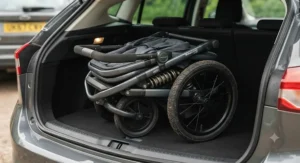
What that combination means in practice is straightforward: at under 10kg, it’s dramatically easier to lift in and out of a car boot than the 12-14kg premium models further down this list, and the fixed front wheel delivers dead-straight tracking at speed, which serious runners specifically look for. The trade-off, and it’s worth being upfront about it, is that a fixed wheel makes tight manoeuvring around shop aisles or narrow doorways noticeably harder than a swivel design. Reviewer sentiment from UK-based testing (Advnture) describes it as arguably the lightest and best-value running buggy available, with the handlebar brake singled out as genuinely useful on steep descents.
Pros:
- ✅ Among the lightest true running buggies available, at 9.8kg
- ✅ Genuinely fixed front wheel keeps a dead-straight line at pace
- ✅ Roughly half the price of premium running-stroller rivals
Cons:
- ❌ Fixed front wheel makes tight, low-speed manoeuvring harder
- ❌ Sun canopy offers limited coverage when running into low sun
Priced around £330-£400, the Nipper Sport V6 is the strongest value pick for anyone who wants a genuine, certified running buggy without paying premium prices.
3. Joovy Zoom360 Ultralight — roomiest budget-value option
The Joovy Zoom360 Ultralight takes a different approach to keeping weight down: an aircraft-grade 6061 aluminium frame that Joovy claims is around 10% lighter than its predecessor, paired with 16-inch rear pneumatic wheels and a 12-inch front wheel on a straight-through axle designed to track truer over longer runs. It also comes bundled with a few extras that competitors sell separately, including an air pump and a two-cup parent organiser.
Where this one genuinely stands out is canopy coverage. The oversized hood with its “peek-a-boo” viewing window offers noticeably more shade than most budget rivals, which matters on the unpredictable sunny-one-minute, overcast-the-next days that pass for British summer. On the downside, aggregated reviewer feedback flags a stiffer-than-ideal foot brake and a fixed, non-adjustable handlebar height, both of which become more noticeable on longer runs or when height mismatches between parents sharing the buggy. There’s no verified UK-specific customer review pool as deep as the Nipper’s, so treat this as a solid, if less battle-tested, budget-value alternative rather than a market leader.
Pros:
- ✅ Oversized canopy provides genuinely better sun coverage
- ✅ Lightweight aircraft-aluminium frame keeps the price competitive
- ✅ Bundled air pump and parent organiser add real value
Cons:
- ❌ No hand brake, only a stiffer foot-operated brake
- ❌ Handlebar height is fixed rather than adjustable
Typically listed in the low-to-mid £300s on Amazon UK at the time of research (prices may vary, so check current price), it’s a sensible pick for parents prioritising shade and storage over ultimate off-road polish.
4. Phil&Teds Sport — most flexible family buggy with a genuinely unique brake
The Phil&Teds Sport earns its place here through one distinctive engineering choice: a pushbar-mounted autostop brake that engages automatically the moment you let go of the handlebar. That’s a meaningfully different safety mechanism to the simple foot-pedal or hand-lever brakes on most rivals, because it removes the chance of the buggy rolling away unattended on a slope, something worth weighing seriously if you regularly stop on hills. It also runs on air-filled tyres with an optional locking front wheel, and can be converted into a double buggy later via a separate kit, which extends its useful life as your family grows.
Positioned as a genuine mid-range hybrid rather than a pure running specialist, the Sport works well for parents who want one buggy that copes with daily errands and occasional jogging rather than serious weekly mileage. Aggregated UK reviewer sentiment (MadeForMums, Treats & Treadmills) is consistently positive on the fold mechanism and manoeuvrability, though testers note the rain cover is sold as a separate accessory, an easy extra cost to forget when budgeting.
Pros:
- ✅ Autostop brake engages automatically without you touching a lever
- ✅ Converts into a double buggy later via an optional kit
- ✅ Genuinely easy one-hand fold for quick storage
Cons:
- ❌ Rain cover is sold separately, adding to the total cost
- ❌ Tyres need manually pumping up before first use
Priced roughly £450-£620 depending on colourway and bundle, the Sport suits families who want flexibility first and running capability as a welcome bonus.
5. Baby Jogger Summit X3 — smoothest ride for serious off-road mileage
Step up to the Baby Jogger Summit X3 and the headline upgrade is suspension on all three wheels, not just the front. On rutted forest paths or gravel tracks, that’s a genuinely noticeable difference compared with buggies that only cushion the front wheel, smoothing out the kind of repeated jolting that otherwise travels straight up your arms on a long trail run. It’s rated for jogging from nine months and carries a generous 34kg maximum weight capacity, meaning it can realistically stay in service well into a child’s school years rather than being outgrown within eighteen months.
The lockable swivel front wheel switches between nimble everyday manoeuvring and locked-straight running mode, and the frame folds compactly with one hand despite the premium build. UK reviewer testing (GoodTo, Coach) rates the off-road smoothness highly, but consistently flags two real-world niggles worth knowing before you buy: the handlebar height isn’t adjustable, which can be uncomfortable for taller or shorter runners, and the foot brake becomes fiddly to operate once it’s picked up mud.
Pros:
- ✅ All-wheel suspension smooths out rutted, off-road terrain
- ✅ High 34kg weight limit extends the buggy’s useful lifespan
- ✅ Compact one-handed fold despite the premium three-wheel build
Cons:
- ❌ Handlebar height is fixed, not adjustable to the runner
- ❌ Foot brake gets awkward to use once it’s muddy
At around £500-£570, the Summit X3 rewards parents who run off-road regularly rather than occasionally, where the extra suspension genuinely earns its price premium.

6. Thule Urban Glide 3 — best all-round build quality and manoeuvrability
The Thule Urban Glide 3 is built as a genuine dual-purpose buggy rather than a running specialist with everyday features bolted on. Its 16-inch air-filled wheels pair with full suspension and a twist hand brake, which gives noticeably finer speed control on descents than a simple foot pedal, useful when you’re trying to hold pace without breaking stride. The front wheel swivels for tight, everyday manoeuvring and locks solidly in place for running, a two-in-one approach that reviewers specifically praised for resisting small children trying to unlock it with a curious foot.
At roughly 11.9kg with a self-standing, one-handed fold, it sits comfortably between the featherweight budget options and the heaviest flagship models. International testing (Road Trail Run, Men’s Journal) consistently rates it as smooth, stable and genuinely effortless to push across paved trails and light mud, describing it as making running with a child feel surprisingly straightforward. The trade-off is a firmly premium price point, and several genuinely useful accessories, including car seat adapters and a cargo tray, are sold separately.
Pros:
- ✅ Twist hand brake gives precise control on hills
- ✅ Swivel-then-lock front wheel suits errands and running equally well
- ✅ Self-standing, one-handed fold saves space at home
Cons:
- ❌ Sits at a firmly premium price point versus rivals
- ❌ Car seat adapters and cargo tray are sold separately
Typically priced £600-£700 in the UK, the Urban Glide 3 is the strongest all-rounder here if you want one buggy that genuinely does everything well.
7. Mountain Buggy Terrain — most versatile wheel setup, trail-to-town in seconds
The Mountain Buggy Terrain is the flagship of this shortlist, and its standout feature is included dual wheel sets: a pair of 16-inch wheels for trails and a pair of 12-inch wheels for town, swappable in seconds. That’s a genuinely different proposition to every other buggy here, most of which force you to pick one wheel size and stick with it. Add a three-mode front wheel (fixed, swivel, or swivel-lock) and a frame built from 6061 T6 aircraft-grade aluminium, and you have a buggy engineered specifically for parents who split their week between muddy trail runs and narrow high-street pavements.
At 13.5kg it’s the heaviest buggy in this roundup, and that weight is the direct cost of its versatility, more frame, two wheel sets, and reinforced components all add up. Aggregated reviewer sentiment (Advnture) praised the thick, grippy 16-inch wheels on rocky, rutted trails, going as far as noting testers were tempted to push it into muddier conditions than rival buggies could handle, though the same testers found the front wheel could clog in particularly sticky mud, and rated the handlebar brake’s position as somewhat awkward.
Pros:
- ✅ Interchangeable 16-inch and 12-inch wheel sets for trail or town
- ✅ Three-mode front wheel adapts to almost any terrain
- ✅ Aircraft-grade aluminium frame built for years of hard use
Cons:
- ❌ Heaviest buggy in this comparison at 13.5kg
- ❌ Handlebar brake position criticised as awkward by testers
Prices vary considerably by retailer and bundle, generally landing in the £650-£950 range, making this the buggy to choose only if you genuinely need both trail and town capability from one frame.
Real-World Scenarios: Which Running Buggy Suits You?
Specs only tell half the story, so here’s how three common situations map onto the shortlist above.
If you’re a first-time parent on a tight budget who mostly walks briskly around the local park with the occasional gentle jog, the Hauck Runner 2 covers everyday terrain brilliantly for under £200, though it’s worth being honest with yourself that it isn’t certified for genuine running, so treat any faster pace as occasional rather than habitual. If you’re returning to regular 5k training after your six-week check and want the lightest possible buggy to push through a full session without arm fatigue, the Out’n’About Nipper Sport V6 at 9.8kg with its fixed front wheel is purpose-built for exactly that, and its price keeps a serious running habit affordable rather than a luxury. If you’re a trail-running parent who also needs a compact everyday buggy for narrow city pavements and weekly supermarket trips, the Mountain Buggy Terrain‘s swappable wheel sets solve a genuine two-buggy problem with one purchase, at the cost of a heavier frame and a higher price tag.
A fourth scenario worth flagging: parents planning to run with two children eventually should look specifically at models offering a double conversion kit, such as the Phil&Teds Sport, rather than assuming any single buggy can simply be upgraded later.
Practical Usage Guide: Getting Started With Your Running Buggy
Buying the right pushchair for running is only step one; setting it up correctly is what actually keeps your child safe once you’re moving. Most jogging buggies arrive with the rear wheels detached and tyres only partially inflated, so budget ten to fifteen minutes for initial assembly and always check tyre pressure against the manufacturer’s guidance printed on the sidewall before the first outing, since underinflated tyres noticeably worsen ride quality and steering precision.
Every genuine running buggy includes a wrist strap attached to the handlebar, and this is not an optional accessory: the jogging stroller safety wrist strap should be looped around your wrist on every single run, not just the first few, because it’s the only thing preventing the buggy rolling away from you if you trip or lose your grip momentarily. Pair that with the five-point harness cinched snugly around your child every time, checking it hasn’t loosened as they grow, and always engage the front wheel lock (where fitted) before picking up any real pace; running with an unlocked swivel wheel is one of the more common and entirely avoidable causes of instability.
In the first thirty days, common mistakes include starting too fast before either you or the buggy’s handling feel familiar, forgetting to recheck tyre pressure weekly (air-filled tyres do lose pressure gradually), and neglecting to wipe down the frame after wet or muddy runs, which accelerates corrosion on cheaper components. A quick monthly check of brake responsiveness and wheel-bearing smoothness will catch most maintenance issues before they become expensive ones.
How to Choose the Best Running Buggy
Cutting through the marketing, here’s the reasoning that should actually drive your decision:
- Confirm genuine running certification first. Look for compliance with BS EN 1888-3, the specific UK and EU standard for pushchairs intended for leisure sport activities, rather than assuming any three-wheeler with big tyres qualifies.
- Match front wheel type to your terrain. A fixed front wheel like the Nipper Sport’s tracks straighter at speed but is harder to manoeuvre; a swivel-lock design like the Thule or Baby Jogger’s trades a little straight-line stability for everyday flexibility.
- Weigh the buggy against your own strength and storage. A sub-10kg buggy is dramatically easier to lift into a car boot or up stairs than a 13-14kg premium model, which matters daily even if it barely shows up in a spec sheet comparison.
- Check the weight capacity against your child’s growth curve. A higher limit, such as the Summit X3’s 34kg, extends useful life by years rather than months.
- Factor in brake type for your local terrain. Hilly routes benefit noticeably from a hand or twist brake over a basic foot pedal, which becomes harder to use precisely on descents.
- Price in the accessories you’ll actually need. Rain covers, car seat adapters and cargo trays are sold separately on several premium models, and can add £50-£100 to the real cost.
- Read aggregated review sentiment, not just star ratings. A 4.5-star average can hide a recurring, specific complaint (a stiff brake, a non-adjustable handlebar) that matters enormously to you and not at all to another reviewer.
Running Buggy vs Standard Pushchair: What’s Actually Different
It’s tempting to assume any sturdy-looking three-wheeler will do, but the differences between a genuine running buggy and a standard everyday pushchair for running are structural, not cosmetic. Standard pushchairs are engineered and safety-tested for walking pace, with smaller wheels, lighter suspension and a swivel front wheel that’s designed purely for manoeuvrability at low speed, not stability at a run. Push one at jogging pace over anything rougher than smooth pavement and the front wheel can begin to shimmy or “wobble,” a genuinely dangerous handling characteristic at speed.
Running buggies address this with larger, air-filled tyres that absorb impact rather than transmitting it, a front wheel that’s either fixed outright or lockable into a fixed position, and typically a longer wheelbase for stability. They’re also usually certified to BS EN 1888-3, the running-specific safety standard, whereas most everyday pushchairs are only tested to the general BS EN 1888-1/2 standards covering walking-pace use. As the honest caveat on the Hauck Runner 2 demonstrates, even a robust all-terrain-looking pushchair can explicitly fall outside that running certification, so it genuinely pays to check rather than assume.
| Feature | Running Buggy | Standard Pushchair |
|---|---|---|
| Front wheel | Fixed or lockable-swivel | Free-swivel only |
| Tyres | Large air-filled | Small, often solid |
| Suspension | Full or multi-wheel | Front-only or minimal |
| Certification | BS EN 1888-3 (where certified) | BS EN 1888-1/2 |
| Best For | Jogging, off-road running | Walking pace, city errands |
The table above makes the practical gap clear: a running-certified buggy like the Out’n’About Nipper Sport V6 or Thule Urban Glide 3 is engineered from the ground up for pace and impact absorption, while a standard pushchair prioritises tight manoeuvrability at a walk. Trying to make a standard pushchair do a running buggy’s job isn’t just less comfortable, it removes a safety margin the certification is specifically designed to provide.
Fixed Front Wheel vs Swivel-Lock: Why It Matters for Runners
Among everything covered so far, the choice between a fixed and a swivel-lock front wheel is arguably the single biggest handling difference between models, so it deserves its own closer look. A running buggy with fixed front wheel, like the Out’n’About Nipper Sport V6, has no swivel mechanism at all, which means nothing to lock, nothing to wobble loose over time, and genuinely the straightest possible tracking at speed. The trade-off is manoeuvrability: turning a fixed-wheel buggy in a tight supermarket aisle means physically lifting and pivoting the front end, which becomes tiresome fast if the buggy also does everyday duty.
A swivel-lock front wheel, used on the Thule Urban Glide 3, Baby Jogger Summit X3 and Mountain Buggy Terrain, swivels freely for everyday manoeuvring and locks into a fixed position with a simple mechanism before a run. Done properly, that gives you both worlds: nimble steering around the house and shops, dead-straight tracking once locked for a run. The catch is discipline, because forgetting to lock it before picking up pace is a genuinely common and avoidable cause of instability, and reviewers of the Thule specifically noted the lock needs to be secure enough that a small child can’t accidentally release it mid-run.
Common Mistakes When Buying a Running Buggy
Even careful shoppers fall into predictable traps with this category. First, assuming any three-wheeler with big tyres is automatically running-certified, when, as the Hauck Runner 2’s own labelling shows, that’s simply not always true, so always check for explicit BS EN 1888-3 compliance rather than inferring it from appearance. Second, prioritising price over weight capacity, then finding the buggy is outgrown within a year because the maximum weight limit was lower than expected; models like the Summit X3, with its 34kg ceiling, avoid this specific regret. Third, ignoring your own height when a buggy’s handlebar isn’t adjustable, several models reviewed here, including the Summit X3 and Zoom360, have fixed handlebar heights that can cause genuine back strain over repeated long runs for parents outside the “average” height range they were designed around.
Fourth, forgetting to budget for accessories sold separately: rain covers, car seat adapters and cargo trays routinely add £50-£100 to premium models like the Thule and Phil&Teds, a cost that rarely appears in headline pricing. Finally, buying based on star rating alone rather than reading what the reviews actually say, since a strong average can still mask a specific, recurring flaw (a stiff brake, a wheel that clogs in mud) that matters enormously depending on where you actually plan to run.
Suspension, Wheels and Ride Quality: What to Expect
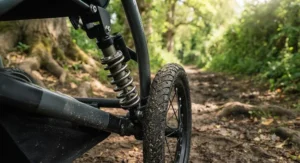
Running pram suspension varies more between these seven models than almost any other spec, and it’s worth understanding what that means in practice rather than on paper. Front-only suspension, found on budget and mid-range models, cushions the wheel that takes the brunt of forward impact but leaves rear wheels to transmit bumps more directly upward, noticeably felt on rutted or cobbled surfaces. Full three-wheel suspension, as fitted to the Baby Jogger Summit X3, cushions every wheel independently, producing a genuinely smoother ride on gravel trails and rutted parkland, the kind of difference you’ll feel within the first few hundred metres off pavement.
Wheel size also does real work here: 16-inch air-filled wheels, used on the Thule Urban Glide 3, Out’n’About Nipper Sport and Joovy Zoom360, roll over obstacles like tree roots and potholes with noticeably less jolt than smaller 12-inch wheels, which excel instead at tight, low-speed manoeuvring in town. The Mountain Buggy Terrain sidesteps the trade-off entirely by including both sizes, letting you fit whichever suits the day’s route. Whatever suspension setup you choose, tyre pressure has an outsized effect on all of it: an underinflated air-filled tyre softens the ride slightly but noticeably increases rolling resistance and steering vagueness, so a five-minute pressure check before longer runs pays for itself in handling precision.
Safety First: Wrist Straps, Certification and Regulations
Safety in this category isn’t just about the buggy’s build quality, it’s also about how you use it. Under UK product safety rules, any pram or pushchair sold must comply with the relevant British Standard, and manufacturers and retailers carry a legal duty to supply products that are safe for their intended, normal use, as set out in guidance from local trading standards authorities, including Lancashire County Council’s consumer advice on prams and pushchairs. For running buggies specifically, that relevant standard is BS EN 1888-3, covering pushchairs intended for leisure sport activities, distinct from the general-use BS EN 1888-1/2 standards that cover everyday pushchairs.
Beyond certification, three practical habits matter every single time you run. Always attach and wear the jogging stroller safety wrist strap; it’s the last line of defence if you stumble or the buggy pulls away from you unexpectedly on a downhill stretch. Always lock a swivel front wheel into its fixed position before running, since an unlocked wheel at speed is one of the more common causes of sudden instability. And always use the five-point harness correctly, checked and tightened as your child grows, rather than relying on the buggy’s frame and wheels alone to keep them secure. If you’re planning to run with your buggy at organised community events, it’s also worth checking event-specific guidance; UK parkrun events, for example, publish their own rules and guidance for taking part with a buggy or pushchair, which can vary slightly by venue and course.
Long-Term Cost & Maintenance
The sticker price is only part of what a running buggy actually costs over its lifetime, and it’s worth thinking in terms of total cost of ownership rather than the upfront figure alone. Budget models like the Hauck Runner 2 or Nipper Sport V6 save £200-£400 initially, but replacement inner tubes, punctures on air-filled tyres, and eventual bearing wear are broadly comparable costs across the whole category, since most of these buggies share similar tyre and wheel technology regardless of price point. Where the real cost gap opens up is accessories: premium models like the Thule Urban Glide 3 and Baby Jogger Summit X3 sell rain covers, car seat adapters and cargo trays separately, and a fully accessorised premium buggy can easily add £100-£150 on top of the headline price.
Weight capacity has a direct effect on long-term value too. A buggy like the Summit X3, rated to 34kg, can realistically remain in service for four to five years, spreading its higher upfront cost over a genuinely longer useful life, whereas a lower-capacity model might need replacing within two to three years as a child outgrows it. Basic maintenance, keeping tyres correctly inflated, wiping the frame after wet or muddy runs, and periodically checking bearing smoothness, costs little beyond a few minutes a month but meaningfully extends any buggy’s working life regardless of price bracket, which makes it arguably the single best-value habit in this entire guide.
Best Jogging Pushchair Review: Buyer’s Decision Framework
If you’re still weighing your options after all of the above, this simple framework should help cut through the noise:
If your budget is under £250 and you mainly walk briskly rather than genuinely run, choose the Hauck Runner 2, because it delivers excellent all-terrain comfort at that price, provided you accept it isn’t a certified running buggy. If your budget sits between £300 and £450 and you want confirmed running certification with the lowest possible weight, choose the Out’n’About Nipper Sport V6 or Joovy Zoom360, because both prioritise a lightweight frame that’s genuinely easier to live with day to day. If you need flexibility for a growing family and might have a second child in a buggy within a few years, choose the Phil&Teds Sport, because its double-conversion kit avoids a second full purchase later. If you run regularly off-road on trails or gravel, choose the Baby Jogger Summit X3, because its all-wheel suspension is a genuine, noticeable upgrade over front-only systems. If you want one buggy to handle both daily errands and serious running without compromise, choose the Thule Urban Glide 3, because its swivel-lock front wheel and twist hand brake are built specifically for that dual role. And if you genuinely split your time between muddy trails and narrow city streets and don’t want two separate buggies, choose the Mountain Buggy Terrain, because its interchangeable wheel sets solve that specific problem better than anything else on this list.
Frequently Asked Questions
❓ What is the best running buggy for a beginner runner?
❓ Can I use a standard pushchair for jogging instead?
❓ Do running buggies need a special safety wrist strap?
❓ How much does a good running buggy cost in the UK?
❓ At what age can a baby go in a running buggy?
Conclusion
There’s no single best running buggy, only the right one for your budget, your terrain and how seriously you plan to run. If weight and price matter most, the Out’n’About Nipper Sport V6 delivers genuine running certification without the premium cost. If you want one buggy to handle both daily life and regular running, the Thule Urban Glide 3 earns its price with a swivel-lock front wheel and precise hand-brake control. And if your week genuinely splits between muddy trails and city pavements, the Mountain Buggy Terrain‘s interchangeable wheels solve a problem most other buggies simply can’t.
What matters most across every price point covered here is honesty about certification and use: a buggy that looks rugged isn’t automatically built for running, as the Hauck Runner 2‘s own labelling makes clear, so always confirm BS EN 1888-3 compliance before you commit to genuine jogging use. Beyond that, the wrist strap, the front wheel lock and a properly tightened harness matter every single time you head out, regardless of which model you choose. Get those fundamentals right, and any of the seven buggies in this guide will help you get back to running with your child safely and comfortably.
✨ Don’t Miss These Exclusive Deals!
🔍 Take your running routine to the next level with one of these carefully compared pushchairs. Click through on any highlighted model above to check current pricing and availability, and find the running buggy that will get you and your little one out the door together.
Recommended for You
- Best Double Pushchair 2026: 7 Top UK Picks Parents Love
- Best Lie Flat Seat Buggy 2026: 7 Genuinely Flat Picks Ranked
- Forward Facing Pushchair UK 2026: 7 Best Buggies Ranked
Disclaimer: This article contains affiliate links. As an Amazon Associate, I earn from qualifying purchases. If you purchase products through these links, we may earn a small commission at no additional cost to you.
✨ Found this helpful? Share it with your friends! 💬🤗
