In This Article
Anyone who has ever wrestled a full-size pram through airport security while a toddler screams about a dropped dummy will understand why the search for the best travel buggy becomes something close to an obsession. A travel buggy is a lightweight, compact-folding pushchair designed to collapse small enough for aeroplane overhead lockers or car boots, trading some bulk and storage for portability and speed. It is not the same animal as your everyday three-in-one travel system, and treating it like one is where most parents go wrong.
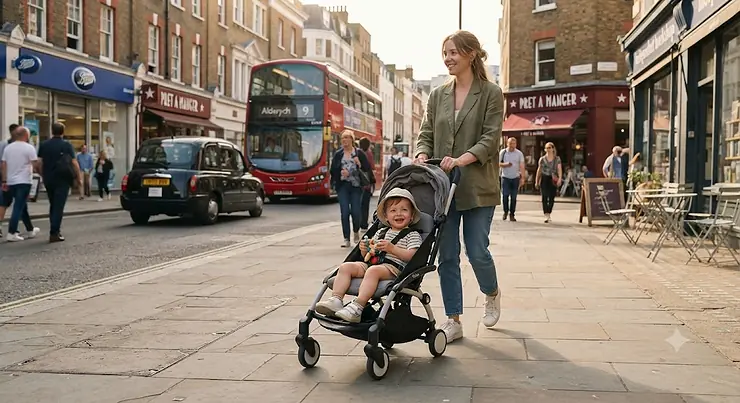
This guide exists because “cabin-approved” is one of the most misused phrases in the pram aisle. Manufacturers slap it on the box, then bury a disclaimer telling you to check with your airline anyway — which, frankly, is maddening when you’re trying to book flights three months out. So we’ve done the unglamorous bit: cross-referencing folded dimensions against published airline hand-luggage sizers, digging into real spec sheets, and reading through genuine aggregated review sentiment rather than marketing copy.
What follows are seven real, currently available pushchairs spanning budget, mid-range and premium price points, alongside honest commentary on which one actually suits your family, your route and your patience threshold. We’ll cover cabin approved pushchair rules in plain English, look at what makes an airline friendly buggy different from a merely “lightweight” one, and work through real scenarios — including which is the best buggy for travel with baby from six weeks old. Whether you fly twice a year or twice a month, by the end you’ll know exactly which compact travel stroller hand luggage rules actually allow, and which one deserves a spot in your cabin bag allowance.
Quick Comparison Table
| Buggy | Weight | Folded Size (approx.) | Best For |
|---|---|---|---|
| Ickle Bubba Pisces | 6.3kg | 46 x 30 x 56cm | Best budget cabin approved pushchair |
| GB Pockit+ All-Terrain | 5.6kg | 42 x 20 x 34cm | Smallest fold, minimalist packers |
| Maxi-Cosi Lara² | 7.2kg | 50 x 30 x 44cm | Everyday use plus occasional flying |
| Babyzen YOYO2 | 6.2kg | 52 x 44 x 18cm | Best all-rounder for frequent flyers |
| Cybex Libelle | 5.9kg | 48 x 20 x 32cm | Lightest full-featured option |
| Cybex Orfeo | 6.3kg | 52.5 x 47.5 x 15.5cm | Sturdiest ride, daily-use crossover |
| Bugaboo Butterfly 2 | 7.3kg | 55.5 x 44.8 x 24.5cm | Premium comfort, newborn to preschool |
Looking across the table, there’s an obvious trade-off at play: the tinier the fold, the more compromises show up in seat comfort, basket size or wheel robustness. The GB Pockit+ wins on raw pocketability, but families wanting a pushchair that also functions as their main daily buggy will get more mileage from the Cybex Orfeo or Bugaboo Butterfly 2, both of which strike a genuinely different balance between compactness and everyday usability.
✈️ Ready to stop guessing and start comparing? Scroll down for the full breakdown of all seven — your perfect match is in there somewhere.
Top 7 Best Travel Buggies: Expert Analysis
1. Ickle Bubba Pisces — best-value cabin approved pushchair
The Pisces proves you don’t need to spend £400 to get a genuinely airline friendly buggy, and that alone makes it worth a proper look. At 6.3kg it’s not the lightest thing here, but it undercuts every other product on this list by a significant margin while still folding down small enough for most carry-on sizers.
Its single-hand recline goes almost fully flat, which matters more than it sounds — younger babies who can’t yet hold their head up for long stretches genuinely need that option, and plenty of “travel” buggies at this price skip it entirely. The frame uses a two-handed fold rather than the flashier one-second mechanisms on pricier models, so budget an extra few seconds at the gate when the queue behind you is getting impatient.
Based on the spec comparison, this is squarely a buy for parents who fly occasionally rather than constantly, and for whom a second, lighter buggy purely for holidays makes more financial sense than upgrading their everyday pram. What most buyers overlook about this model is that it doubles surprisingly well as an everyday buggy for city errands, not just a suitcase-dweller that only comes out twice a year.
Reviewers consistently report that it held up well on real family trips, with parents specifically praising how straightforward it was getting through airport security and boarding without a fuss. A recurring theme in aggregated feedback is that the storage basket feels on the small side and the two-handed fold is fiddly one-handed with a baby on your hip — a fair trade-off, most agree, for the price.
Pros:
- ✅ Genuinely budget-friendly without cutting recline function
- ✅ Almost lie-flat recline suits younger babies
- ✅ Doubles well as an everyday buggy, not just holiday-only
Cons:
- ❌ Two-handed fold is slower than premium rivals
- ❌ Storage basket noticeably smaller than mid-range options
Expect this one to sit around £100-£150 depending on colourway and retailer promotions, which makes it one of the strongest value picks in this entire round-up if flying with a newborn is your priority.
2. GB Pockit+ All-Terrain — smallest fold on the market
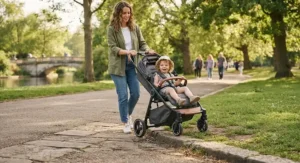
If your priority is squeezing a pushchair into the smallest possible footprint, the GB Pockit+ is difficult to beat — it’s the buggy that other “compact” strollers get compared against, not the other way round. At roughly 5.6kg and folding to about the size of a large handbag, it was engineered from the outset around exactly the kind of overhead-locker dimensions that airlines publish.
The trade-off for that record-breaking fold is a lighter-duty build: smaller wheels, a slimmer frame, and a basket that’s really only suited to a phone, passport and a packet of wet wipes. On paper this means it’s brilliant for city breaks and short-haul flights but a poor choice as anyone’s only pushchair, since there’s no lie-flat recline and limited use from birth.
Here’s what to weigh: this buggy is a specialist tool, not a generalist. Parents who already own a full-size everyday pram and want a dedicated “just for travel” backup will get exactly what they’re after; parents hoping for a single buggy to cover daily life and holidays will likely find it too minimal.
Aggregated review sentiment is polarised in a predictable way — five-star reviews from travel-focused parents praising the sheer portability, alongside three-star reviews from people who tried to use it as an everyday buggy and found the ride quality underwhelming on rough pavements. The unfold mechanism also draws mixed comments, with some testers needing a firm knee-assisted pop to get it open.
Pros:
- ✅ Genuinely the smallest folded footprint on this list
- ✅ Lightweight enough to carry one-handed through security
- ✅ Purpose-built around real airline cabin dimensions
Cons:
- ❌ Not suitable from birth without an add-on
- ❌ Small wheels and basket limit everyday usefulness
Prices typically sit in the £300-£350 range, which feels steep for a second buggy — but for families who fly often enough to value every centimetre saved, the maths tends to work out.
3. Maxi-Cosi Lara² — best balance of storage and portability
The Lara² takes a different approach to the compact-fold problem: instead of shrinking everything down to the bone, it keeps a genuinely useful under-seat basket and just accepts a slightly deeper folded profile as the price of that convenience. At 7.2kg it’s not chasing any lightness records, but it’s still comfortably within most airlines’ published limits for compact travel stroller hand luggage.
Double front wheels add a welcome bit of stability on cobbles and uneven pavements that catch out some of the ultra-light competitors here, and the one-touch fold, while not instant, is genuinely manageable one-handed. Maxi-Cosi itself is careful to say it “may” meet cabin baggage requirements for some airlines rather than guaranteeing it outright — an honesty that’s rarer than it should be in this category, and worth taking at face value before you book.
What most buyers overlook about this model is that the underseat basket, while modest, is one of the few genuinely usable ones on a compact-fold buggy, which matters enormously for parents who hate carrying a separate changing bag. Reviewers consistently note the buggy feels sturdier underfoot than its ultra-lightweight rivals, likely thanks to that double-wheel setup.
A common thread in aggregated feedback is that it’s “almost” cabin-sized rather than definitively so — several reviewers mention it fitting on some airlines and being gate-checked on others, reinforcing why checking your specific carrier’s sizer matters more than trusting the marketing.
Pros:
- ✅ Usable underseat storage basket, rare at this size
- ✅ Double front wheels improve stability on rough ground
- ✅ Carry strap makes lifting into overhead lockers easier
Cons:
- ❌ Slightly deeper fold than the most compact rivals
- ❌ Cabin approval isn’t guaranteed on every airline
Expect a price in the £200-£250 range, which puts it firmly in the middle of this list — a sensible middle-ground choice for parents who want travel-friendliness without sacrificing daily practicality.
4. Babyzen YOYO2 — best all-rounder for frequent flyers
The YOYO2 is the buggy most parenting forums reach for first when someone asks about flying with a baby, and there’s a good reason it keeps coming up. At 6.2kg it folds to 52 x 44 x 18cm — dimensions specifically designed around what most airlines will accept in the cabin, with a one-handed fold that genuinely takes seconds rather than a fiddly minute of button-hunting.
Under the surface, the Hytrel elastomer suspension on all four wheels does real work: it’s the difference between a jarring ride over cobbles and one that barely registers, and it’s part of why this buggy transitions so well from “holiday accessory” to “the pram we use every single day.” The basket, while not enormous, comfortably takes a nappy bag and shopping, and the multi-position recline covers everything from newborn naps (with the optional bassinet) to a wide-awake toddler people-watching at the gate.
Based on the spec comparison, this is the buggy for parents who want one product to handle daily life, weekend trips and long-haul flights without ever feeling like a compromise. Reviewers consistently report it holding up impressively over years of near-daily use, with several parents specifically mentioning it surviving cobbled European city streets and multiple long-haul flights without any structural complaints. The main recurring criticism is that the price feels high for what is, underneath the clever engineering, still a lightweight umbrella-style stroller.
Pros:
- ✅ Genuinely one-handed fold that takes seconds, not minutes
- ✅ All-wheel suspension smooths out rough surfaces
- ✅ Doubles as a durable everyday pushchair, not just a travel spare
Cons:
- ❌ Among the pricier options in this round-up
- ❌ Car seat compatibility limited to specific certified brands
Prices generally land in the £425-£475 range. It’s not cheap, but reviewers who’ve owned one for years consistently say it’s the one purchase in the whole baby-gear list they’d make again without hesitation.
5. Cybex Libelle — lightest full-featured option
If weight is your only concern, the Libelle takes the crown among the fully-featured buggies on this list at just 5.9kg — light enough that carrying it one-handed through a packed terminal barely registers as effort. Its two-step fold collapses down to a genuinely tiny 48 x 20 x 32cm package, comfortably inside most published carry-on sizers.
That featherweight frame does come with a catch: smaller, less robust wheels than the Bugaboo or Cybex Orfeo, which means it’s happiest on smooth airport floors, city pavements and hotel lobbies rather than gravel paths or cobbled old-town streets. It’s also not suitable from birth, requiring babies to be around six months old before use, which rules it out as anyone’s sole pushchair for a newborn.
Here’s what to weigh: the Libelle is a specialist’s tool for parents who already have a proper everyday pram and want the lightest possible companion purely for trips through airports. What the spec sheet won’t tell you, but reviewers note, is that the ultra-light build makes it feel slightly less planted at higher pushing speeds than sturdier alternatives — noticeable if you’re power-walking to catch a connecting flight with a toddler in tow.
Aggregated customer sentiment is largely positive on portability and ease of carrying, with the recurring praise being how effortlessly it slots into overhead lockers compared with bulkier “compact” folds. The main criticism that surfaces repeatedly is the smaller canopy coverage compared with rivals like the Orfeo or Butterfly 2.
Pros:
- ✅ Among the lightest fully-featured travel buggies available
- ✅ Two-step fold collapses to a genuinely tiny package
- ✅ Effortless one-handed carrying through busy terminals
Cons:
- ❌ Not suitable from birth — six months minimum
- ❌ Smaller wheels struggle on rough or uneven ground
Expect to pay in the £350-£400 range. Value here hinges entirely on how much you weight (pun intended) the convenience of carrying almost nothing extra through security.
6. Cybex Orfeo — sturdiest ride for daily-use crossover
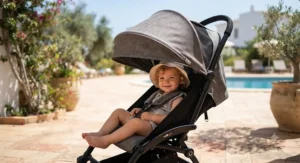
Launched in 2023 and a Red Dot Design Award winner for its compact fold, the Orfeo sets out to solve a problem the ultra-light buggies above don’t even attempt: how do you build something cabin-sized that still feels reassuringly solid on an everyday dog walk? At around 6.3kg and folding to 52.5 x 47.5 x 15.5cm, it’s lighter than premium rivals like the Butterfly 2 while still fitting inside most airline overhead lockers.
Enhanced suspension and noticeably solid-feeling wheels are the standout here — this isn’t a buggy that feels flimsy the moment you push it off tarmac onto grass or gravel, which is a genuine limitation on several lighter competitors in this list. Based on the spec comparison, that sturdiness comes at a modest weight cost compared with the Libelle, but for parents who intend to use this as their primary everyday pushchair — not just a holiday extra — it’s a sensible exchange.
Reviewers consistently describe the ride as secure and stable even on inclines, with one tester specifically noting the brake holds firm on hills without any rolling. Aggregated feedback across independent parenting sites is unusually consistent on this point: stability is the Orfeo’s calling card, more so than outright lightness.
What most buyers overlook about this model is that its everyday usability means you’re not really buying a “just for flights” buggy at all — you’re buying a daily pushchair that happens to also satisfy cabin-approval dimensions, which is arguably a smarter way to spend the budget if you only fly once or twice a year.
Pros:
- ✅ Sturdier ride quality than most cabin-sized rivals
- ✅ Red Dot Award-winning compact fold engineering
- ✅ Lighter than premium competitors at a similar price point
Cons:
- ❌ Bulkier folded depth than the most minimal options
- ❌ Premium pricing compared with budget travel buggies
Pricing typically sits in the £250-£320 range depending on promotions, positioning it as genuinely strong value for a buggy that can realistically replace your everyday pram altogether.
7. Bugaboo Butterfly 2 — best premium pick, newborn to preschool
The Butterfly 2 is the buggy for parents who refuse to compromise on comfort just because they’re flying. At 7.3kg it’s the heaviest on this list, but that extra weight buys a genuinely roomy, well-padded seat, a lie-flat recline suitable from birth, and an 8kg-capacity underseat basket that puts most compact rivals to shame.
Its IATA-compatible folded dimensions of 55.5 x 44.8 x 24.5cm are engineered specifically with overhead compartments in mind, and the one-second fold mechanism genuinely lives up to the marketing — pull the handle and it collapses almost instantly, no fiddly buttons or knee-assisted force required. Four-wheel suspension keeps the ride smooth across grass, gravel and cobbles alike, addressing the exact weakness that trips up the lighter Libelle and Pockit+.
Based on the spec comparison, this is the buggy for families who want one pushchair to genuinely last from newborn to preschooler, used daily at home and confidently on every flight in between, rather than a dedicated once-a-year travel spare. Bugaboo also builds it from recycled aluminium and bio-based fabrics, a detail that matters to buyers weighing sustainability alongside practicality.
Reviewers consistently praise the fold speed and comfort, with several noting it as their everyday buggy rather than a travel-only purchase. A recurring theme in aggregated feedback is that the total folded length can occasionally trip up smaller regional aircraft with tighter overhead lockers, meaning gate-checking is sometimes unavoidable despite the IATA-compatible badge — a reminder that “compatible” isn’t the same as “guaranteed.”
Pros:
- ✅ Genuine one-second fold that works as advertised
- ✅ Lie-flat recline suitable from birth to around four years
- ✅ Four-wheel suspension handles rough surfaces with ease
Cons:
- ❌ Heaviest buggy in this round-up at 7.3kg
- ❌ Occasionally too long for smaller aircraft’s overhead lockers
Expect to pay in the £400-£440 range. It’s the most expensive pick here, but for parents wanting a single buggy that never needs replacing until the toddler years, the value proposition genuinely stacks up.
Top 7 Buggies: Full Spec Comparison
| Buggy | Weight | Suitable From | Basket Capacity | Price Range |
|---|---|---|---|---|
| Ickle Bubba Pisces | 6.3kg | Birth | Small | £100-£150 |
| GB Pockit+ All-Terrain | 5.6kg | ~6 months | Minimal | £300-£350 |
| Maxi-Cosi Lara² | 7.2kg | Birth | Small-medium | £200-£250 |
| Babyzen YOYO2 | 6.2kg | Birth (with bassinet) | Medium | £425-£475 |
| Cybex Libelle | 5.9kg | ~6 months | Small | £350-£400 |
| Cybex Orfeo | 6.3kg | Birth | Medium | £250-£320 |
| Bugaboo Butterfly 2 | 7.3kg | Birth | Large (8kg) | £400-£440 |
Read across this table and a clear pattern emerges: the buggies suitable from birth without an add-on (Ickle Bubba Pisces, Maxi-Cosi Lara², Cybex Orfeo, Bugaboo Butterfly 2) tend to carry either a lower price or a sturdier build, while the two lightest options (GB Pockit+, Cybex Libelle) both require your baby to be around six months old first. If you’re buying before your baby arrives, that six-month restriction is easy to overlook until you’re stuck using a car seat adaptor as a stopgap — worth factoring into your decision now rather than at 2am during a 3am feed.
Practical Usage Guide: Flying With Your Cabin Approved Pushchair
Buying the right buggy is only half the job — using it well at the airport is where most of the stress actually happens. Start by measuring your folded buggy at home with a tape measure, including wheels and handles, and compare that figure directly against your specific airline’s published cabin bag dimensions rather than trusting a “cabin-approved” sticker on the box. According to guidance from Which?, many airlines specify that pushchairs need to weigh 7kg or less to travel in the cabin, so double-check your model’s actual weight, not just its marketed “lightweight” branding.
At the gate, keep your buggy assembled and in use for as long as possible — you’ll usually be able to wheel your baby right up to the aircraft door, fold it there, and hand it to cabin crew, who’ll tag it for either cabin stowage or a hold-adjacent gate-check. Practise the fold at home a handful of times before you fly; a buggy that takes thirty fumbling seconds in your living room becomes a minute-long ordeal with a fractious toddler and an impatient queue behind you.
In the first thirty days of ownership, the most common mistake parents make is skipping the fold-and-unfold “drill” until they’re already at security. Do it five or six times at home first, ideally one-handed while holding something the weight of your baby. Maintenance-wise, wipe down the frame after any coastal or sandy holiday, check the wheel locks monthly if you’re a frequent flyer, and store the buggy folded rather than half-open to avoid stressing the hinge mechanisms.
🧳 Want the full airline-by-airline breakdown before you book? Check current pushchair policies directly with your carrier before travel — rules change more often than you’d think.
Real-World Scenarios: Which Travel Buggy Suits Your Family?
The city-break couple with a six-month-old, flying twice a year on a modest budget. Here, the Ickle Bubba Pisces or Maxi-Cosi Lara² makes the most sense — both are affordable, suitable from birth, and don’t demand you drop £400 on a buggy that spends 50 weeks a year in a cupboard. Neither will feel like a downgrade from a full-size pram on short city breaks.
The frequent-flying family with a toddler, travelling monthly for work or family visits. This is where the Babyzen YOYO2 earns its higher price tag — daily durability, a genuinely fast fold, and suspension that copes with cobbled European squares as easily as UK pavements. Buying cheap here often means replacing the buggy within a year of heavy use, which erodes any initial saving.
The minimalist backpacker parent prioritising cabin space above all else. The GB Pockit+ or Cybex Libelle are built exactly for this brief — smaller than most rucksacks when folded, light enough to carry alongside hand luggage, and genuinely disappearing into an overhead locker. Accept the trade-off in ride comfort as the price of maximum portability.
Problem → Solution: Common Travel Buggy Headaches Solved
Problem: your buggy is refused at the gate despite being marketed as cabin-approved. Solution: always carry your buggy’s exact folded dimensions on your phone (a screenshot of the manufacturer spec page works well) so you can politely reference it if a gate agent’s sizer looks generous. If refused, ask specifically for the “return to aircraft door” service that carriers like British Airways offer, which reunites you with the buggy at the jet bridge rather than the baggage carousel.
Problem: the one-handed fold isn’t actually one-handed when you’re also holding a baby. Solution: practise folding with a weighted item — a bag of rice or a doll roughly your baby’s weight — before you travel, so muscle memory takes over under pressure rather than fine motor skill.
Problem: your buggy arrives damaged after being gate-checked. Solution: photograph the buggy before handing it over, and report any damage immediately at the baggage desk before leaving the airport, since claims are far harder to process once you’ve left the terminal.
Problem: you’re travelling with a newborn but your chosen ultra-light buggy needs baby to be six months old. Solution: either choose one of the birth-ready options here (the Ickle Bubba Pisces, Maxi-Cosi Lara², Cybex Orfeo or Bugaboo Butterfly 2), or pair a six-months-plus buggy with a compatible car seat adaptor for the interim period.
How to Choose the Best Travel Pushchair for Flying
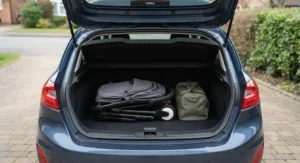
- Confirm your airline’s actual cabin bag dimensions first. Don’t shop by weight or size claims alone — check your specific carrier and fare type, since allowances vary even within the same airline.
- Weigh birth-readiness against portability. The lightest buggies here often aren’t usable until six months, so factor your baby’s current age into the shortlist.
- Decide whether this is a dedicated travel buggy or your everyday pushchair. Buggies like the Cybex Orfeo and Bugaboo Butterfly 2 are built to do both; the GB Pockit+ is not.
- Test the fold in-store or via video before buying. A fold that looks effortless in marketing photos can be genuinely fiddly in practice — reviewer feedback on ease of one-handed folding is worth more than spec sheets here.
- Check basket capacity against how you actually travel. Families carrying nappies, snacks and toys need more storage than a couple travelling light.
- Factor in ride quality for your destination. Cobbled old towns and gravel paths punish ultra-light wheels; smooth city pavements don’t.
- Set a realistic budget band and stick close to it. Spending £450 on a buggy you’ll use twice a year rarely makes financial sense compared with a well-chosen £150-£250 option.
Compact Travel Stroller vs Full-Size Pushchair
The instinct for many first-time parents is to buy one “do everything” pushchair and skip a dedicated travel buggy altogether — understandable, but often a false economy once you actually try wheeling a 12kg travel system through security. Full-size pushchairs generally offer superior storage, a more comfortable ride and often a carrycot option for newborns, but they’re heavier, bulkier and almost never qualify as compact travel stroller hand luggage; they’ll be checked into the hold on virtually every flight.
A dedicated travel buggy trades some of that comfort and storage for genuine portability: faster through security, easier on public transport, and — for the cabin-approved models here — able to stay with you right up to the boarding gate rather than disappearing into the hold. The honest trade-off is ride quality on rough terrain, where lighter frames and smaller wheels simply can’t match a full-size pushchair’s suspension.
| Factor | Compact Travel Buggy | Full-Size Pushchair |
|---|---|---|
| Typical weight | 5.5-7.5kg | 9-13kg |
| Cabin storage possible | Often yes | Rarely |
| Ride comfort on rough ground | Fair to good | Very good |
| Storage basket | Small-medium | Large |
| Best for | Flights, city breaks | Daily use, long walks |
The verdict from this comparison is straightforward: most families genuinely benefit from owning both, using the full-size pushchair for daily life and a compact buggy purely for travel days. If budget only stretches to one, prioritise a birth-ready travel buggy like the Cybex Orfeo that can realistically double as your everyday pram, rather than a full-size system that will never fit in an overhead locker.
Airline Rules: Is Your Pushchair Allowed on the Plane?
The short answer is: usually yes, but the details matter enormously. Most UK airlines — including British Airways, easyJet, Ryanair, Jet2 and TUI — allow a pushchair free of charge for travelling infants, entirely separate from your standard cabin bag allowance. According to British Airways’ own baggage guidance, children and infants can check in a fully-collapsible pushchair alongside a car seat or travel cot at no extra cost.
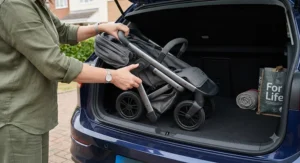
Whether that pushchair stays with you in the cabin or travels in the hold depends entirely on its folded dimensions against that specific airline’s sizer. Genuinely cabin approved pushchair models — the GB Pockit+, Cybex Libelle, Babyzen YOYO2 and, on many carriers, the Cybex Orfeo — can often be taken right to the boarding gate, folded, and stowed overhead. Bulkier options like the Bugaboo Butterfly 2, despite being IATA-compatible in design, sometimes still get gate-checked on smaller regional aircraft simply because overhead locker sizes vary between plane types, not just airlines.
Either way, most carriers offer a free “return to aircraft door” service for gate-checked buggies within published size limits, meaning you’re reunited with it on the jet bridge rather than waiting at baggage claim — genuinely useful when you’re also carrying a fractious toddler and hand luggage. Always tag your buggy at the gate rather than assuming; unlabelled buggies are far more likely to end up on the carousel instead.
Common Mistakes When Buying a Cabin Approved Pushchair
The single biggest mistake is trusting “cabin-approved” as a guarantee rather than a starting point — it’s a manufacturer’s best estimate against general airline norms, not a binding promise from any specific carrier. The second most common error is buying based on weight alone; a 5.9kg buggy that folds to an awkward shape can be harder to stow than a slightly heavier one with a flatter, more locker-friendly profile.
Parents also frequently underestimate how much basket capacity they’ll actually need, assuming they’ll “just carry a bag” and then resenting the extra weight on a long airport walk. Skipping the practice fold before travel day is another classic misstep — the RoSPA guidance on pushchair safety is a useful reminder that folding chassis need both primary and secondary locking devices to engage correctly every time, which matters as much for safety as for speed at the gate.
Finally, some buyers assume any second-hand or older-model buggy will fold to the same dimensions as the current version — manufacturers update fold mechanisms between model years, so always verify the exact folded size of the specific version you’re buying, not the generation reviewed online two years ago.
What to Expect: Real-World Performance of a Travel Buggy
On paper, most of these buggies look broadly similar — light, foldable, cabin-sized. In practice, the differences show up fastest on rough ground: cobbled old towns, uneven pavements and gravel holiday-park paths expose the smaller wheels on the GB Pockit+ and Cybex Libelle far more than a smooth airport terminal ever will. If your travel plans lean towards historic European city centres rather than resort pavements, weight the ride-comfort column of our comparison table more heavily than the weight column.
Fold speed also behaves differently under real pressure than in a calm living-room demo. The Bugaboo Butterfly 2‘s one-second mechanism and the Babyzen YOYO2‘s one-handed fold both hold up well when you’re rushed, whereas two-handed folds like the Ickle Bubba Pisces genuinely do take longer with a baby balanced on one hip — not a dealbreaker, just something worth rehearsing beforehand.
Best Buggy for Travel With Baby: Age & Stage Guide
Choosing the best buggy for travel with baby really comes down to age first, budget second. For newborns up to six months, stick to buggies suitable from birth without an add-on — the Ickle Bubba Pisces, Maxi-Cosi Lara², Cybex Orfeo and Bugaboo Butterfly 2 all offer a near-flat recline appropriate for very young babies who can’t yet support their own head for long periods.
Once your baby reaches six months and can sit with reasonable head control, the ultra-light options open up: the GB Pockit+ and Cybex Libelle become viable, offering the smallest possible footprint for parents juggling a more mobile, curious toddler who wants to see everything at the airport rather than sleep through it. For toddlers up to preschool age, prioritise recline range and basket capacity over sheer lightness — a tired three-year-old mid-meltdown needs somewhere comfortable to sit far more than you need to save 500 grams in your cabin bag.
Long-Term Cost & Maintenance
A cheaper buggy isn’t automatically better value if it needs replacing within eighteen months of heavy travel use. Cost-per-use is the more honest metric: a £425 Babyzen YOYO2 used weekly for three years works out to a few pence per outing, while a £120 budget buggy that survives one summer of daily airport trips before the fold mechanism loosens ends up costing more per use despite the lower sticker price.
Maintenance is minimal across this list but not nonexistent. Wheel bearings on lighter-frame buggies benefit from an occasional wipe-down after sandy or wet holidays, and folding hinges should be checked periodically for play or looseness — a genuine safety issue, not just a comfort one. All new pushchairs sold in the UK must meet the BS EN 1888 safety standard covering wheeled child conveyances, and it’s worth checking that label is present and undamaged if you ever buy second-hand for a lighter travel spare.
Features That Actually Matter (And Those That Don’t)
Genuinely matters: fold speed and ease, suitability from birth if you have a young baby, basket capacity relative to how you actually pack, and verified folded dimensions against your specific airline. These are the features that determine whether your trip is smooth or stressful.
Doesn’t matter nearly as much as marketing suggests: colourway options, “designer collaboration” branding, and headline weight figures on their own — a buggy that’s 200 grams lighter but folds to an awkward shape that won’t sit flat in an overhead locker offers you nothing practically. Reviewers consistently note that peekaboo canopy windows and cup holders are nice-to-haves, not deciding factors, when the core question is simply: does it fold small enough, fast enough, for the way you actually travel?
FAQ
❓ Is a travel buggy the same as a cabin-approved pushchair?
❓ What's the best travel pushchair for flying with a newborn?
❓ Can I take my pushchair right up to the plane door?
❓ How light does a buggy need to be for carry-on stroller airlines rules?
❓ Do I need to check with the airline even if a buggy is marketed as cabin-approved?
Conclusion
There’s no single best travel buggy for every family — only the right buggy for your baby’s age, your travel frequency and your budget. Parents flying once or twice a year with a young baby will get excellent value from the Ickle Bubba Pisces or Maxi-Cosi Lara²; those wanting one buggy to genuinely handle daily life and every flight in between should look hard at the Cybex Orfeo or Babyzen YOYO2; and anyone chasing the absolute smallest possible cabin footprint will find their answer in the GB Pockit+ or Cybex Libelle. Families wanting the most comfortable, longest-lasting premium option, meanwhile, will find the Bugaboo Butterfly 2 hard to beat.
Whichever you choose, the real lesson from this research is that “cabin-approved” is a starting point for your own checking, not a substitute for it — measure, confirm with your airline, and practise the fold before travel day. Do that, and the buggy stops being the stressful part of your trip and goes back to being what it should be: a genuinely useful tool that gets your baby from the check-in desk to the beach without a meltdown in between.
✨ Ready to book your next trip with confidence? Check current pricing and availability on any of these seven picks before your travel dates lock in — your future airport self will thank you! 🧳👶
Recommended for You
- Lightest Pushchair Under 6kg: 7 Ultralight Buggies Tested (2026)
- Best Umbrella Fold Buggy 2026: 7 Fast-Folding Picks Worth Buying
- Best Lightweight Pushchair 2026: 7 Buggies Under 7kg Rated
Disclaimer: This article contains affiliate links. As an Amazon Associate, I earn from qualifying purchases. If you purchase products through these links, we may earn a small commission at no additional cost to you.
✨ Found this helpful? Share it with your friends! 💬🤗
