
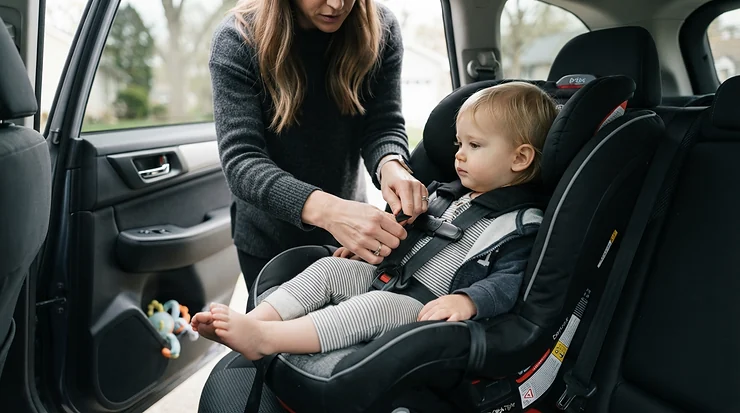
In This Article
Car seats are the one purchase where “good enough” feels like a dirty phrase. Yet the maths is brutal: buy a seat for every stage and you’ll hand over serious money three times before your child can legally ditch the booster. That’s why the group 1-2-3 car seat has become the sensible parent’s shortcut. One harnessed seat for the toddler years, then a high-back booster for the long school-run stretch.

Here’s the catch. The label on the box says “9-36kg”, but it doesn’t say how well the seat does its job at each end of that range. Under UK law, children must use an appropriate car seat until they’re 12 years old or 135cm tall, whichever comes first. Both older weight-based (R44) and newer height-based (R129, or i-Size) seats are currently legal. The two systems behave quite differently in the real world.
So this guide does three jobs. It ranks seven real, widely sold seats across budget, mid-range and premium. It untangles the R44 versus R129 muddle. It also includes a proper Joie Every Stages review, because that’s what half of Britain seems to be typing into Google. Everything here is built on published specifications, independent test reporting and aggregated parent feedback. It isn’t built on invented hands-on claims.
Group 1-2-3 Car Seat Quick Comparison (2026)
Here’s the at-a-glance view before we go deep. Prices are ranges only, so check current pricing before you buy.
| Seat | Standard / Group | ISOFIX | Seat weight | Price range | Best For |
|---|---|---|---|---|---|
| Joie Every Stage FX | R44, 0+/1/2/3 | Yes (Group 1 onwards) | ~13.9kg | £200-£280 range | One seat from birth to 12 |
| Joie Elevate | R44, 1/2/3 | No (belt-only) | ~5.5kg | Under £100 | Tight budgets, second cars |
| Britax Römer Advansafix IV R | R44, 1/2/3 | Yes (optional later) | ~11kg | £200-£250 range | Safety-feature seekers |
| Cybex Pallas G i-Size | R129, 76-150cm | Yes (required) | ~8.9kg | £160-£250 range | Quick buckling, impact shield fans |
| Graco Nautilus | R44, 1/2/3 | No (belt-only) | ~9kg | £100-£130 range | Mid-budget, car-to-car flexibility |
| Ickle Bubba Solar | R44, 1/2/3 | Yes (plus belt option) | Check listing | £150-£200 range | Recline for sleepy passengers |
| Cosatto Hug | R44, 1/2/3 | ISOFIX version available | ~9.5kg | High-£200s | Style-led buyers |
Looking at the table, the Joie Elevate wins on sheer affordability and low weight. The Joie Every Stage FX is the only seat here that starts at birth. The Cybex Pallas G i-Size stands apart because it is a modern R129 seat, so it behaves differently at purchase and in use. Notice, too, that only some of these seats offer ISOFIX. If your car has the anchor points, that single feature narrows the field fast.
💬 Just one click — help others make better buying decisions too!😊
Top 7 Group 1-2-3 Car Seat Picks: Expert Analysis
A quick note on method. These write-ups come from published specifications, independent publisher reviews, test-house commentary and aggregated parent feedback. Where I couldn’t verify review sentiment for a seat, I say so rather than papering over the gap.
1. Joie Every Stage FX — birth to 12 years in one shell
Most seats ask you to commit to one chapter of childhood. The Joie Every Stage FX tries to cover the whole book. It’s an R44/04-approved Group 0+/1/2/3 seat, rear-facing from birth to 18kg (around four years), then forward-facing from 9kg to 36kg. ISOFIX arrives from Group 1 onwards, while rear-facing use relies on the car’s three-point belt.
Retailer specifications list roughly 13.9kg, six recline positions and a ten-position headrest whose side wings widen as it rises. In practice, that means a toddler can stay rear-facing well past the legal minimum without outgrowing the seat. Based on the spec comparison, it suits families who want one purchase and one learning curve. The trade-off is bulk: that weight is a workout between cars. Which? also notes that multi-group seats don’t always match specialist seats at every stage, so treat the label as a starting point.
Reviewers on MadeForMums, Pushchair Expert and Mumsnet consistently praise the comfort, sturdy build and straightforward seatbelt fitting. The recurring complaint is weight.
Pros:
- ✅ Rear-facing use from birth to around four years
- ✅ ISOFIX option from Group 1 onwards
- ✅ Multiple recline positions for napping
Cons:
- ❌ Heavy to move between vehicles
- ❌ Multi-group compromise versus specialist seats
Expect roughly £200-£280 depending on retailer and version. Check the label for R44 or R129, as newer R129 variants now exist. It’s strong value if one car carries this seat for years.
2. Joie Elevate — lightest and cheapest here
The Joie Elevate is the budget answer to a long-lasting seat, covering 9-36kg with a five-point harness before converting to a belted high-back booster. Specs list around 5.47kg, belt-only installation, a ten-position adjustable headrest and side protection around head, body and thighs. That featherweight build is genuinely useful: second cars, grandparent runs and awkward taxi swaps all become far less painful.
With no ISOFIX, everything depends on correct belt routing. Which? has flagged installation problems on some belt-only budget group 1-2-3 car seat models, so budget extra time for fitting and re-checking. Retailers now list both older R44 and newer R129 Elevate variants, so confirm which one is in your basket. Mother&Baby gave the successor Joie Elevate 2 a Best Multi-Stage gold award in 2024, though I couldn’t verify a current Which? score for the original.
Parent write-ups describe straightforward installation and good value for the price. I couldn’t verify a large, consolidated review pool.
Pros:
- ✅ Very light for easy car swaps
- ✅ Covers roughly one to twelve years
- ✅ Ten-position adjustable headrest
Cons:
- ❌ Belt-only fitting demands careful routing
- ❌ Fewer premium comfort features
It sits under £100 at the time of research, with prices varying by retailer. It’s the value pick if budget leads.
3. Britax Römer Advansafix IV R — premium safety features, premium feel
The Britax Römer Advansafix IV R is the grown-up option for parents who read spec sheets for fun. It’s an R44/04 Group 1/2/3 seat at around 11kg. Group 1 uses ISOFIX with a top tether, then Group 2/3 can use ISOFIX plus belt or belt alone. Britax’s Flip&Grow system converts harness mode to booster mode without removing the harness, which neatly dodges the “where did I put the straps” problem.
Side Impact Cushion Technology (SICT) and a SecureGuard cushion for the belted stage are headline safety features. Mumsnet’s summary cites an ADAC “Good” rating of 2.3, though German reviewers noted workmanship slightly below expectations for the price. Based on the evidence, it’s a strong all-rounder whose limits are regulatory, not practical. It’s tested to the older R44 standard and has no rear-facing option.
MadeForMums called it beautifully designed and easy to fit. A Mother&Baby tester found it more comfortable and higher quality than a Graco group 1-2-3 car seat, though noticeably dearer.
Pros:
- ✅ ISOFIX and top tether for Group 1
- ✅ Side Impact Cushion Technology (SICT)
- ✅ Flip&Grow converts without removing harness
Cons:
- ❌ Tested to older R44, no rear-facing
- ❌ Heavier and pricier than basic rivals
Expect around £200-£250, with prices varying by retailer. It’s good value if you’ll use the ISOFIX stage.
4. Cybex Pallas G i-Size — impact shield instead of a harness
The Cybex Pallas G i-Size swaps the traditional harness for a padded impact shield. It’s a modern R129 seat for 76-150cm (from about 15 months to around 12 years, up to 50kg), forward-facing only, at roughly 8.9kg. The shield is used from 76-105cm, then the car’s three-point belt takes over from 105-150cm. ISOFIX is required.
Cybex claims a 40% reduction in neck injuries compared with a classic harness. That’s a manufacturer claim, though retailers also cite ADAC and Stiftung Warentest recognition from 2021. Testing protocols evolve, so check recent results. One parent-testing blog felt it suits older toddlers better than young ones, and one retailer buyer found it wide for a middle seat. The covers wash at 30°C in four removable parts.
The shield is quick to use: one buckle and your child is secured. That’s valuable if you’ve ever wrestled a wriggly three-year-old into a harness in the rain.
Pros:
- ✅ Impact shield secures child in seconds
- ✅ Modern R129 height-based approval
- ✅ Four-part washable covers
Cons:
- ❌ Wide seat can crowd back-seat space
- ❌ Requires compatible ISOFIX anchors
Expect roughly £160-£250, with prices varying. I couldn’t access the member-only Which? score. It’s good value for ISOFIX families wanting R129.
5. Graco Nautilus — mid-budget workhorse
The Graco Nautilus is the seat for parents who want proven simplicity rather than gadgetry. It’s a belt-only Group 1/2/3 seat at about 9kg. Auto Express previously labelled it a bargain next to the £200-plus norm. Parkers named it editor’s choice in its Graco roundup, and MadeForMums included the Nautilus Elite among its best-performing 1/2/3 seats.
No ISOFIX means no hunting for anchor points, so it moves between cars of any age. It also means the seat is only as safe as your belt routing. Hence, fit it in daylight with the manual open. Those editorial endorsements are some years old, so check the current version and its latest independent scores before purchase.
I couldn’t verify a large, current pool of verified-buyer reviews, so treat the editorial praise as a starting point.
Pros:
- ✅ Fits cars without ISOFIX anchors
- ✅ Established brand with long track record
- ✅ Mid-range price for twelve years of use
Cons:
- ❌ Belt-only fitting needs careful routing
- ❌ Older evidence base, so check current tests
It sits roughly in the £100-£130 range. It’s good value if your car lacks ISOFIX.

6. Ickle Bubba Solar — ISOFIX with recline and side-impact tech
The Ickle Bubba Solar earned a MadeForMums Joint Bronze award for best multistage seat. It’s a forward-facing Group 1/2/3 seat with integrated ISOFIX, seatbelt compatibility and a top tether. It also has three recline positions and side-impact technology.
Recline matters more than the spec sheet suggests. A toddler who naps in the car drops their head forward when upright, so recline translates into calmer journeys. I couldn’t verify a seat weight, so check the retailer listing before assuming it’s easy to swap between cars. MadeForMums’ judges described it as comfortable and good-looking. I couldn’t find a large pool of verified owner reviews.
Pros:
- ✅ Integrated ISOFIX plus belt option
- ✅ Three recline positions for nappers
- ✅ Top tether and side-impact features
Cons:
- ❌ Seat weight unverified, so check before buying
- ❌ Smaller review pool than bigger brands
Expect mid-£100s to around £200. It’s a solid value pick for ISOFIX-equipped cars.
7. Cosatto Hug — style-led, with an ISOFIX version
The Cosatto Hug is the fashion choice. MadeForMums includes it in its best-performing 1/2/3 roundup, noting an ISOFIX version (ISOFIX for Group 1, then ISOFIX plus belt or belt-only) and a belt-only variant. The roundup lists a seat weight around 9.5kg.
Here’s the honest take. Cosatto is typically priced at a premium for design and fabrics, and the group coverage is the same as the cheaper seats above. Pick the Cosatto Hug if colour, print and aesthetics genuinely matter, or if you want ISOFIX at Group 1 in a more stylish shell. If safety performance per pound is your priority, the Britax Römer Advansafix IV R and Cybex Pallas G i-Size are more convincing on the evidence I could verify.
I couldn’t verify enough aggregated owner reviews to describe consistent sentiment. Check recent buyer reviews on your chosen listing.
Pros:
- ✅ ISOFIX variant available for Group 1
- ✅ Distinctive design and fabrics
- ✅ Group 1/2/3 coverage in one seat
Cons:
- ❌ Premium price for same group coverage
- ❌ Limited verifiable review evidence
Expect roughly the high-£200s. It’s average value unless style tips the balance.
Here’s how the seven stack up once you strip away the marketing.
| Seat | Strongest point | Watch-out | Best For |
|---|---|---|---|
| Joie Every Stage FX | Birth-to-12 coverage | Weight | Long-term single-seat buyers |
| Joie Elevate | Price and low weight | Belt-only fitting | Budget and second cars |
| Britax Römer Advansafix IV R | Safety features, build | R44 only, no rear-facing | Safety-first families |
| Cybex Pallas G i-Size | Impact shield, R129 | Width, ISOFIX required | Quick-buckle fans |
| Graco Nautilus | Mid-range, car flexibility | Older evidence | Cars without ISOFIX |
| Ickle Bubba Solar | Recline, ISOFIX | Weight unverified | Napping toddlers |
| Cosatto Hug | Design | Premium price | Style-led buyers |
The table points to a clear pattern: spend more and you buy safety features, ISOFIX and refinement, while spending less buys weight savings and flexibility. For most families, the Joie Every Stage FX and Britax Römer Advansafix IV R justify extra spend. If you’re counting pennies, the Joie Elevate is the sensible floor.
What Is a Group 1-2-3 Car Seat?
A group 1-2-3 car seat is a forward-facing child seat approved under the older ECE R44 weight system for children from 9kg to 36kg, roughly nine months to 12 years. It starts with a five-point harness, then converts to a high-back booster used with the car’s adult seat belt as your child grows.
The “groups” correspond to weight bands: Group 1 covers 9-18kg, Group 2 covers 15-25kg, and Group 3 covers 22-36kg. Age is only an approximation, and weight is what the label actually enforces. A big-boned two-year-old may be ready for Group 1 earlier than a slight toddler. A tall child may need a new seat sooner, because their shoulders exceed the harness slots or their head passes the headrest.
Seats that begin at birth are labelled Group 0+/1/2/3. The Joie Every Stage FX is the example in this guide. Meanwhile, i-Size seats like the Cybex Pallas G i-Size replace weight groups with height bands. That’s why you’ll see Group 1/2/3 and 76-150cm used almost interchangeably in shops.

Joie Every Stages Review: Verdict Before You Buy
Let’s tackle the naming confusion head-on. Searches for a “Joie Every Stages review” almost always mean one of two seats. The first is the Joie Every Stage and its ISOFIX sibling, the Joie Every Stage FX, both covering birth to 36kg (about 12 years). The second is the older Joie Stages, which is a 0+/1/2 seat that tops out at 25kg, roughly six or seven years. In the Joie Every Stages review territory, the “Every” is the key word. It means all the way to 12.
Across published reviews, the pattern is consistent. Reviewers on MadeForMums, Pushchair Expert and Mumsnet praise comfort, build quality, easy seatbelt fitting and extended rear-facing. The consistent complaint is weight, and Which? cautions that multi-group seats don’t always protect as well as specialist seats at every stage. There’s also a regulatory wrinkle: Which? reviews a newer Joie Every Stage R129 version for birth to 145cm, which uses seatbelt-only installation.
Here’s my verdict from the evidence. A Joie Every Stages review that ends in “buy it” is justified if you want extended rear-facing, one seat for the long haul and a primary car that rarely changes. It’s less convincing if you swap vehicles weekly or need a light seat. Before buying, check the exact model code, the regulation label (R44 or R129) and whether it’s the ISOFIX FX version. Retailers mix the variants more than you’d expect.
How to Choose a Group 1-2-3 Car Seat
Choosing the right group 1-2-3 car seat comes down to a handful of decisions.
- Confirm weight and height. The seat must suit your child’s current weight, and for i-Size seats their height. A seat that’s merely “nearly right” is the wrong seat.
- Decide between R44 and R129. R44 is weight-based and cheaper; R129 is height-based and includes a side-impact test. Both are legal, but newer seats are generally stricter.
- Check your car. Look for ISOFIX anchors, top tether points and enough rear-seat width. A great seat that doesn’t fit your car is a bad seat.
- Read independent crash tests. Which? tests go beyond legal minimums, and it publishes safety alerts for seats that pass regulations but perform poorly. ADAC results are also useful.
- Judge the harness stage honestly. Group 1 is where multi-group seats are most compromised, so look closely at side protection, harness adjustment and recline.
- Weigh carry-ability. A 5.5kg seat and a 13.9kg seat live very different lives if you swap cars.
- Try before you commit. A shop fitting or a returns-friendly retailer is worth more than any review.
Group 1-2-3 Car Seat vs Separate Seats
The central question is whether one seat for twelve years can match three seats for three stages. Here’s the trade-off.
| Factor | Group 1-2-3 car seat | Separate seats (0+, 1, 2/3) |
|---|---|---|
| Outlay | One purchase | Typically three purchases |
| Fit per stage | Compromise across range | Tuned to each stage |
| Rear-facing | Limited or none (R44 1-2-3) | Easier to extend |
| Learning curve | Once | Re-learn each time |
| Best For | Budget and simplicity | Safety-first, long rear-facing |
The honest read is that separate seats usually win on stage-specific protection. A group 1-2-3 car seat wins on cost and simplicity. Which? has warned that combination seats can be weaker at one end of the range. The practical fix is to choose a good one, check its independent scores, and avoid moving your child up a stage early. If you want rear-facing beyond 15 months, look at the Joie Every Stage FX rather than a forward-facing-only 1-2-3.
UK Car Seat Law and Safety Rules for 2026
UK rules are simpler than they look. Children must use a suitable child restraint until 12 years or 135cm, whichever comes first. Only approved seats are legal: look for a capital “E” in a circle with either “ECE R44” (weight-based) or “R129” (height-based). Both are currently permitted.
Height-based i-Size seats must stay rear-facing until your child is over 15 months. A rear-facing seat must never be used in a front seat protected by an active airbag. Backless booster cushions are now restricted to larger children (about 125cm and 22kg, per RAC guidance), so a group 1-2-3 car seat with a high back remains the safer long-term choice.
Remember the legal minimum isn’t the safety optimum. Which? advises that for children over 36kg but under 150cm, going by height is wiser than going by weight. Also note that EU-approved seats are what the UK accepts, and seats approved outside the EU aren’t legal here.
Common Mistakes When Buying a Group 1-2-3 Car Seat
The classic mistake is trusting the label alone. A seat can pass R44 or R129 and still disappoint in tougher testing. Which? flagged the Kinderkraft Comfort Up, an R44 group 1/2/3 seat, with a Safety Alert after poor side-impact results and installation concerns. Always check the Which? Don’t Buy list before you order.
Other frequent errors:
- Buying by age, not weight or height. Ages are guidelines. The weight and height limits are the rule.
- Moving up a stage too early. Which? warns this can raise injury risk in a crash.
- Assuming price equals safety. Expensive doesn’t guarantee a good score.
- Ignoring car fit. A seat that wobbles isn’t safe, however well rated.
- Buying second-hand blind. You can’t see crash history or hidden damage.
- Ignoring weight. If you’ll swap cars, a heavy seat becomes a daily irritation.

Long-Term Cost & Maintenance
Here’s the money maths. The table below is a rough illustration based on typical UK price bands at the time of research, not a quote.
| Route | Seats to buy | Indicative outlay | Rough cost per year | Best For |
|---|---|---|---|---|
| Budget group 1-2-3 (Joie Elevate) | One | Under £100 | Under ~£10 | Tight budgets |
| Mid-range group 1-2-3 (Graco Nautilus) | One | ~£100-£130 | ~£10-£12 | Belt-only cars |
| Premium group 1-2-3 (Britax Römer Advansafix IV R) | One | ~£200-£250 | ~£20 | ISOFIX users |
| Birth-to-12 (Joie Every Stage FX) | One | ~£200-£280 | ~£17-£23 | Long rear-facing |
| Separate seats | Typically three | Often £400+ | Higher | Safety-first |
The takeaway is that one seat almost always beats three on cost. Pushchair Expert previously calculated roughly £17 a year for the Joie Every Stage‘s twelve-year lifespan. Even the premium option works out at about the price of a coffee a month.
Maintenance is mostly common sense. Wash covers per the label (the Cybex Pallas G i-Size covers wash at 30°C; the Britax Römer Advansafix IV R cover is machine-washable). Check harness webbing for fraying. Register your seat with the manufacturer to receive recall alerts, and replace any seat involved in a crash.
Transformation Guide: Fitting Your Seat and the First 30 Days
Most seat-safety problems come from installation, not the seat. Use this checklist for your first month.
Day one: fit it properly. Read the manual with the seat beside you. For ISOFIX models like the Ickle Bubba Solar, click the connectors in until the indicators confirm, then attach the top tether. For belt-only seats like the Joie Elevate and Graco Nautilus, route the belt through the correct guides and check there’s no twist.
Test the wobble. Grip the seat at the belt path and tug sideways. It shouldn’t move more than about an inch.
Adjust the harness. For rear-facing, straps sit at or just below shoulder height. For forward-facing, they sit at or just above. The harness should be snug enough that you can’t pinch webbing at the collarbone.
Week one: check recline and headrest. Napping toddlers need recline. Raise the headrest as your child grows, and check it again every month.
Week four: re-check everything. Belts loosen, children grow, and covers get removed and put back wrongly. A monthly five-minute check is the cheapest safety upgrade you’ll ever make.
Transformation Guide: Real-World Scenarios
Specs mean nothing until they meet your life, so here are three profiles.
The two-car family on a budget. Grandparents do the Tuesday school run, and the budget is under £100. The Joie Elevate is the logical pick: it’s light enough to swap, and cheap enough to avoid guilt. The cost is belt-only fitting, so one person should learn the routing and check it each time.
The one-car commuter with a toddler. A single vehicle with ISOFIX, 30-mile daily trips, and a two-year-old who still naps. Here the Britax Römer Advansafix IV R or the Joie Every Stage FX makes sense. The first offers ISOFIX and premium side protection. The second keeps your toddler rear-facing for longer. Both are heavy, but they stay in place.
The school-run family with a six-year-old and a newer ISOFIX car. The Cybex Pallas G i-Size shines for older children who buckle themselves in. The impact shield is quick, but check the width against your rear seat. If three children share a back row, measure first.
Transformation Guide: Problems and Solutions
Problem: the seat wobbles. Re-check belt routing, tighten the belt while pressing down on the seat, and use the top tether if offered. Still wobbling? Try the other seating position, or ask a retailer to fit it.
Problem: my child slumps when asleep. Use the recline positions. The Ickle Bubba Solar and Joie Every Stage FX both offer multiple.
Problem: when do I switch from harness to booster? When your child exceeds the harness weight limit (18kg for Group 1) or their shoulders pass the top harness slot. Don’t move early. On the Britax Römer Advansafix IV R, Flip&Grow makes the switch simple.
Problem: my child is over 36kg but under 150cm. Go by height, not weight. Which?’s car seat law guide recommends waiting until 150cm before relying on the adult belt alone.
Problem: the seat is too heavy to carry. If you swap cars often, choose the Joie Elevate over the Joie Every Stage FX. Weight is a daily cost.
FAQ
❓ Can a group 1-2-3 car seat be used from birth?
❓ Is a group 1-2-3 car seat as safe as separate seats?
❓ What do owners say in a Joie Every Stages review?
❓ Do I need ISOFIX for a group 1-2-3 car seat?
❓ How long does a group 1-2-3 car seat last?
Conclusion
So, is a group 1-2-3 car seat worth it? For most British families, yes, provided you choose carefully and fit it correctly. One seat is kinder to your wallet, and one learning curve is kinder to your sanity. But the label alone proves very little, so check independent tests, check your car, and check the regulation.
If you want the best all-round combination, the Joie Every Stage FX earns the long-haul prize for extended rear-facing and birth-to-12 coverage. The Britax Römer Advansafix IV R is the safety-feature pick for ISOFIX cars. The Cybex Pallas G i-Size brings modern R129 approval and a quick-buckle shield, and the Joie Elevate and Graco Nautilus keep budgets under control. The Ickle Bubba Solar suits nappers, and the Cosatto Hug is for those who care about style.
If you take one thing from this guide, make it this: a proper Joie Every Stages review is only useful if you’ve checked which model you’re buying. Variants, regulations and ISOFIX options vary more than listings suggest. Do the homework once and you won’t need to buy another seat until your child is tall enough to ditch it.
Recommended for You
- Extended Rear-Facing Car Seat: 7 Essential UK Picks (2026)
- Forward-Facing Toddler Car Seat: 7 Best Safe UK Picks (2026)
- Rotating Toddler Car Seat: 7 Best Picks For UK Parents (2026)
Disclaimer: This article contains affiliate links. As an Amazon Associate, I earn from qualifying purchases. If you purchase products through these links, we may earn a small commission at no additional cost to you.
✨ Found this helpful? Share it with your friends! 💬🤗
