
In This Article
Somewhere between “just pop him in the buggy, it’ll be fine” and standing in a car park wrestling with a frame that won’t fold, most parents work out that not all buggies are built the same. If you’re hunting for the best toddler buggy, you’ve probably already lived through at least one of these moments — a nap that only happens on the move, a pavement that turns to gravel halfway through the school run, or a boot that simply won’t swallow another oversized frame.

This guide breaks down seven real, currently available options on amazon.co.uk, chosen to cover the actual trade-offs you’ll be weighing: featherlight versus properly sturdy, lie-flat recline versus a smaller everyday footprint, budget-friendly versus built to outlast the toddler years. We’ve pulled genuine specifications and aggregated review sentiment from UK sources — including RoSPA’s official pushchair safety guidance — rather than simply repeating marketing copy, because a buggy that photographs beautifully on Instagram isn’t always the one that survives a rainy Tuesday at the park.
We’ll cover what “toddler buggy” actually means versus a pushchair or pram, how recline genuinely affects nap quality, and why the weight limit printed on the box matters more than most people realise. By the end, you should have a shortlist that matches your pavements, your car boot and your toddler’s temperament — not just the highest star rating on a listing page.
What Is a Toddler Buggy?
A toddler buggy is a lightweight, foldable pushchair designed for children roughly from six months to around four years old, typically featuring a forward-facing seat, a simplified fold, and a lower weight than a full pram or travel system. Unlike newborn-specific prams, most toddler buggies skip the lie-flat carrycot stage entirely and focus on portability, manoeuvrability and everyday convenience for a child who can already sit up unsupported.
The category exists because a toddler’s needs are genuinely different from a newborn’s. Once a child is sitting confidently, the priorities shift from “flat, enclosed and cushioned” to “quick to fold, easy to steer, and light enough that you’re not doing bicep curls every time you get off a bus.”
Quick Comparison Table: Best Toddler Buggy at a Glance
| Buggy | Weight | Best For | Typical Price Range |
|---|---|---|---|
| Cybex Libelle | 5.9 kg | Smallest fold, air travel | £280–£350 |
| Silver Cross Jet 3 | 6.2 kg | City living, near-flat recline | £300–£400 |
| Mountain Buggy Nano V3 | 6 kg | Full lie-flat naps, travel | £150–£220 |
| Joie Pact Lite | 5.5 kg | Tightest budget, lightest overall | £90–£130 |
| Out n About Nipper 360 V5 | 9.8 kg | Rough terrain, country walks | £280–£350 |
| Baby Jogger City Mini GT2 | approx. 8 kg | Daily all-rounder, puncture-proof tyres | £280–£350 |
| Hauck Rapid 4 | approx. 9 kg | Budget all-terrain, highest weight limit | £140–£180 |
Looking at the spread here, there’s a genuine split between the sub-6kg “carry it up the stairs without thinking” category and the heavier all-terrain builds that trade portability for stability on rough ground. If your daily reality is pavements, buses and lifts, the lighter end of this table will serve you better; if it’s muddy park paths and gravel, the heavier three are worth the extra kilos. Price-wise, don’t assume weight and cost move together — the Mountain Buggy Nano V3 undercuts several heavier options despite its lie-flat party trick.
💬 Found a buggy you like the look of already? Bookmark this page and keep scrolling — the full breakdown below explains exactly why each one made the cut.
Top 7 Best Toddler Buggies: Expert Analysis
We’ve picked these seven to cover every realistic budget and use case, from ultra-light travel companions to proper all-terrain workhorses. Each one is a real, currently sold product — no invented models, no rebadged mystery buggies.
1. Cybex Libelle — smallest fold of any buggy in its class
The standout here is genuinely the fold: at roughly 32 x 20 x 48cm collapsed, it’s compact enough to be treated as hand luggage on most airlines, which is not something you can say about the majority of toddler buggies. Weighing just under 6kg, the aluminium-framed Cybex Libelle is aimed squarely at parents who travel often or live somewhere without a lift.
What most buyers overlook about this model is that its recline is gradual rather than fully flat — a strap-toggle mechanism eases the backrest back, but it stops short of lie-flat. Based on the spec comparison with the other buggies here, that makes it better suited to a child from around six months upward who can already tolerate a semi-upright nap, rather than a newborn. Aggregated reviewer sentiment from Mumsnet and MadeForMums consistently notes that while it isn’t the sturdiest buggy on the market, it copes well with daily use, and the seat material holds up even with a heavy bag hung on the handlebar.
For families who fly regularly, commute by tube, or simply live up several flights of stairs, this is hard to beat on portability alone. Reviewers do flag one practical gap: there’s no built-in shoulder strap, so carrying it any distance means slinging it into a bag or holding the frame directly. At the time of research, prices for the Cybex Libelle sit in the £280–£350 range — check current price and availability before buying, as figures shift regularly.
Pros:
- ✅ Smallest fold in its class — genuinely hand-luggage sized
- ✅ Sub-6kg weight makes one-handed lifting effortless
- ✅ Removable seat cover washes at 30°C with ease
Cons:
- ❌ Recline doesn’t lie fully flat, less ideal for younger toddlers’ naps
- ❌ No built-in carry strap despite the ultra-light build
2. Silver Cross Jet 3 — near-flat recline that wheels like a suitcase
The Silver Cross Jet 3 splits the difference between an ultra-compact travel buggy and something you’d actually want to use every day. At around 6.2kg with a seat load capacity of 22.7kg, it’s built by a British brand with a long pram-making history, and it shows in the details: a 20% larger storage basket than the previous generation, front-and-rear basket access, and a magnetic “Genius” buckle that clicks together in three simple motions rather than the usual harness wrestling match.
Here’s what the spec sheet won’t tell you outright: the recline is described as “infinite” and strap-operated, reaching a genuinely near-flat position rather than the shallower recline you get on some rivals — useful if naps-on-the-go are a regular occurrence. The recommended age range tops out at around 30 months, though the seat’s rated weight capacity extends further, so it’s worth checking your child’s proportions rather than just their age before assuming it’ll see you all the way to four.
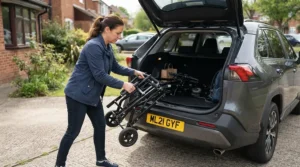
Where this buggy earns its keep is genuinely dual-purpose use: fold it down and it wheels behind you like hand luggage, complete with a bumper bar that doubles as a pull-along handle — a small but clever detail for airport dashes. The solid (non-air-filled) wheels mean less puncture risk but a firmer ride over broken pavements, which is the trade-off you’re accepting for the compact fold. Expect to pay in the £300–£400 range at the time of research, with prices varying by colourway and retailer.
Pros:
- ✅ Near-flat, strap-adjustable recline suits daytime naps
- ✅ 20% bigger storage basket with front-and-rear access
- ✅ Wheels behind you like hand luggage — genuinely travel-ready
Cons:
- ❌ Recommended age tops out around 30 months, shorter than most rivals
- ❌ Solid (non-air) wheels feel firmer over rough pavements
3. Mountain Buggy Nano V3 — full lie-flat recline for genuine naps
If proper lie-flat recline matters more to you than shaving off the last few hundred grams, the Mountain Buggy Nano V3 is worth a serious look. At under 6kg with a 20kg seat load, it’s genuinely one of the lightest full-recline buggies available, and the fabric sling seat reclines completely flat — a rarer feature at this weight than you’d expect, and one that Mountain Buggy backs with a notably generous 3-year warranty.
What the marketing doesn’t emphasise is that independent testing has found the ride comfort somewhat average — BabyGearLab rated it “middle of the road” on components, with the recline and two-wheel suspension setup falling short of the smoothest strollers tested, though manoeuvrability scored near the top of its category, second only to the Babyzen Yoyo2. That’s a useful piece of honest context: this buggy wins on portability and nap-readiness, not on plush ride quality over cobbles.
The puncture-proof EVA tyres are a genuine practical win for anyone who’s ever had to deal with a flat buggy tyre mid-outing — there’s simply nothing to puncture. The trade-off is that reviewers note basket access becomes fiddly once the seat is reclined, since the backrest sits close to the storage space. For families who travel with a toddler regularly, or who value nap reliability over off-road comfort, this buggy’s combination of light weight, full recline and long warranty makes it a strong mid-range pick, typically found in the £150–£220 range at the time of research.
Pros:
- ✅ Full lie-flat recline genuinely useful for toddler naps
- ✅ 3-year warranty — longer than most rivals in this class
- ✅ EVA tyres need zero maintenance, no punctures to worry about
Cons:
- ❌ Basket access is fiddly once the seat is reclined
- ❌ Independent testers rate ride comfort as average rather than outstanding
4. Joie Pact Lite — lightest and cheapest on this list
For anyone whose primary concern is keeping costs down without ending up with something flimsy, the Joie Pact Lite deserves attention. At 5.5kg it’s the lightest buggy in this whole line-up, and its one-hand fold collapses into a genuinely flat, compact bundle — Joie even includes a carry strap and matching travel bag, a nice touch that costs extra as an accessory on some pricier rivals.
Here’s the catch that a spec sheet alone won’t flag clearly: the Joie Pact Lite is rated from birth to 15kg, which in practice tends to mean roughly three years rather than the four-plus that most of its rivals here offer. Based on the spec comparison, that’s a meaningfully shorter usable window, and it’s worth weighing against the lower purchase price — you may be replacing this buggy sooner than a pricier alternative rated to 22kg.
Aggregated review sentiment from MadeForMums is candid about a genuine limitation: even in its most upright setting, testers found the seat sat more reclined than a typical buggy, meaning some toddlers who like to sit bolt upright and watch the world go by end up pulling themselves forward. The storage basket is also on the narrow, shallow side — fine for a nappy bag and snacks, not for a proper supermarket shop. What it does deliver is genuine portability at a genuinely low price point, which makes it a sensible choice for a second buggy, a grandparents’ house buggy, or simply a tight-budget first purchase. Prices at the time of research typically sit in the £90–£130 range.
Pros:
- ✅ One of the lightest buggies here at just 5.5kg
- ✅ One-hand fold collapses into a genuinely flat, compact bundle
- ✅ Comes with its own carry strap and travel bag included
Cons:
- ❌ 15kg weight limit is noticeably lower than most rivals here
- ❌ Basket is narrow and shallow — fine for essentials, not a big shop
5. Out n About Nipper 360 V5 — best all-terrain grip on rough ground
Once pavements turn into gravel paths, kerbs, or the kind of muddy park track that swallows smaller wheels whole, the Out n About Nipper 360 V5 is built specifically for that scenario. Its 12-inch air-filled tyres and genuine suspension are a different category of engineering to the smaller solid wheels on the lightweight buggies above, and at 9.8kg with a 22kg maximum load, it’s designed to be a proper daily workhorse rather than an occasional travel companion.
What most buyers overlook about all-terrain buggies generally is that the swivel-lock front wheel is the real feature to check, not just tyre size — locking it converts a nimble, swivelling front wheel into a stable, straight-tracking wheel for gravel, sand or uneven ground, then unlocks again for tight manoeuvring around shops. Out n About is explicit that you shouldn’t jog with a child under six months in this model, which is a sensible, honestly stated limitation rather than a marketing omission.
Real-world feedback shared by families using this buggy (via Out n About’s own customer testimonials) consistently mentions its usefulness in tight, narrow hallways despite its size, and — notably for this article’s focus on naps — more than one parent describes a child happily sleeping in it thanks to the deep recline. It comes complete with a rain cover, bumper bar and removable basket as standard, which avoids the “yes but you’ll need to buy these separately” trap some buggies fall into. The trade-off for all that capability is the extra weight versus the lightweight picks above — at close to 10kg, this isn’t a buggy you casually sling over one shoulder onto a train. Expect a price in the £280–£350 range at the time of research.
Pros:
- ✅ 12″ air-filled tyres with suspension smooth out kerbs and cobbles
- ✅ Swivel-lock front wheel adapts from tight pavements to trails
- ✅ Comes complete with rain cover, bumper bar and seat liner
Cons:
- ❌ At 9.8kg, noticeably heavier to lift than the lightweight picks here
- ❌ Not recommended for jogging with a child under 6 months

6. Baby Jogger City Mini GT2 — puncture-proof tyres for daily reliability
The Baby Jogger City Mini GT2 occupies a useful middle ground: not as featherlight as the travel-focused buggies, not as heavy-duty as a dedicated jogger, but built around a genuinely clever detail — “forever-air” rubber tyres that never go flat, paired with all-wheel suspension. For anyone who’s ever had to abandon a walk because of a punctured buggy tyre, this alone is worth factoring into the decision.
Independent testing tells a more mixed story than the brand’s own marketing suggests. BabyGearLab’s review notes that this design has remained largely unchanged for over a decade, with smaller wheels that “struggled both on and off-road” in testing and a narrow wheelbase that felt tippy on tight turns — useful context if you were assuming “all-terrain” in the name meant genuinely rugged capability. What most buyers overlook is that “all-terrain” branding on lighter buggies like this one generally means “copes with mixed pavements and light gravel,” not “handles a muddy trail with ease” — for that, the heavier Nipper 360 above is the stronger pick.
On the plus side, the near-flat recline with adjustable calf support is a genuine comfort feature for toddler naps, and the signature one-hand, in-seat fold is quick enough to manage at a school gate with a toddler already tugging at your sleeve. The basket, while reasonably sized, has a crossbar that limits how you load it — something reviewers consistently flag as mildly annoying rather than a dealbreaker. At the time of research, prices for the Baby Jogger City Mini GT2 typically sit in the £280–£350 range.
Pros:
- ✅ Forever-air tyres never go flat or need pumping up
- ✅ Near-flat recline with adjustable calf support for comfort
- ✅ One-hand, in-seat fold that’s genuinely quick at the school gate
Cons:
- ❌ Independent testers found the narrow wheelbase a little tippy on turns
- ❌ Storage basket’s crossbar limits how much you can load in
7. Hauck Rapid 4 — highest weight limit at the lowest price
Rounding out the list on pure value, the Hauck Rapid 4 carries a combined maximum load of 25kg (22kg child plus 3kg in the basket) — among the highest weight allowances of any buggy featured here — while typically retailing for less than half the price of several premium picks above. That’s a genuinely useful combination for budget-conscious families who don’t want to worry about outgrowing their buggy just as their toddler hits a growth spurt.
Here’s what the price tag doesn’t immediately signal: this isn’t a stripped-down budget shell. The backrest and footrest both adjust to a proper lie-flat position, the front wheels swivel and lock for rough ground, and the one-hand “Press & Pull” fold mechanism is genuinely quick to operate one-handed while holding a toddler with the other arm. Hauck’s Rapid 4D variant has been independently lab-tested by Which?, assessing handling across pavements, uneven ground and obstacles — a meaningful point of reassurance for a budget buy, since it means the claims aren’t purely self-reported.
Reviewers’ honest expectations align with the price point: build materials feel noticeably less premium than the likes of Silver Cross or Cybex, and the 3kg basket capacity is modest next to the Jet 3’s larger equivalent. But for families prioritising longevity and reach over plush finishing, that’s an entirely reasonable trade to make. On paper, this means you’re getting genuine all-terrain functionality and a class-leading weight limit for a fraction of the premium-tier price — a strong pick for second children, growing toddlers, or anyone buying on a tighter budget. Prices at the time of research typically fall in the £140–£180 range.
Pros:
- ✅ 25kg total load capacity — one of the highest limits here
- ✅ Lie-flat recline on both backrest and footrest for proper naps
- ✅ Independently tested by Which? for handling and ease of use
Cons:
- ❌ Budget build feels less plush than pricier rivals
- ❌ Basket capacity is modest at just 3kg
Top 7 Buggies: Full Comparison Table
| Buggy | Weight | Max Load | Recline | Price Range | Best For |
|---|---|---|---|---|---|
| Cybex Libelle | 5.9 kg | 22 kg | Gradual, not flat | £280–£350 | Air travel, smallest fold |
| Silver Cross Jet 3 | 6.2 kg | 22.7 kg | Near-flat | £300–£400 | City living, dual-purpose |
| Mountain Buggy Nano V3 | 6 kg | 20 kg | Full lie-flat | £150–£220 | Naps, long warranty |
| Joie Pact Lite | 5.5 kg | 15 kg | Multi-position | £90–£130 | Tightest budgets |
| Out n About Nipper 360 V5 | 9.8 kg | 22 kg | Deep recline | £280–£350 | Rough terrain, country walks |
| Baby Jogger City Mini GT2 | approx. 8 kg | approx. 22 kg | Near-flat | £280–£350 | Daily mixed-terrain use |
| Hauck Rapid 4 | approx. 9 kg | 25 kg | Full lie-flat | £140–£180 | Budget, highest weight limit |
The clearest pattern in this table is the direct trade-off between weight limit and portability: the Joie Pact Lite is the lightest to carry but caps out earliest at 15kg, while the Hauck Rapid 4 carries the most weight but asks you to accept a heavier, less premium-feeling frame in return. If you’re planning to use one buggy right through to the four-year mark, the Out n About Nipper 360 V5 and Hauck Rapid 4 both offer more headroom than the ultra-light travel options.
How to Choose the Best Toddler Buggy
Working through the right choice for your family comes down to matching a handful of practical factors against your actual daily routine, rather than chasing whichever model currently has the flashiest marketing.
- Weigh your actual terrain, not your ideal terrain. If 90% of your walking happens on smooth pavements and school runs, a lightweight buggy like the Cybex Libelle or Joie Pact Lite will serve you better than an all-terrain model you’ll rarely need.
- Check the true weight limit against your toddler’s growth curve. A child on higher growth percentiles may outgrow a 15kg-rated buggy well before the “approx. 4 years” age guide suggests — the Hauck Rapid 4 or Silver Cross Jet 3 offer more room to grow.
- Prioritise recline if naps-on-the-go are a daily reality. The Mountain Buggy Nano V3 and Hauck Rapid 4 both offer genuine lie-flat positions, which matters more than most buyers initially assume.
- Factor in your storage situation before your budget. A buggy that won’t fit your car boot or hallway cupboard isn’t a bargain no matter the price — check folded dimensions, not just weight.
- Test the fold mechanism in person if you can. One-hand folds vary enormously in how intuitive they actually feel with a toddler tugging at your other arm; reading a spec sheet won’t tell you this.
- Think about resale or hand-me-down potential. Premium brands like Silver Cross and Cybex tend to hold value better on the second-hand market than budget alternatives.
- Don’t ignore basket size if you’re a regular shopper-while-walking family. The difference between a 3kg basket and a larger one adds up fast on a weekly supermarket run.
Buggy vs Pushchair Terminology: What’s the Real Difference?
If you’ve found yourself confused by “buggy,” “pushchair” and “pram” being used almost interchangeably across UK retailers, you’re not imagining things — the terminology genuinely overlaps more than it used to. Historically, “pram” referred specifically to a lie-flat carriage for newborns, “pushchair” was the broader umbrella term for anything with a seat a baby or toddler sits in, and “buggy” described a lightweight, foldable, usually umbrella-style pushchair aimed at older babies and toddlers.
In practice, on amazon.co.uk and most UK retail sites today, “buggy” and “pushchair” are used near-interchangeably for anything from a Joie Pact Lite to a Silver Cross Jet 3, while “pram” and “travel system” are reserved for products that include a newborn-suitable carrycot or lie-flat mode from birth. The distinction that still matters practically is this: a true buggy or lightweight pushchair, as reviewed throughout this article, is generally not designed as a newborn’s primary sleeping space, whereas a pram or carrycot is.
That distinction has genuine safety weight behind it, not just semantics. The Lullaby Trust — the UK’s leading safer sleep charity — advises that a suitable pram carrycot, rather than a reclined buggy seat, is the appropriate flat sleeping space for very young babies, and cautions against covering a hood with material to block light, since padded buggy sides can trap heat. If your child is old enough to be sitting up confidently and you’re shopping specifically for the toddler years, any of the seven buggies above are a genuinely appropriate category — but if you’re still choosing your very first pram for a newborn, that’s a different buying decision entirely.
Recline for Naps: What Actually Matters
Recline is one of the most misunderstood specs on any buggy listing, partly because manufacturers describe wildly different mechanisms using near-identical language. “Multi-position recline,” “near-flat” and “full lie-flat” are not the same thing, and the difference genuinely affects whether your toddler will actually sleep in the buggy or just doze fitfully with their chin on their chest.
Based on the spec comparison across this list, only the Mountain Buggy Nano V3 and Hauck Rapid 4 offer a genuinely full lie-flat position among the seven featured here — both use a strap-and-toggle or multi-adjust backrest-and-footrest system rather than a single reclining hinge. The Silver Cross Jet 3 and Out n About Nipper 360 V5 sit in the “near-flat” category, which in practice is comfortable for most toddlers but stops short of completely horizontal. The Cybex Libelle and Joie Pact Lite, by contrast, offer gradual or multi-position recline that doesn’t reach flat at all — a reasonable compromise for their compact fold, but worth knowing before you buy if naps are your primary concern.
RoSPA’s official guidance is a useful sense-check here: it notes that non-reclining seats aren’t suitable for a child under six months old, which underlines why recline isn’t just a comfort feature but a genuine developmental consideration for younger toddlers. Practically speaking, if your toddler regularly falls asleep mid-walk, prioritise the buggies with genuine lie-flat capability; if naps happen predominantly at home and the buggy is mainly for upright exploring, the shallower-reclining, lighter options will serve you just as well while saving you both weight and money.
Weight Limits for Toddlers: What the Numbers Really Mean
The weight limit printed on a buggy’s spec sheet is one of the most consequential numbers in this entire buying decision, yet it’s routinely skimmed past in favour of looking at price and colour options first. As this comparison shows, the spread across just seven buggies runs from 15kg on the Joie Pact Lite right up to 25kg total load on the Hauck Rapid 4 — a gap of 10kg, which in real terms can mean the difference between a buggy lasting to age three versus comfortably reaching age four or beyond.
What most buyers overlook is that these limits are safety ratings, not just theoretical upper bounds — a buggy loaded beyond its rated capacity behaves less predictably, with slower, less responsive braking and a genuine risk of frame stress over time. UK product safety oversight in this category sits with the Office for Product Safety and Standards, which publishes recall notices for pushchairs and buggies found to have safety defects, underlining that weight and structural ratings aren’t arbitrary marketing figures.
In practice, average UK toddler weights mean most children reach the 15kg mark somewhere between two and three years old, and the 20–22kg mark closer to four — so a buggy rated to 15kg like the Joie Pact Lite may need replacing noticeably earlier than one rated to 20kg or above. If you’re hoping a single buggy purchase will comfortably last from toddlerhood through to school age, the Hauck Rapid 4, Out n About Nipper 360 V5 or Silver Cross Jet 3 all offer meaningfully more headroom than the lightest travel-focused options.
| Buggy | Weight Limit | Approx. Age Ceiling |
|---|---|---|
| Joie Pact Lite | 15 kg | ~3 years |
| Mountain Buggy Nano V3 | 20 kg | ~4 years |
| Cybex Libelle | 22 kg | ~4 years |
| Out n About Nipper 360 V5 | 22 kg | ~4 years |
| Silver Cross Jet 3 | 22.7 kg | ~4 years (seat rating) |
| Hauck Rapid 4 | 25 kg (incl. basket) | ~4 years |
Reading this table alongside your toddler’s current weight and growth trajectory is genuinely more useful than reading it alongside your budget alone. A cheaper buggy with a lower weight ceiling isn’t necessarily false economy — but it is worth going in with eyes open about a probable earlier replacement rather than being caught out at eighteen months in.
Best Lightweight Buggy for a Toddler: What Sets Them Apart
Within this list, three buggies stand out specifically as the best lightweight buggy for toddler use: the Cybex Libelle at 5.9kg, the Joie Pact Lite at 5.5kg, and the Mountain Buggy Nano V3 at just under 6kg. What separates a genuinely good lightweight buggy from a merely small one comes down to a handful of engineering choices rather than the headline weight figure alone.
Here’s what most buyers overlook when comparing lightweight options purely on kilos: fold mechanism matters just as much as final weight. A buggy that’s 5.5kg but requires two hands and a bit of a wrestling match to fold isn’t meaningfully more convenient day-to-day than one that’s 6.2kg with a genuinely one-motion fold, like the Silver Cross Jet 3. Similarly, a lighter frame often means a smaller storage basket and less robust wheels — the trade-off buyers accept for portability is rarely spelled out clearly on the product page itself.
The other factor genuinely worth weighing is recline capability, since lightweight buggies frequently sacrifice full lie-flat positions to keep the mechanism simple and the frame light — as seen with both the Cybex Libelle and Joie Pact Lite above. If naps matter more to you than shaving off the last few hundred grams, the Mountain Buggy Nano V3 offers a genuinely useful middle ground: still under 6kg, but with a proper full-recline seat that the other two ultra-light options don’t match.
Best All-Terrain Buggy for a Toddler: What Sets Them Apart
On the opposite end of this list, the Out n About Nipper 360 V5, Baby Jogger City Mini GT2 and Hauck Rapid 4 all market themselves under the all-terrain banner, but genuinely differ in what that label means in practice — a distinction that’s easy to miss when scrolling through similar-sounding product descriptions.
Based on the spec comparison, the Out n About Nipper 360 V5 is the only one of the three built around genuinely large air-filled tyres (12 inches) with proper suspension, which independent commentary and Out n About’s own product information consistently position for country paths, sand and genuinely uneven ground — not just “slightly bumpier pavement.” The Baby Jogger City Mini GT2, by contrast, uses smaller “forever-air” rubber tyres that independent testing found “struggled both on and off-road” compared with genuinely rugged options, meaning its all-terrain branding is better read as “copes with mixed urban terrain” rather than genuine off-roading. The Hauck Rapid 4 sits between the two, with swivelling, lockable front wheels suited to gravel and country paths at a notably lower price point than either rival.
What most buyers overlook is that genuine all-terrain capability typically comes with a real weight penalty — all three buggies in this category weigh close to double the lightweight picks above. If your walks genuinely involve gravel tracks, uneven parkland or the odd muddy verge, that extra weight buys real capability; if “all-terrain” mostly means “the pavement outside my house has a few cracks in it,” a lighter buggy will likely serve you just as well while saving your arms on the stairs.
Practical Usage Guide: Setup, Maintenance & the First 30 Days
Getting a new buggy set up correctly in the first few days makes a genuinely noticeable difference to how well it performs — and how long it lasts — over the following years. Before your toddler’s first outing, unfold and refold the buggy several times at home so the mechanism becomes familiar; doing this for the first time on a busy pavement with a wriggling toddler is a recipe for frustration. Check that both locking mechanisms engage fully each time — RoSPA specifically flags this as a key pre-use safety check, since an incompletely locked frame is a genuine collapse risk.
In the first month, resist the urge to overload the storage basket or hang shopping bags from the handlebars; both RoSPA and manufacturer guidance consistently warn that overloading, particularly hanging weight from handles, is a leading cause of buggies tipping backwards unexpectedly. If your buggy has air-filled tyres, like the Out n About Nipper 360 V5, check tyre pressure roughly monthly, since underinflated tyres both handle worse and wear the frame’s suspension components faster than they should.
For ongoing maintenance, most seat covers on this list — including the Cybex Libelle and Joie Pact Lite — are machine washable at 30°C, which is worth doing every few weeks given how much a toddler’s snacks, drinks and occasional sickness end up on the fabric. Wipe down frames and wheel axles with a damp cloth monthly to prevent grit build-up in folding joints, since this is the single most common cause of a fold mechanism becoming stiff or sticky over time. A common first-30-days mistake is skipping the manufacturer’s specific fold instructions in favour of guessing — every model here has a slightly different sequence, and forcing an unfamiliar mechanism is how hinges get damaged.
Real-World Scenarios: Which Buggy Suits Which Family
The city-dwelling flat-share family, no lift, third floor: For a family carrying a buggy up several flights daily, weight is non-negotiable. The Joie Pact Lite at 5.5kg or the Cybex Libelle at 5.9kg both make sense here — the small storage basket is a manageable trade-off against not needing a workout every time you come home.
The weekend country-walk family with an SUV boot: If Saturdays mean muddy paths, farm shops and gravel car parks, the Out n About Nipper 360 V5‘s air-filled tyres and suspension earn their extra weight, especially with a larger boot to absorb the bulkier fold.
The budget-conscious family expecting a second child soon: With resale and longevity both factoring into the decision, the Hauck Rapid 4‘s 25kg combined load and lie-flat recline offer genuine headroom to grow into, at a price point that leaves room in the budget for a second-hand car seat or carrycot alongside it.
The frequent-flyer family with holidays booked most terms: The Silver Cross Jet 3 and Cybex Libelle both fold into genuinely cabin-friendly dimensions, sparing you the gate-check gamble that comes with bulkier all-terrain buggies at airport security.
Common Mistakes When Buying a Toddler Buggy
One of the most frequent mistakes is buying based purely on the “suitable up to 4 years” headline without checking the actual kilogram figure against your toddler’s growth trajectory — as this guide’s weight limit section shows, that figure genuinely varies by up to 10kg across similarly marketed products. Another common error is assuming a lighter buggy is automatically the better choice; weight and durability are frequently in tension, and the Which? independent testing programme exists precisely because lab conditions reveal handling and stability differences that spec sheets alone don’t communicate.
Buyers also regularly underestimate storage needs, focusing entirely on the buggy’s weight and fold size while ignoring basket capacity — a mistake that only becomes apparent on the first proper supermarket run. Similarly, skipping a genuine test of the fold mechanism before buying, relying instead on a product video, means some parents discover only after purchase that a “one-hand fold” still requires more coordination than manageable with a toddler attached to the other arm.
Finally, a subtler mistake is treating all “all-terrain” branding as equivalent — as covered above, the difference between genuinely rugged tyres and marketing-led terminology is significant, and buying the wrong one for your actual terrain means either overpaying for capability you don’t need or under-delivering on the rough ground you actually walk.
Long-Term Cost & Maintenance: The Real Value Picture
Sticker price is only part of the total cost of owning a toddler buggy, and it’s worth thinking in terms of cost-per-year of actual use rather than upfront spend alone. A £120 Joie Pact Lite rated to 15kg, if it needs replacing a year earlier than a 22kg-rated alternative, may end up costing more per year of use than a pricier buggy with a longer working life — particularly once you factor in the cost of buying a second buggy to bridge the gap.
Replacement parts and accessories are another often-overlooked cost. Rain covers, spare wheels and replacement seat fabric vary significantly by brand availability; established brands like Silver Cross and Baby Jogger tend to have longer-running spare parts support than newer or budget entrants, which matters if a wheel needs replacing three years into ownership. Warranty length is a genuinely useful proxy here too — the Mountain Buggy Nano V3‘s 3-year warranty is notably longer than the 1-year cover typical of several budget alternatives, effectively building in extra peace of mind at no additional cost.
Resale value is worth factoring in for anyone planning to sell once their toddler outgrows the buggy. Premium, well-known brands generally hold value better on platforms like Facebook Marketplace or Vinted than budget alternatives, meaning the effective net cost of a pricier buggy can end up closer to a budget option than the initial price tags suggest — something rarely mentioned on the product listing itself.
Safety, Regulations & Compliance: What UK Standards Mean
Every pushchair and buggy sold in the UK should comply with a recognised safety standard — currently BS EN 1888-1:2018+A1:2022, or the older BS 7409:1996 for some legacy stock — and RoSPA’s guidance is explicit that buyers should look for this reference before purchasing, whether new or second-hand. This isn’t a bureaucratic technicality; these standards set out genuine structural, harness and stability requirements that a compliant product must meet.
Beyond the initial standard, the UK’s Office for Product Safety and Standards publishes ongoing recall notices for childcare products, including pushchairs found to have manufacturing defects after they’ve reached the market — it’s genuinely worth a quick search for your specific model and batch number before first use, particularly for second-hand purchases where you can’t verify the full ownership history. RoSPA’s day-to-day safety advice is equally practical: always keep a child harnessed while the buggy is in use, never hang bags from the handlebars, and check both locking mechanisms are fully engaged before every outing.
For families using a buggy for jogging or fast walking, it’s worth noting that several models in this list — including the Out n About Nipper 360 V5 — explicitly advise against running with a child under six months, a manufacturer-stated limitation rooted in developmental safety rather than marketing caution. Following these standards and manufacturer guidance isn’t optional box-ticking; it’s the difference between a buggy that protects your toddler as intended and one that merely looks the part.
Toddler Buggies for Different Lifestyles
For first-time parents navigating buggy shopping for the first time, simplicity is genuinely undervalued — a straightforward one-hand fold like the Joie Pact Lite‘s or the Baby Jogger City Mini GT2‘s reduces the daily friction of a task you’ll repeat dozens of times a week, more than any premium fabric or colourway ever will.
For families juggling an older sibling too, buggy weight becomes secondary to basket size and stability, since you’ll often be hanging a school bag or scooter helmet off the frame despite the safety advice against it — the Hauck Rapid 4‘s higher weight rating and sturdier build offer more forgiveness here than the ultra-lightweight options.
For grandparents or secondary carers, an adjustable handlebar height matters more than most buyers initially consider — several buggies here, including the Hauck Rapid 4 and Cybex Libelle, offer meaningful handle height adjustment, which genuinely changes comfort for anyone significantly taller or shorter than the buggy’s average intended user.
For families in rural or semi-rural areas, the terrain argument made earlier in this guide applies directly — the Out n About Nipper 360 V5‘s air-filled tyres and suspension will consistently outperform lighter, pavement-focused options on unpaved lanes, farm tracks or beach visits.
Frequently Asked Questions
❓ What is the best toddler buggy for everyday use?
❓ What's the difference between a buggy and a pushchair?
❓ How do I know if a buggy's recline is good enough for naps?
❓ What weight limit should I look for in a toddler buggy?
❓ Are lightweight buggies less safe than heavier all-terrain ones?
Conclusion
There’s no single best toddler buggy that suits every family, and honestly, that’s the whole point of comparing genuine specifications rather than chasing whichever product currently has the most five-star badges on its listing page. If portability is your priority, the Cybex Libelle and Joie Pact Lite deliver genuinely impressive fold sizes and weights. If naps matter more than shaving off grams, the Mountain Buggy Nano V3 and Hauck Rapid 4 both offer proper lie-flat recline. And if your daily reality involves anything rougher than smooth pavement, the Out n About Nipper 360 V5 is built specifically for that job.
What matters most is matching the buggy’s genuine strengths — weight, recline, terrain capability and weight limit — against your actual routine rather than an idealised one. A buggy that’s technically superior on paper but wrong for your hallway, your car boot or your toddler’s nap habits isn’t actually the better buy. Use the comparison tables above as your starting point, check current prices and availability before committing, and factor in the total cost of ownership rather than the sticker price alone.
Whichever of these seven you land on, you’re choosing from genuinely well-reviewed, currently available products rather than an untested gamble — which, if you’ve ever been burned by a buggy that seemed great in photos and fell apart in month three, is worth more than any single spec on the page.
✨ Ready to compare prices and make your pick?
Click through to any of the buggies above on amazon.co.uk to check current availability — the right toddler buggy for your family might just be one tap away! 🛒👶
Recommended for You
- From Birth Pushchair For City Use: 7 Best Picks (2026)
- Pushchair Suitable From Birth To 4 Years: 7 Trusted UK Picks (2026)
- From Birth Pushchair: 7 Best UK Picks Parents Love (2026)
Disclaimer: This article contains affiliate links. As an Amazon Associate, I earn from qualifying purchases. If you purchase products through these links, we may earn a small commission at no additional cost to you.
✨ Found this helpful? Share it with your friends! 💬🤗
