In This Article
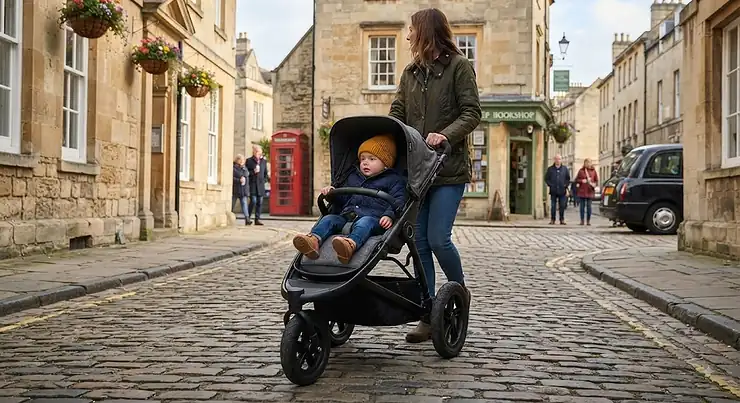
Somewhere between a shopping trolley and a mountain bike sits the 3 wheel pushchair — and if you’ve never pushed one, the difference from a standard four-wheeler is bigger than you’d think. A 3 wheel pushchair is a buggy built around a single front wheel and two rear wheels, a layout that trims the turning circle right down and, on most models, adds proper suspension and chunkier tyres built to shrug off kerbs, cobbles and muddy towpaths. It’s the buggy of choice for parents who measure their week in miles rather than metres.
We’ve spent this guide digging into real specs, real owner feedback and honest side-by-side comparisons — not recycled marketing copy — because a pushchair is one of those purchases you live with daily for two to four years. Get it wrong and you’ll know about it on every school run. Get it right and it practically disappears into the background of your day, which, frankly, is the whole point.
Below you’ll find seven genuine three-wheelers spanning budget, mid-range and premium price points, a full spec comparison, and answers to the questions parents actually type into Google at 11pm with a sleeping baby on one arm — including whether a swivel front wheel buggy is worth the extra cash, how three wheel pushchair stability actually stacks up against a four-wheeler, and which model suits a 3 wheel pram for active parents who run, hike or simply refuse to let a baby slow them down. Before you buy anything, it’s worth reading independent guidance from the Royal Society for the Prevention of Accidents. Their pushchair and buggy safety guidance covers exactly the checks a rushed showroom visit tends to skip.
Quick Comparison: The Best Three Wheeler Prams at a Glance
If you’ve got thirty seconds and a strong opinion about your budget, this table is your shortcut.
| Pushchair | Price Range | Weight | Best For |
|---|---|---|---|
| My Babiie MB200+ | Under £250 | ~10kg | Tightest budget |
| Ickle Bubba Venus Prime | £250-£350 range | ~10.5kg | Lightweight jogging on a budget |
| Out ‘n’ About Nipper 360 | £400-£500 range | ~10-11kg | All-round UK favourite |
| Phil & Teds Sport | £450-£600 range | ~12kg | Growing families (single-to-double) |
| Mountain Buggy Urban Jungle | £500-£650 range | ~11kg | Style-conscious city dwellers |
| Baby Jogger City Elite 2 | £600-£750 range | ~12kg | Long-term luxury use |
| Thule Urban Glide 2 | £550-£700 range | ~11kg | Serious runners and parkrun regulars |
Prices shown are indicative ranges based on research at the time of writing — always check current price before buying, since retailers adjust these constantly. What jumps out here is that the gap between “budget” and “premium” in this category isn’t really about whether the buggy works — it’s about how much refinement, weight-saving and long-term durability you’re buying into. The My Babiie MB200+ and Ickle Bubba Venus Prime get the fundamentals right for a fraction of the outlay, but the Baby Jogger City Elite 2 and Thule Urban Glide 2 are built to still be smooth-rolling in year three, which is where the extra spend starts paying for itself.
💬 Found a favourite already? Scroll down for the full breakdown before you commit — the small print matters more than the marketing photos.🤗
Top 7 Three Wheel Buggies: In-Depth Review & Expert Analysis
Each of these seven pushchairs earned its place through genuine specs and aggregated review sentiment — not because a brand paid to be here. We’ve covered budget, mid-range and premium options, plus a couple of lesser-known picks that outperform their price tag.
1. My Babiie MB200+ — budget-friendly do-it-all three-wheeler
The standout here is simply value: this is one of the cheapest genuine three-wheelers on amazon.co.uk that doesn’t feel like a compromise. Built with an aluminium chassis and lockable front swivel wheels, the My Babiie MB200+ is suitable from birth up to around 15kg, with a multi-position backrest and a three-position extendable canopy.
On paper, the lightweight frame and detachable wheels mean it’s genuinely easy to lift into a boot — a detail that matters more than glossy brochures ever admit, especially if you’re doing the lift solo with a toddler on your hip. The swivel front wheel gives it decent manoeuvrability around shops, though it lacks the pneumatic tyres and heavy-duty suspension of the pricier all-terrain models, so it’s better suited to pavements and parks than genuine off-roading.
Reviewers consistently report that the My Babiie MB200+ range punches well above its price point for everyday use, with many praising how easy it is to steer one-handed and how quickly it folds down. A recurring theme in aggregated feedback is that the ride quality on rough or uneven ground is noticeably softer than on the premium all-terrain models — unsurprising given the smaller wheels, and something to weigh up if you’re regularly tackling cobbles or unpaved paths rather than smooth pavements.
Pros:
- ✅ Genuinely affordable entry point into three-wheeler handling
- ✅ Lightweight aluminium frame, easy to lift and store
- ✅ Detachable wheels simplify boot storage
Cons:
- ❌ Smaller wheels mean less comfort over rough terrain
- ❌ Weight limit lower than premium all-terrain rivals
At under £250 at the time of research, this is squarely a value pick — buyers on a tight budget who mostly stick to pavements and parks get a real three-wheeler experience without the premium price tag.

2. Ickle Bubba Venus Prime Jogging Stroller — lightest jogger for under £350
The Ickle Bubba Venus Prime Jogging Stroller stands out for delivering a genuinely sporty three-wheel design at a price that undercuts most “proper” jogging buggies by hundreds of pounds. Its large rear wheels and rotating, lockable front wheel are built with active use in mind, not just tacked on for looks.
The frame is notably light for the price bracket, which matters if you’re the one hauling it up front steps or in and out of a car boot several times a day. Removing the bumper bar and larger side wheels shrinks the folded footprint further — a genuinely useful trick for families who need to fit it in a smaller boot or take it on public transport.
Based on the spec comparison with rivals in this bracket, what most buyers overlook about this model is that it’s designed primarily as an outward-facing stroller rather than an everyday travel-system-first buggy, so it may not suit parents who want a fully flexible newborn setup without adding a separate carrycot. Aggregated reviewer sentiment consistently describes it as a nimble, lightweight and versatile option for active parents who don’t want to compromise on comfort or quality just to hit a lower price point, though some testers noted the newborn nest is on the smaller side.
Pros:
- ✅ Sporty three-wheel handling at a genuinely low price
- ✅ Lightweight build, ideal for frequent lifting
- ✅ Compact fold once bumper bar and wheels are removed
Cons:
- ❌ Newborn nest is limited compared with a full carrycot
- ❌ Always outward-facing, which won’t suit every parent
Around the £250-£350 mark, this is one of the smartest lesser-known picks in the category — a genuine jogging-style three-wheeler without the four-figure price tag some rivals charge.
3. Out ‘n’ About Nipper 360 — UK’s best-loved all-terrain workhorse
There’s a reason the Out ‘n’ About Nipper 360 turns up in more UK prams-and-pushchairs threads than almost any rival: it’s a proper all-terrain three-wheeler from a specialist British brand, and it’s priced to be genuinely attainable rather than aspirational.
The 12-inch air-filled tyres and 360-degree swivel front wheel (which also locks straight for speed) mean it tackles gravel, woodland trails and cracked pavements with equal confidence. Testers report that the swivel-lock front wheel copes just as well with deep gravel and bumpy woodland tracks as it does with ordinary pavement. What that means in practice is you’re not choosing between a “town buggy” and a “country buggy” — this one genuinely does both without you needing a second pushchair for weekend walks.
Aggregated review sentiment is remarkably consistent: parents rate it highly for how light it feels to push despite its robust build, with several testers noting it sits among the lighter all-terrain pushchairs at under 10kg, and that it’s easy to carry up or down a flight of steps when needed. The main recurring gripe across reviews is that the pneumatic tyres need occasional maintenance — a pump and puncture kit are worth keeping in the storage pocket — and the recline adjustment on some versions has been described as slightly fiddly.
Pros:
- ✅ All-terrain performance at a genuinely mid-range price
- ✅ Consistently praised as light and easy to manoeuvre
- ✅ 360-degree swivel front wheel locks for speed and stability
Cons:
- ❌ Pneumatic tyres need occasional pumping and puncture care
- ❌ Recline mechanism can be fiddly on some builds
In the £400-£500 range, the Out ‘n’ About Nipper 360 is arguably the benchmark against which every other three-wheeler in this list gets measured, and it’s easy to see why.
4. Phil & Teds Sport — grows from single to double
The defining feature of the Phil & Teds Sport is flexibility: buy it as a single now, and it converts into a double by adding a second seat later, without needing an entirely new pushchair if your family grows.
Its three 12-inch air-filled tyres and all-wheel suspension are built to handle genuinely mixed terrain. Testers describe pushing it across grass, gravel, mud, pavements and even snow without the effort ever feeling laboured, with the front wheel swivelling for shops and busy places but locking solid the moment the ground gets rougher. That’s a meaningful practical difference from single-purpose strollers — you’re not buying a buggy that only performs well on one type of surface.
Here’s what to weigh up: the second-seat conversion is genuinely clever, but reviewers note it adds a few extra steps to fold and unfold once the second seat is fitted, and some accessories like the rain cover are sold separately rather than included. Aggregated feedback frequently singles out the unusual pushbar autobrake as a standout once parents get used to it, alongside praise for the comfortable tall-backed seat and straightforward folding system, though a few testers flagged the hood and wheel guards as feeling slightly flimsy for the price.
Pros:
- ✅ Converts from single to double without buying a new buggy
- ✅ All-terrain suspension proven on grass, gravel and mud
- ✅ Distinctive auto-stop pushbar brake for hilly routes
Cons:
- ❌ Folding gets fiddlier once the second seat is added
- ❌ Some accessories, like the rain cover, cost extra
At £450-£600 for the single configuration, this is the smart pick for parents who suspect — or already know — they’ll want a second seat down the line.
5. Mountain Buggy Urban Jungle — stylish lightweight all-rounder
The Mountain Buggy Urban Jungle stands out for squeezing genuine off-road capability into a frame that still looks at home outside a coffee shop. Its brushed aluminium chassis keeps total weight down to around 11kg, while air-filled tyres and proper suspension mean it isn’t just for show.
The current version’s shorter footprint compared with older Mountain Buggy models — roughly a 10cm reduction from front wheel to back — noticeably improves manoeuvrability, along with a decent “kerb pop” that lets you nip up and down kerbs with minimal effort. What that means day-to-day is fewer awkward three-point turns in narrow shop aisles, which matters more than most spec sheets let on.
Which?’s independent pushchair reviews are worth checking before you buy, since their lab scores come from standardised testing rather than brand marketing, and the Urban Jungle is one of several Mountain Buggy models they’ve put through formal assessment. Reviewers consistently rate the handlebar brake as reassuring on hills, and the large wheels combined with improved suspension are frequently praised for keeping a sleeping baby asleep over bumps and steps. The recurring criticism is that on-board storage is comparatively limited next to bulkier all-terrain rivals.
Pros:
- ✅ Lightweight aluminium frame with genuine off-road ability
- ✅ Compact footprint improves manoeuvrability in tight spaces
- ✅ Handlebar brake rated as sturdy and reassuring on hills
Cons:
- ❌ Limited on-board storage compared with bulkier rivals
- ❌ Carrycot for newborn use is a separate purchase
Sitting in the £500-£650 range, this is the pick for parents who want off-road ability without the visual bulk of a dedicated jogging buggy.
6. Baby Jogger City Elite 2 — most luxurious ride in the class
The Baby Jogger City Elite 2 leads with comfort: a wider, deeper seat that takes heavier weights than most rivals, paired with “Forever Air” tyres that give the ride quality of pneumatic tyres without the puncture risk.
The seat now takes a child up to around 22kg, which means this pushchair can realistically stay in service for years longer than a lighter-duty alternative, potentially saving you the cost of upgrading to a separate toddler buggy. On paper this means a genuinely long usable lifespan — the kind of total-cost-of-ownership thinking that Amazon listings rarely spell out.
The all-wheel suspension and swivelling-or-locking front wheel mean it handles smoothly across most surfaces, though reviewers do flag one recurring practical issue: the notably wide rear axle can be tricky to judge in tighter spaces, such as narrower door frames. Aggregated feedback frequently praises the one-hand quick fold, the lie-flat recline, and the extra-long UV50+ hood — all genuinely premium touches that separate this from the budget end of the market. What most buyers overlook is that the carrycot for newborn use is a separate accessory purchase, so factor that into your total budget if you want it from birth.
Pros:
- ✅ Higher weight limit means years of extra use
- ✅ Puncture-proof “Forever Air” tyres with all-wheel suspension
- ✅ Praised one-hand fold and generous lie-flat recline
Cons:
- ❌ Wide rear axle can be awkward in tight doorways
- ❌ Newborn carrycot sold separately, adding to total cost
Priced in the £600-£750 range, this is the buggy for parents who plan to use one pushchair for the long haul and want every detail to feel considered.
7. Thule Urban Glide 2 — built for parkrun parents
The Thule Urban Glide 2 is unapologetically built for runners first, everyday parents second — and it shows in details like the reflective rims on the hood and wheels, and the squeeze-and-twist brake designed for quick speed control mid-jog.
With notably large wheels — a rear diameter well over 40cm and a substantial front wheel too — plus reliable spring suspension, the ride stays composed even on hilly terrain, while the pushchair itself weighs around 11kg. What that means in practice is you get genuine running-buggy stability without hauling around the bulk of a dedicated jogger that’s useless for everyday errands.
Its closest rival in this bracket is arguably the Mountain Buggy Urban Jungle, which shares several of the same strengths — a lightweight build, adjustable handlebar and carrycot compatibility from newborn — usually at a somewhat lower price, though it lacks a touch of the Glide’s polish and robustness. Reviewers consistently rate the front swivel wheel as excellent for everyday strolling, with the option to lock it solid the moment you pick up the pace. The main criticism across aggregated feedback is that the folded size is genuinely large, taking up a significant chunk of boot space, and the canopy doesn’t extend as low as some parents would like for full sun coverage.
Pros:
- ✅ Purpose-built stability for running, not just walking
- ✅ Reflective detailing genuinely useful for early-morning runs
- ✅ Front wheel swivels for town use, locks solid for jogging
Cons:
- ❌ Large folded footprint eats into boot space
- ❌ Canopy doesn’t extend low enough for full sun protection
At £550-£700 depending on configuration, this is the pick for parents whose 3 wheel pram needs to double as genuine running kit, not just a stroller that photographs well.
Top 7 Three Wheel Buggies: Full Spec Comparison
| Pushchair | Weight | Wheel Type | Front Wheel | Best For |
|---|---|---|---|---|
| My Babiie MB200+ | ~10kg | Standard | Lockable swivel | Tight budgets |
| Ickle Bubba Venus Prime | ~10.5kg | Sport | Rotating, lockable | Lightweight jogging |
| Out ‘n’ About Nipper 360 | ~10-11kg | Pneumatic | 360° swivel/lock | All-terrain value |
| Phil & Teds Sport | ~12kg | Pneumatic | Swivel/lock | Single-to-double growth |
| Mountain Buggy Urban Jungle | ~11kg | Pneumatic | Swivel/lock | Lightweight style |
| Baby Jogger City Elite 2 | ~12kg | Forever Air | Swivel/lock | Long-term luxury |
| Thule Urban Glide 2 | ~11kg | Pneumatic | Swivel/lock | Serious running |
Looking at the spread here, weight and wheel type do most of the talking: the Ickle Bubba Venus Prime and My Babiie MB200+ are the lightest to lift, but the pneumatic-tyred Out ‘n’ About Nipper 360, Mountain Buggy Urban Jungle and Thule Urban Glide 2 are the ones genuinely built for rough terrain. Budget buyers should note that puncture-proof tyres, like the Baby Jogger City Elite 2‘s Forever Air setup, trade a small amount of ride comfort for zero maintenance hassle over years of use.
3 Wheel Pram for Active Parents: Real-World Scenarios
Specs only tell half the story. Here’s how these seven pushchairs actually map onto real family situations.
The daily runner. If you’re lacing up for a 6am parkrun three times a week with baby in tow, the Thule Urban Glide 2 or Ickle Bubba Venus Prime Jogging Stroller make the most sense. Both lock their front wheel solid for stability at pace, and both have suspension genuinely engineered for repetitive jarring impact — something a standard three-wheeler’s lighter suspension isn’t built to absorb long-term.
The countryside dog-walker. For parents doing daily muddy field walks, the Out ‘n’ About Nipper 360 or Mountain Buggy Urban Jungle are the stronger picks. Their pneumatic tyres and higher ground clearance handle uneven, unpaved ground far better than a standard-tyred budget buggy, and both fold compactly enough to still fit in a hatchback boot after a walk.
The growing family on a budget. If you already have a toddler and are expecting again, the Phil & Teds Sport solves a genuine problem: rather than buying a second pushchair or an entirely new double, you add a second seat to the one you already own. It’s a smarter long-term spend than it first appears, even if the upfront cost feels higher than a basic single buggy.
The city commuter with a long train platform to navigate. The Mountain Buggy Urban Jungle‘s shorter footprint and light weight make it easier to manoeuvre through ticket barriers and packed platforms than the bulkier all-terrain options, while still coping with the odd cobbled street or pothole.
The parent who wants one buggy for everything, forever. If budget isn’t the primary constraint and you’d rather buy once, the Baby Jogger City Elite 2‘s higher weight limit and puncture-proof tyres are built for genuinely long service — from newborn through to a sturdy four-year-old.
✨ Ready to Find Your Perfect Match?
🔍 Whichever scenario fits your family, click through on any highlighted model above to check current pricing and availability. A three-wheeler suited to how you actually spend your week will save you money — and frustration — in the long run.
Setting Up and Maintaining Your Three Wheel Pushchair
Getting the setup and early maintenance right in the first month makes a genuine difference to how long a three-wheeler lasts and how pleasant it is to use.
First unboxing and build. Most models arrive part-assembled, but take the ten extra minutes to check the front wheel locks and unlocks smoothly before your first outing — a stiff swivel mechanism straight out of the box is a common early complaint, and it’s far easier to resolve with the retailer in week one than month six.
Tyre pressure, if applicable. Pneumatic-tyred models like the Out ‘n’ About Nipper 360, Mountain Buggy Urban Jungle and Thule Urban Glide 2 need their tyres checked roughly monthly, the same as a bike. Underinflated tyres make the buggy noticeably harder to push and wear unevenly — keep a small pump in the storage basket rather than only reaching for one when you get a puncture.
The 30-day check. After the first month of regular use, re-check every bolt and quick-release lever. Vibration from daily pavement use can loosen fittings that felt perfectly tight on day one — this is standard for any wheeled equipment, not a fault specific to any brand here.
Folding technique. Learn the fold properly rather than forcing it — most complaints about a “stiff” or “sticky” fold mechanism actually come down to skipping a step (like failing to swivel the front wheel fully before folding), not a manufacturing fault.
Storage. Store the pushchair somewhere dry between uses. Fabric seats and hoods on all seven models here are washable, but repeated damp storage accelerates wear on stitching and zips far faster than regular outdoor use does.
Problem → Solution: Fixing Common Three-Wheeler Niggles
Problem: The buggy pulls to one side. This is almost always a tyre pressure or wheel-alignment issue rather than a structural fault. On pneumatic-tyred models, check both rear tyres are equally inflated first; on models with a tracking adjustment, like the Mountain Buggy Terrain-style designs, a small cog adjustment usually solves it in seconds.
Problem: Fold feels stiff after a few months. Wipe down the folding hinges and any exposed metal joints with a dry cloth, then apply a small amount of silicone-based lubricant (never oil, which attracts grit). This is a five-minute job that solves the vast majority of “my buggy won’t fold properly anymore” complaints.
Problem: Front wheel won’t stay locked straight. Debris in the locking mechanism is the usual culprit. A quick clean with a soft brush around the swivel wheel front wheel buggy mechanism resolves this in most cases; if it persists, it may indicate wear that’s worth flagging to the retailer under warranty.
Problem: Basket sags or won’t hold much weight. Distribute shopping evenly rather than piling it on one side — an unevenly loaded basket puts uneven strain on the chassis and can affect steering, particularly on lighter budget models like the My Babiie MB200+.
Problem: Squeaky brakes. A light spray of silicone lubricant on the brake mechanism (avoiding the tyre itself) generally quietens things down; persistent squeaking on a buggy under a year old is worth raising with the manufacturer.
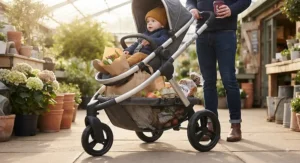
How to Choose a 3 Wheel Pushchair (And Spot the Best Three Wheeler Pram for You)
Here’s a five-step framework for narrowing down the best three wheeler pram for your actual life, not just your Pinterest board.
- Work out your terrain first. If 90% of your walking is smooth pavement, you don’t need pneumatic tyres or heavy-duty suspension — a lighter, cheaper model like the My Babiie MB200+ will serve you just as well and save you money.
- Be honest about weight limits and how long you want to keep it. A higher weight limit, like the Baby Jogger City Elite 2‘s 22kg capacity, means fewer years of use lost to your child simply outgrowing the seat.
- Decide if you actually need the double-conversion option. If a second child is a genuine possibility within the pushchair’s lifespan, a convertible model like the Phil & Teds Sport can work out cheaper than buying twice.
- Check the fold size against your actual boot, not an average boot. Measure your car boot before you buy — the Thule Urban Glide 2, for instance, folds larger than several rivals here, which matters enormously if you drive a small hatchback.
- Factor in ongoing costs, not just the sticker price. Pneumatic tyres need occasional maintenance; puncture-proof tyres like Baby Jogger’s Forever Air cost more upfront but less over time.
- Test the fold and unfold motion in person if you can. A one-handed fold that looks effortless in a product video can feel very different when you’re one-handed for real reasons — holding a toddler, a coffee, or both.
- Match the front wheel type to your typical use. A swivel front wheel buggy that also locks gives you the best of both worlds; a fixed-wheel-only jogger is faster but genuinely harder to manoeuvre round shops.
3 Wheel vs 4 Wheel Pushchair: Which Is Right for You?
This is the comparison most parents wrestle with before they’ve even picked a brand, and the honest answer is that neither layout is objectively “better” — they’re built for different priorities.
A three-wheeler’s single front wheel gives it a noticeably tighter turning circle than most four-wheel designs, which is why three-wheelers dominate among parents who walk long distances or tackle uneven ground regularly. The trade-off is that a single front wheel, particularly when unlocked and swivelling, can feel less planted at speed than a four-wheel chassis with a wider footprint. Four-wheel pushchairs, by contrast, tend to sit lower and wider, which generally translates to a steadier feel when stationary — useful if you’re frequently parking the buggy on uneven ground rather than moving it — but they usually can’t match a three-wheeler’s manoeuvrability in tight aisles or narrow gates.
| Factor | 3 Wheel Pushchair | 4 Wheel Pushchair |
|---|---|---|
| Turning circle | Tighter, easier in tight spaces | Wider, needs more room |
| Off-road capability | Generally stronger with pneumatic tyres | Varies, often weaker off-road |
| Static stability | Slightly less planted when parked | Generally more planted when parked |
| Best For | Active parents, mixed terrain | Parents prioritising a compact, stable park |
What the data actually suggests is that your typical walking terrain should decide this more than brand loyalty or aesthetics. Parents doing regular off-road or long-distance walking consistently report a stronger preference for three-wheelers like the Out ‘n’ About Nipper 360, while parents whose walks are mostly short trips around flat urban pavements often find a four-wheeler perfectly adequate and sometimes easier to park stationary outside a café table.
Three Wheel Pushchair Stability: What the Engineering Actually Means
Three wheel pushchair stability is the single most-searched concern in this category, and it’s worth separating myth from mechanics.
A three-wheeler’s stability comes down to three factors: wheelbase width, wheel size, and whether the front wheel is locked or left swivelling. A wider wheelbase and larger wheels — as seen on the Mountain Buggy Urban Jungle and Out ‘n’ About Nipper 360 — generally translate to a more planted, confident feel over kerbs, cobbles and uneven ground, because a bigger wheel simply rolls over an obstacle that a smaller wheel would catch on. Locking the front wheel straight, meanwhile, meaningfully increases stability at speed — which is exactly why every jogging-oriented three-wheeler in this list, including the Thule Urban Glide 2 and Ickle Bubba Venus Prime, makes locking the front wheel a one-click action rather than a fiddly process.
All new prams and pushchairs sold in the UK, three-wheeled or otherwise, are required to meet the safety standard BS EN 1888, which covers wheeled child conveyances and their testing, alongside separate fire-resistance rules for upholstered products. You can check the detail of what that actually requires via the official trading standards guidance on pram and pushchair safety. What this means practically is that every model featured in this guide has already cleared a formal stability and structural testing bar before it ever reached amazon.co.uk — the real-world differences between them are about degree and terrain suitability, not basic safety.
The spec sheet won’t tell you this, but user reports suggest the biggest practical stability issue isn’t the buggy itself — it’s overloading the handlebar with shopping bags, which shifts the centre of gravity backwards and can cause a lightweight three-wheeler to tip. Keep heavy loads in the underseat basket, not hanging off the handles.
Swivel Front Wheel Buggy: Why This Feature Matters More Than You’d Think
Every three-wheeler in this guide includes some form of swivel front wheel, but the quality and versatility of that mechanism varies more than most buyers expect.
A genuine swivel front wheel buggy lets the front wheel rotate 360 degrees for tight manoeuvring — essential in shops, on buses, or navigating a crowded farmers’ market — while also offering a lock function that fixes the wheel dead straight for speed, stability and rough terrain. On models like the Out ‘n’ About Nipper 360, the 360-degree swivel wheel lets the whole pushchair turn on the spot, which is a genuinely different experience from a fixed-wheel-only jogger built purely for running.
Based on the spec comparison across all seven models here, what most buyers overlook is that the lock mechanism itself varies in ease of use — some, like the standard on the Out ‘n’ About Nipper 360, have been described in aggregated reviews as slightly fiddly, while others offer a simple one-click lock. If you’ll be switching frequently between locked and swivel mode — pavement to trail and back again on the same walk — it’s worth testing this mechanism in person rather than trusting a spec sheet alone, since the difference between “quick click” and “genuinely fiddly” only shows up in daily use.
Common Mistakes When Buying a Three Wheel Buggy
Buying based on looks alone. A pushchair you’ll love the look of but resent pushing daily is a false economy. Function should outrank Instagram appeal, every time.
Ignoring your actual car boot size. As covered above, folded dimensions vary significantly across this list — the Thule Urban Glide 2 folds notably larger than the Ickle Bubba Venus Prime, for instance, and that difference matters enormously for small-car owners.
Underestimating how long you’ll want to use it. Buying the cheapest option available can mean re-buying within eighteen months once your child outgrows the weight or height limit — a higher weight-limit model, even at a higher upfront cost, is often the better long-term value.
Skipping the maintenance question. Pneumatic tyres offer superior ride comfort but do need occasional attention; if you know you’ll never remember to check tyre pressure, a puncture-proof option like the Baby Jogger City Elite 2‘s Forever Air tyres may suit you better long-term.
Forgetting to check second-hand safety compliance. If buying used, always confirm the pushchair still meets BS EN 1888 and carries no outstanding product recalls — RoSPA’s guidance on this is genuinely worth ten minutes of your time before handing over cash for a pre-loved buggy.
Long-Term Cost & Maintenance of Three Wheelers
The sticker price only tells part of the cost story. Here’s how the total cost of ownership tends to play out across this list.
| Pushchair | Upfront Cost | Ongoing Maintenance | Typical Usable Years |
|---|---|---|---|
| My Babiie MB200+ | Low | Low | 1-2 years |
| Ickle Bubba Venus Prime | Low-mid | Low-medium | 1-3 years |
| Out ‘n’ About Nipper 360 | Mid | Medium (tyres) | 3-4 years |
| Phil & Teds Sport | Mid | Medium (tyres) | 3-4+ years |
| Mountain Buggy Urban Jungle | Mid-high | Medium (tyres) | 3-4 years |
| Baby Jogger City Elite 2 | High | Low (puncture-proof) | 4+ years |
| Thule Urban Glide 2 | High | Medium (tyres) | 3-4 years |
Cost-per-use tells a different story than sticker price alone: a Baby Jogger City Elite 2 used daily for four years works out considerably cheaper per outing than a budget buggy replaced twice in the same period. On the other hand, if you genuinely only need a pushchair for twelve to eighteen months — perhaps as a second buggy, or before switching to a buggy board — the lower upfront cost of the My Babiie MB200+ or Ickle Bubba Venus Prime is the more rational spend, since you’d never recoup the premium price difference in that timeframe.
Frequently Asked Questions
❓ What is the difference between a 3 wheel and 4 wheel pushchair?
❓ Are three wheel pushchairs more stable than four wheel ones?
❓ What is the best three wheeler pram for active parents?
❓ How do I know if a swivel front wheel buggy is right for me?
❓ Do three wheel pushchairs need more maintenance than four wheel ones?
Conclusion
Choosing between these seven three-wheelers ultimately comes down to matching the buggy to your actual weekly routine, not the routine you imagine you’ll have. If your walks are mostly pavements and the odd park, the My Babiie MB200+ or Ickle Bubba Venus Prime Jogging Stroller will serve you brilliantly without overspending. If you’re a genuine all-terrain family, the Out ‘n’ About Nipper 360 remains the benchmark UK three-wheeler for good reason, while the Mountain Buggy Urban Jungle adds a welcome dose of style without sacrificing capability.
For families expecting a second child, the Phil & Teds Sport‘s single-to-double conversion is a genuinely smart long-term investment, and serious runners will get the most out of the Thule Urban Glide 2‘s purpose-built stability. If you want one pushchair to simply last, the Baby Jogger City Elite 2‘s higher weight limit and puncture-proof tyres make a strong case for spending more once rather than less, twice.
Whichever you choose, prioritise genuine three wheel pushchair stability, a swivel front wheel buggy mechanism that actually suits how you’ll use it, and a weight limit that matches how long you realistically want to keep the pushchair. Do that, and you’ll end up with a genuine best three wheeler pram for your family — not just the one with the nicest product photos.
✨ Don’t Miss These Exclusive Deals!
🔍 Take your search for the perfect 3 wheel pushchair further with these carefully selected picks above. Click through on any highlighted model to check current pricing and availability, and give your family the smooth, all-terrain ride it deserves!
Recommended for You
- Off Road Pushchair: 7 Best All-Terrain Buggies for 2026 (Muddy-Path Tested)
- 7 Best Rugged Buggies for UK Families 2026 Slug
- 7 Best Lightweight Jogging Pushchair Picks UK 2026
Disclaimer: This article contains affiliate links. As an Amazon Associate, I earn from qualifying purchases. If you purchase products through these links, we may earn a small commission at no additional cost to you.
✨ Found this helpful? Share it with your friends! 💬🤗
