In This Article
There’s a moment every parent remembers: the day your baby stops staring up at you and starts craning their neck to see everything else instead. The bin lorry. The dog three doors down. A pigeon doing something inexplicable on the pavement. That’s usually the first sign you’re shopping for a forward facing pushchair, and if you’ve already fallen down the research rabbit hole, you’ll know the market is a genuinely bewildering mix of three-wheelers, travel systems, umbrella-fold strollers and premium modular prams that all claim to be “the one.”
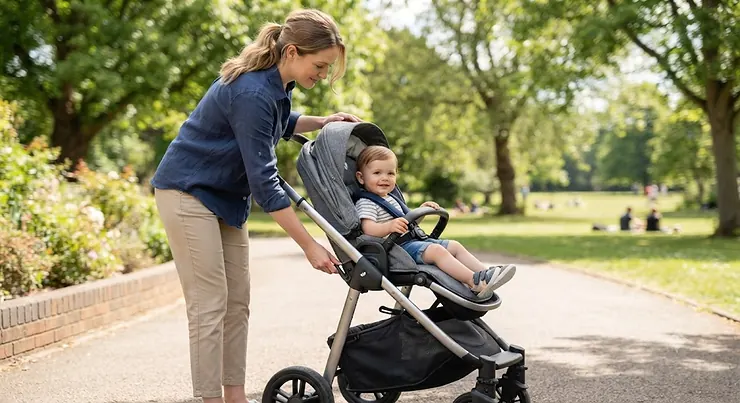
This guide cuts through the noise. We’ve pulled together seven real, currently available forward facing pushchairs sold in the UK, spanning budget three-wheelers under £200 through to premium travel systems well into four figures, and we’ve looked past the marketing copy to what actually matters: how the seat performs day to day, what reviewers consistently say once the novelty wears off, and which model suits which kind of family. Whether you’re buying your very first forward facing buggy from birth or upgrading a fast-growing toddler who’s outgrown their old pram, you’ll find a genuinely useful shortlist below — plus the age guidance, safety standards and buying pitfalls that Amazon’s product pages conveniently leave out.
What Is a Forward Facing Pushchair?
A forward facing pushchair is a buggy or stroller whose seat unit faces away from the parent, letting the child look out at the world ahead rather than back at the person pushing them. Most modern models on the market are “two-way” or reversible, meaning the same seat can be clicked into either a parent-facing or a world-facing position, giving families flexibility as their child grows in confidence and curiosity.
For a long stretch of a child’s first year, that direction of travel barely matters — what matters far more is whether the seat reclines flat. According to RoSPA’s guidance on pushchair safety, non-reclining seats simply aren’t suitable for a child under six months old, regardless of which way they’re facing, because a young baby’s neck and spine can’t yet cope with sitting upright for extended periods. Once head control is established, though, plenty of babies genuinely seem to prefer facing outward — and plenty of parents are quietly relieved to stop making eye contact with a toddler who’s decided screaming is a hobby.
Quick Comparison Table
| Product | Best For | Price Range | Suitable From |
|---|---|---|---|
| Ickle Bubba Stomp Luxe | Budget-conscious families wanting a full travel system | £400-£600 | Birth (carrycot included) |
| Hauck Runner 2 | Off-road walks on a tight budget | Under £200 | Birth to approx. 4 years |
| Joie Litetrax 4 Air | Everyday all-rounder for city and park | £200-£300 | Birth (with car seat) to 22kg |
| Silver Cross Reef 2 | Premium reversible seat with a huge hood | £700-£1,000+ | Birth to toddler |
| Cybex Gazelle S | Growing or expanding families needing modularity | £900-£1,300+ | Birth to toddler |
| Mountain Buggy Nano | Lightest true forward-facing toddler stroller | £150-£220 | 6 months to approx. 4 years |
| Silver Cross Clic 2 | Compact everyday fold for city living | £200-£300 | 6 months to approx. 4 years |
Looking across the table, there’s a clear split between the birth-ready travel systems — Ickle Bubba Stomp Luxe, Silver Cross Reef 2 and Cybex Gazelle S — and the lighter, toddler-focused strollers like the Mountain Buggy Nano and Silver Cross Clic 2, which trade a lie-flat carrycot for portability once a baby can sit unaided. Budget doesn’t automatically mean compromise, either: the Hauck Runner 2 punches well above its price point for all-terrain use, while genuinely premium features (huge hoods, reversible seats, one-hand folds) start appearing from the mid-range Joie Litetrax 4 Air upward.
💬 Just one click — help others make better buying decisions too!😊
Top 7 Forward Facing Pushchairs: Expert Analysis
1. Ickle Bubba Stomp Luxe — best-value travel system from birth
The Welsh-designed Ickle Bubba Stomp Luxe has quietly become one of the most popular “one-box solution” travel systems for UK parents who want everything sorted before their due date. It ships as a bundle: chassis, carrycot, seat unit, a compatible infant car seat and an ISOFIX base, so you’re not chasing down separate adapters weeks after the birth. The carrycot gives a genuine lie-flat position for newborn naps, while the seat unit clicks on facing either direction once your baby’s ready for it.
Where the Stomp Luxe earns its keep is the hood — deep, UPF 50+ rated, with a mesh ventilation panel that stops the seat turning into a greenhouse on a rare sunny British afternoon. Reviewers consistently note that the puncture-proof rear wheels handle kerbs and gravel driveways with far more confidence than you’d expect from a travel system at this price. Based on the spec comparison against pricier rivals, the main trade-off is weight: this is not a pushchair you’ll casually sling into a hatchback boot one-handed, and the seat unit itself takes two hands to swap between carrycot and seat mode.
Aggregated review sentiment describes it as remarkably complete for the money, though a recurring complaint concerns the recline mechanism feeling stiff until it’s bedded in over the first few weeks of use. This is the pushchair for parents who’d rather buy once, buy properly, and not think about accessories again for years.
Pros:
- ✅ Complete travel system bundle straight out of the box
- ✅ Deep UPF 50+ hood with genuine ventilation panel
- ✅ Puncture-proof wheels cope well with rough pavements
Cons:
- ❌ Noticeably heavy to lift in and out of a car boot
- ❌ Recline mechanism needs bedding in before it feels smooth
Prices for the full bundle typically sit in the £400-£600 range depending on the fabric colourway and car seat included. For families who want birth-to-toddler cover in a single purchase, it represents strong value against premium travel systems costing twice as much.
2. Hauck Runner 2 — best budget all-terrain pick
German brand Hauck built a reputation on solid, no-nonsense engineering, and the Hauck Runner 2 is the clearest example of that philosophy applied to a forward facing pushchair. It’s a three-wheeler with genuinely large, air-filled tyres rather than the small plastic casters you get on cheaper city strollers, which means kerbs, cobbles and muddy park paths don’t send a jolt straight through to your toddler.
The specification sheet is deceptively humble for the price: an adjustable handle for parents of different heights, a lockable front swivel wheel for stability on faster walks or jogs, and a seat suitable from birth right through to roughly four years old or 25kg. What that means in practice, per aggregated reviewer feedback, is a pushchair that keeps pace with an active family for years rather than months — plenty of parents report still using it well into the preschool years for dog walks and countryside trips. What most buyers overlook is the weight cost of those big tyres: at over 11kg, it’s genuinely heavy to lift, and you’ll want a strong core (or a spouse) for regular loading into a car boot.
Pros:
- ✅ Large air-filled tyres smooth out rough terrain
- ✅ Suitable from birth through to around four years old
- ✅ Significantly cheaper than rival all-terrain three-wheelers
Cons:
- ❌ Heavy at over 11kg, awkward for solo car boot loading
- ❌ Bulkier folded footprint than city-focused strollers
At an RRP typically under £200, the Runner 2 is one of the strongest value propositions in this entire round-up — you’re paying three-wheeler prices for what’s genuinely closer to premium off-road performance.
3. Joie Litetrax 4 Air — best everyday all-rounder
If the Stomp Luxe and Runner 2 represent two extremes — full travel system versus rugged three-wheeler — the Joie Litetrax 4 Air sits comfortably in the middle as a genuine do-everything pushchair. Joie has built a huge following in the UK by making mid-range products that don’t feel like compromises, and the Litetrax range (compatible with Joie’s own infant car seats via adapters) is a good example of that reputation earned.
The air-filled front wheels smooth out pavement cracks better than the solid rubber tyres on many similarly priced rivals, and the seat reclines through multiple positions, meaning it genuinely works from the early car-seat-on-chassis stage through to an upright, forward-facing toddler seat. What the spec sheet won’t tell you, but reviewers note repeatedly, is how easy the one-hand fold becomes once you’ve done it a handful of times — a detail that matters enormously when you’re also holding a squirming toddler and a bag of shopping.
Honest analysis here: this isn’t the lightest or the most luxurious option on this list, but for a family who wants one pushchair that handles the school run, the supermarket and the odd weekend away without a second thought, it’s hard to beat at its price point.
Pros:
- ✅ Air-filled front wheels smooth out cracked pavements
- ✅ Multiple recline positions suit newborn through to toddler
- ✅ Genuinely easy one-hand fold once you’ve practised it
Cons:
- ❌ Basket access can be fiddly with the seat fully reclined
- ❌ Fewer premium fabric options than luxury competitors
Expect to pay somewhere in the £200-£300 range, making it one of the better value-per-feature buys in the mid-range bracket.
4. Silver Cross Reef 2 — best premium reversible seat with a supersized hood
British heritage brand Silver Cross has been making prams since 1877, and the Silver Cross Reef 2 is its modern flagship travel system — the kind of pushchair that gets stopped-and-asked-about on the school run. The reversible seat unit swaps between parent-facing and forward-facing modes without tools, and Silver Cross’s own product information confirms it can be folded one-handed with the seat attached in either direction, which is a genuinely rare feature at any price point.
The standout here is the hood: it’s supersized, UPF 50+ rated, and covers far more of the seat than most competitors even at this premium tier. Paired with large wheels and softer suspension, the ride quality reviewers describe reads more like a premium pram than a fold-up stroller — smooth over cobbles, stable on uneven park paths, and composed enough that a sleeping baby tends to stay asleep. Based on the spec comparison against the rest of this list, the Reef 2 is squarely aimed at parents who see a pushchair as a long-term investment piece rather than a functional necessity, and the price tag reflects that positioning.
Pros:
- ✅ Reversible seat folds one-handed facing either direction
- ✅ Supersized UPF 50+ hood offers excellent sun and weather cover
- ✅ Large wheels and soft suspension give a genuinely premium ride
Cons:
- ❌ Premium price puts it well beyond budget and mid-range shoppers
- ❌ Bulkier overall footprint than lightweight toddler strollers
Complete bundles with a carrycot and compatible car seat typically start around £700 and climb well past £1,000 depending on the accessories included — check current pricing before committing, as configurations vary widely.
5. Cybex Gazelle S — best modular pushchair for growing families
German-engineered and instantly recognisable by its distinctive chassis, the Cybex Gazelle S is built around one core idea: modularity. The same frame can carry a single carrycot, convert to accommodate a second child, or run with car seat adapters for a newborn travel system — all without buying a different pushchair. For families who know they’re not stopping at one child, or who simply want maximum future-proofing, that flexibility is the entire sales pitch.
Specs alone don’t capture why this matters in daily life: the ability to reconfigure the same chassis as your family grows means you’re not re-buying a whole system in eighteen months’ time, which is where the genuine long-term value lies. Reviewers consistently highlight the smooth-rolling wheels and refined push-feel, alongside a seat that reclines generously flat for younger babies and locks upright, forward-facing, once toddlers want to see the world. A common complaint in user reviews concerns the width of the chassis on narrower UK doorways and shop aisles — worth measuring your usual routes before buying.
Pros:
- ✅ Genuinely modular chassis adapts as your family grows
- ✅ Smooth, refined ride quality on varied UK terrain
- ✅ Seat reclines flat for newborns, locks upright for toddlers
Cons:
- ❌ Wide chassis can be awkward through narrow doorways
- ❌ Among the most expensive options in this round-up
Prices sit firmly in the premium bracket, typically £900-£1,300 or more depending on seat pack and accessory bundle — a serious investment, but one aimed squarely at multi-child, long-term use.
6. Mountain Buggy Nano — lightest true forward-facing toddler stroller
Mountain Buggy built its name on serious off-road pushchairs, so the Mountain Buggy Nano is something of a departure — a genuinely compact, forward-facing-only travel stroller designed for parents who prioritise portability above almost everything else. It’s suitable from around six months (once head control is established) and remains usable to roughly four years old, folding down small enough to qualify as aeroplane cabin baggage on many airlines, which has made it something of a cult favourite among frequently travelling families.
What most buyers overlook about ultra-compact strollers is how much comfort typically gets sacrificed for that fold size — but aggregated reviewer sentiment on the Nano is unusually positive on this point, praising the reclining seat and reasonably generous leg room for a buggy this small. Here’s what to weigh: this is a dedicated toddler pushchair, not a birth-ready travel system, so it needs to be your second buggy or your first once your baby’s sitting confidently unaided.
Pros:
- ✅ Genuinely compact fold, cabin-baggage friendly on many airlines
- ✅ Reclining seat offers real comfort despite the small footprint
- ✅ Lightweight enough for true one-handed carrying up stairs
Cons:
- ❌ Not suitable from birth — needs established head control first
- ❌ Smaller storage basket than full-size travel systems
Typically priced in the £150-£220 range, it’s a smart secondary purchase for holidays, or a lightweight primary buggy for parents whose baby has already graduated from the carrycot stage.
7. Silver Cross Clic 2 — best compact fold for everyday city life
Silver Cross doesn’t only do premium travel systems — the Silver Cross Clic 2 is its answer to the compact stroller market, and it’s a genuinely different proposition from the brand’s flagship Reef range. Aimed at toddlers rather than newborns, it prioritises an ultra-compact, self-standing fold that reviewers describe as one of the simplest one-hand mechanisms on the market, useful for anyone regularly wrestling a buggy onto a bus or into a narrow hallway.
The seat is forward-facing only, with a decent recline for naps on the go, and the overall build feels sturdier than many strollers in the same weight class — a detail that matters once your toddler starts using the pushchair as a climbing frame at every opportunity. Reviewers consistently mention the compact folded size as the standout feature, frequently comparing it favourably against pricier “cabin-approved” travel strollers from more premium brands. On the flip side, the storage basket is on the smaller side, which can catch out parents used to a full-size travel system’s cavernous under-seat space.
Pros:
- ✅ Ultra-compact, self-standing one-hand fold
- ✅ Sturdy build quality for a lightweight stroller
- ✅ Comfortable recline for on-the-go naps
Cons:
- ❌ Smaller storage basket than full-size systems
- ❌ Forward-facing only, no parent-facing option
Expect a price range of roughly £200-£300, positioning it as a strong mid-range choice for parents whose priority is portability over multi-year modularity.
Practical Usage Guide: Setting Up and Living With Your Pushchair
Getting a new pushchair out of the box is one thing; actually living with it for the next three years is another. Most folding mechanisms feel stiff for the first fortnight — work them through their full range a few times before your first outing rather than discovering resistance with a screaming toddler and a bus to catch. Check the recline lock, the harness buckle and both the primary and secondary chassis locks every single time you unfold it; this becomes muscle memory within a couple of weeks, but skipping it in month one is a genuinely common cause of the “it collapsed on me” horror stories you’ll find in review sections.
A maintenance schedule doesn’t need to be complicated. Wipe the wheels and check tyre pressure (on air-filled models) roughly monthly, inspect the fabric for wear at the harness attachment points every few months, and store the pushchair somewhere dry — damp storage is the single biggest cause of squeaky, seized joints reported in long-term owner reviews. The most common first-30-days mistake isn’t mechanical at all: it’s over-tightening the harness “just to be safe,” which can restrict a baby’s breathing comfort and hip movement. A good rule of thumb is two fingers should slide comfortably under the harness strap at the shoulder.
Real-World Scenarios: Which Pushchair Actually Suits Your Family?
Consider a first-time parent in a second-floor flat with no lift, budget capped around £500, wanting one buggy from birth. The Ickle Bubba Stomp Luxe or Joie Litetrax 4 Air both make sense here — the former for the complete bundle convenience, the latter if a car seat’s already sorted and portability up stairs matters more.
Now picture a family with an energetic toddler and a taste for muddy Sunday walks, on a tighter budget. The Hauck Runner 2 is built for exactly this — its air-filled tyres and robust frame are wasted on smooth pavements but genuinely earn their keep on uneven ground, while still costing less than most city-focused strollers.
Finally, think about parents expecting a second child within a couple of years, wanting to avoid buying twice. The Cybex Gazelle S or Silver Cross Reef 2 justify their higher upfront cost through years of use and, in the Gazelle’s case, genuine expandability — the kind of long-term thinking that turns a big spend into solid value per year of ownership.
Problem → Solution: Common Forward Facing Pushchair Frustrations
Problem: My toddler screams to face forward before they can sit unaided. Solution — resist the pressure. Per RoSPA and NHS-aligned guidance, seat position should follow head and trunk control, not toddler preference; a semi-reclined, forward-leaning position on a reversible seat like the Joie Litetrax 4 Air or Silver Cross Reef 2 can be a safe middle ground once head control is established.
Problem: The pushchair won’t fit through my front door or hallway. Solution — measure the folded width before buying, not after. Compact options like the Silver Cross Clic 2 or Mountain Buggy Nano solve this specific problem far better than wide-chassis premium models.
Problem: The hood doesn’t cover enough on rainy walks. Solution — check hood depth specifically, not just “has a hood” on the spec sheet. The Silver Cross Reef 2‘s supersized canopy and the Ickle Bubba Stomp Luxe‘s UPF-rated hood both outperform shallower hoods common on budget strollers.
Problem: The pushchair feels unstable on kerbs and uneven pavement. Solution — prioritise larger, air-filled wheels over small plastic casters; the Hauck Runner 2 and Joie Litetrax 4 Air both handle this noticeably better than lightweight umbrella-fold strollers.
When to Switch to a Forward Facing Pushchair
There’s no single legal age at which a baby must switch to forward-facing — this is a developmental milestone, not a rule. The consistent guidance across UK safety sources is that a baby needs a fully reclining, lie-flat seat until around six months, because their neck and spine simply aren’t ready to support an upright, seated position for extended periods. Per NHS-aligned safety guidance on baby equipment, keeping a young baby’s chin off their chest matters because they lack the neck strength to correct their own head position if it flops forward — a principle that applies just as much to an upright pushchair seat as it does to slings and car seats.
In practice, most families find their baby is developmentally ready for an upright, forward-facing seat somewhere between six and nine months — once they can sit unaided with reasonable stability and hold their head steady without support. Age is a rough guide, not a deadline; some babies show clear signs of wanting to look outward earlier, others take longer, and it’s worth watching your own baby’s cues rather than a calendar. If your pushchair’s seat unit reclines through multiple positions, you can typically transition gradually — a semi-reclined forward-facing position first, moving to fully upright once confidence and core strength catch up.
How to Choose a Forward Facing Pushchair
- Confirm the recline range first. A seat that only goes semi-upright isn’t suitable from birth, whatever the marketing says — check it reclines close to flat if you need birth-ready use.
- Measure your real-world storage and doorways. A gorgeous premium pushchair that doesn’t fit through your porch is a daily headache, not an occasional inconvenience.
- Weigh up wheel size against your typical terrain. Small plastic wheels suit smooth pavements; air-filled or larger wheels earn their keep on kerbs, gravel and grass.
- Check the hood depth and UPF rating. UK weather swings between drizzle and surprise sunshine within the same afternoon — a shallow hood copes with neither well.
- Test the fold mechanism in-store if possible. A “one-hand fold” claim means very little until you’ve tried it one-handed, holding an actual toddler-sized weight in the other arm.
- Factor in total cost of ownership, not just sticker price. Compatible car seat adapters, rain covers and replacement parts vary hugely in price and availability between brands.
- Read aggregated review sentiment, not just star ratings. A 4.5-star average can hide a recurring complaint about, say, a stiff recline mechanism — read the actual text, not just the number.
Forward Facing Pushchair vs Parent-Facing Pushchair: Which Wins?
This isn’t really a competition with a single winner — it’s a trade-off that shifts depending on your baby’s age. A study referenced in a review of parent-facing strollers, conducted by the Sutton Trust, a UK social mobility charity, found that infants in parent-facing buggies laughed, vocalised and interacted with their carer significantly more than those facing outward, alongside suggested links to reduced infant stress and better sleep during the ride. That’s a meaningful point in parent-facing’s favour during the newborn and young infant stage, when bonding and reassurance matter enormously.
However, the calculus changes as babies become mobile, curious toddlers. Reviewers and parenting forums consistently describe forward-facing toddlers as noticeably calmer and more engaged during walks — less prone to boredom-driven meltdowns because there’s simply more to look at. Practically speaking, this is exactly why reversible seats on models like the Silver Cross Reef 2, Cybex Gazelle S and Joie Litetrax 4 Air have become so popular: they let you follow your baby’s developmental stage rather than committing to one orientation for years. If you can only afford a fixed-direction pushchair, the honest advice is to match the direction to your child’s current age and stage, not to guess years ahead.
Best Pushchair for Toddler Forward Facing: What Changes as They Grow
A toddler pushchair asks different things of a design than a newborn travel system does. Weight capacity becomes more relevant — most toddlers are pushing seat limits of 15-22kg by age three, so check the manufacturer’s maximum rather than assuming “suitable to four years” covers every body size. Storage habits shift too: you’re now hauling snacks, spare clothes, scooters-that-refused-to-be-ridden and the occasional abandoned shoe, so basket size and accessibility matter more than they did with a newborn.
Portability also becomes a bigger priority once toddlers alternate between walking and demanding to be carried mid-tantrum. This is exactly the gap that lightweight, forward-facing-only strollers like the Mountain Buggy Nano and Silver Cross Clic 2 are built to fill — both drop the newborn-ready carrycot in favour of a lighter frame, a quicker fold and genuinely easier one-handed manoeuvring around a determined, wriggling two-year-old. Reviewers of both models frequently mention buying them as a deliberate downgrade in features but an upgrade in daily convenience once the newborn stage is well behind them.
Forward Facing Buggy From Birth: What to Look For
Buying a forward facing buggy intended for use from birth means one non-negotiable feature: a seat that reclines to a genuinely flat, or near-flat, lie position — not just a “reclining seat” that stops well short of horizontal. As detailed by parenting safety guidance, the distinction matters because a semi-reclined position can still allow a newborn’s head to tip forward and compromise their airway, which is precisely why products marketed as “reclining” without a specific flat-lie claim need extra scrutiny before purchase.
Among this round-up, the Ickle Bubba Stomp Luxe solves this with a proper carrycot rather than relying on the seat unit alone, giving a newborn a flat, supported surface from day one. The Silver Cross Reef 2 and Cybex Gazelle S take a similar carrycot-first approach, while the Joie Litetrax 4 Air achieves birth-readiness through a compatible infant car seat on the chassis rather than a standalone carrycot — a lighter, often cheaper route to the same safety outcome, provided the car seat itself is correctly rated for newborn use.
Forward Facing Stroller With Large Hood: Why Canopy Coverage Matters
It’s easy to treat the hood as an afterthought, but anyone who’s been caught in a sudden downpour with a shallow-canopy stroller learns fast that hood depth is a genuine functional feature, not a styling detail. A generous hood does three jobs at once: it blocks low winter sun that would otherwise shine straight into a forward-facing baby’s eyes, it shields against the UK’s frequent light rain without needing the separate rain cover every single time, and — with a UPF 50+ rating — it protects delicate skin during the increasingly common heatwave afternoons.
Of the products covered here, the Silver Cross Reef 2‘s supersized canopy stands out as the deepest, extending well beyond the seat’s headrest, closely followed by the Ickle Bubba Stomp Luxe‘s UPF-rated hood with its useful ventilation panel for stopping the seat overheating on warmer days. If hood coverage is a genuine priority rather than a nice-to-have, it’s worth physically checking how far the canopy extends when fully opened — spec sheets rarely give a precise measurement, and “large hood” is a subjective claim that varies enormously between brands.
Common Mistakes When Buying a Forward Facing Pushchair
The single most common mistake is buying for the pushchair you want in eighteen months’ time rather than the baby you have right now — choosing a forward-facing-only lightweight stroller before a newborn has any head control, for instance, simply because it looks sleeker in photos. A close second is skipping the doorway and boot-space measurements, which sounds trivial until you’re wrestling a beautifully engineered but stubbornly wide chassis through a narrow terrace-house hallway every single day.
Parents also frequently under-budget for accessories. Car seat adapters, rain covers, footmuffs and cup holders are rarely included as standard on mid-range models, and can add a genuinely surprising amount to the total cost once you tally them up. Finally, many buyers skip checking the safety standard label entirely — a mistake worth avoiding given how directly it relates to structural safety.
Long-Term Cost & Maintenance
Sticker price only tells part of the story. A £180 budget three-wheeler that needs a replacement wheel or fabric seat cover after eighteen months of daily use can end up costing more per year of ownership than a £700 premium travel system built to last three-plus years across multiple children. Cost-per-use is the more honest metric: divide the total spend, accessories included, by the realistic number of months you’ll actually use the pushchair.
Maintenance costs are usually modest but worth budgeting for regardless: expect the occasional replacement wheel, a rain cover if one isn’t included, and possibly a seat liner as fabric wears with daily use. Premium models like the Cybex Gazelle S and Silver Cross Reef 2 often hold stronger resale value on the second-hand market thanks to brand reputation and modularity, which can meaningfully offset their higher upfront price if you plan to sell once your family’s finished with it.
Safety, Regulations & Compliance Guide
Every pushchair sold in the UK should comply with BS EN 1888, the British Standard covering wheeled child conveyances. Per official UK trading standards guidance, this standard defines a pushchair as a vehicle designed to carry one or more children, consisting of a chassis with an attached pram body, car seat or seat unit, that can be manually steered while being pushed. Compliance covers everything from harness strength and locking mechanisms to stability testing and resistance to sharp edges or entrapment hazards.
Before buying — new or second-hand — check for a label referencing BS EN 1888 (the current version is BS EN 1888-1:2018+A1:2022) on the frame or seat fabric. On second-hand pushchairs specifically, physically test that both the primary and secondary folding locks engage properly, check the harness has five points rather than an older three-point design, and confirm the parking brake holds in both directions. It’s also worth checking any product hasn’t been subject to a safety recall before purchase, particularly with older or discontinued models.
✨ Don’t Miss These Exclusive Deals!
🔍 Take your pushchair shopping to the next level with these carefully selected forward facing pushchairs. Click on any highlighted item to check current pricing and availability. These picks will help you find a genuinely comfortable, safe ride your little one will love exploring the world from!
FAQ
❓ What age can a baby go forward facing in a pushchair?
❓ Is a forward facing pushchair bad for babies?
❓ Can newborns use a forward facing pushchair?
❓ Do forward facing pushchairs need a five-point harness?
❓ What's the difference between a forward facing pushchair and a travel system?
Conclusion
There’s no single “best” forward facing pushchair — only the best one for your household, your budget and your baby’s current stage. If you want one purchase to cover birth through toddlerhood without compromise, the Silver Cross Reef 2 or Cybex Gazelle S deliver genuine long-term value despite the higher upfront cost. Families working with a tighter budget shouldn’t feel short-changed either — the Hauck Runner 2 and Ickle Bubba Stomp Luxe both punch well above their price point on the features that matter most day to day.
Whatever you choose, the fundamentals stay the same: check the recline reaches genuinely flat if you need it from birth, measure your own doorways and boot space before falling for a beautiful chassis, and don’t let a toddler’s short-term preference for facing outward override the developmental green light their body needs to give first. Get those basics right, and any of the seven pushchairs above will serve your family well for years of walks, naps and pavement-level adventures.
✨ Ready to find your perfect match? Browse today’s prices on these forward facing pushchairs and see which one fits your family best!
Recommended for You
- Reversible Seat Pushchair: 7 Best Buggies Compared for 2026
- 7 Best City Pushchairs for 2026: Compact Buggies That Actually Cope
- Best Travel Buggy 2026: 7 Cabin-Approved Pushchairs That Fly
Disclaimer: This article contains affiliate links. As an Amazon Associate, I earn from qualifying purchases. If you purchase products through these links, we may earn a small commission at no additional cost to you.
✨ Found this helpful? Share it with your friends! 💬🤗
